Center for South and Southeast Asia Studies – serie
Visar alla böcker i serien Center for South and Southeast Asia Studies. Handla med fri frakt och snabb leverans.
6 produkter
6 produkter
Traditional Authority, Islam, and Rebellion
A Study of Indonesian Political Behavior
Häftad, Engelska, 2020
811 kr
Skickas inom 3-6 vardagar
Traditional Authority, Islam, and Rebellion by Karl D. Jackson offers a groundbreaking analysis of political integration and rural political behavior in Indonesia through a close study of the Dar’ul Islam rebellion in West Java (1948–1962). Rather than focusing exclusively on the rebellion itself, Jackson uses it as a laboratory to test broader theories of Indonesian politics, exploring why some villages supported the rebellion, others remained neutral, and still others fought alongside the national government. His central argument is that Sundanese village politics cannot be explained solely by ideology, religion, or economic conditions. Instead, enduring systems of traditional authority—dyadic, personal, and affect-laden superior–subordinate bonds—played the decisive role in shaping village political alignments. In this model, villagers acted not primarily out of class interest or religious conviction, but from binding obligations to respected elders and bapak leaders who linked local communities to wider national currents.Drawing on intensive fieldwork, interviews, and archival research, Jackson systematically tests and challenges explanations based on deprivation, education, exposure to mass media, and ideological belief, demonstrating that none of these variables alone explains village-level choices during the rebellion. Instead, political outcomes emerged from networks of traditional authority that enabled village leaders to commit entire communities to political courses with far-reaching consequences. The study moves from a detailed history of the rebellion and micro-level village case studies to a broader typology of political integration, contrasting the reliance on coercion and traditional authority in “traditional” societies with the emphasis on persuasion and economic incentives in transitional and modern contexts. By situating Sundanese politics within both Indonesian history and comparative political theory, Traditional Authority, Islam, and Rebellion makes a major contribution to Southeast Asian studies, political anthropology, and the study of state-building, offering enduring insights into how local authority structures shape national integration and rebellion.This title is part of UC Press's Voices Revived program, which commemorates University of California Press’s mission to seek out and cultivate the brightest minds and give them voice, reach, and impact. Drawing on a backlist dating to 1893, Voices Revived makes high-quality, peer-reviewed scholarship accessible once again using print-on-demand technology. This title was originally published in 1980.
811 kr
Skickas inom 3-6 vardagar
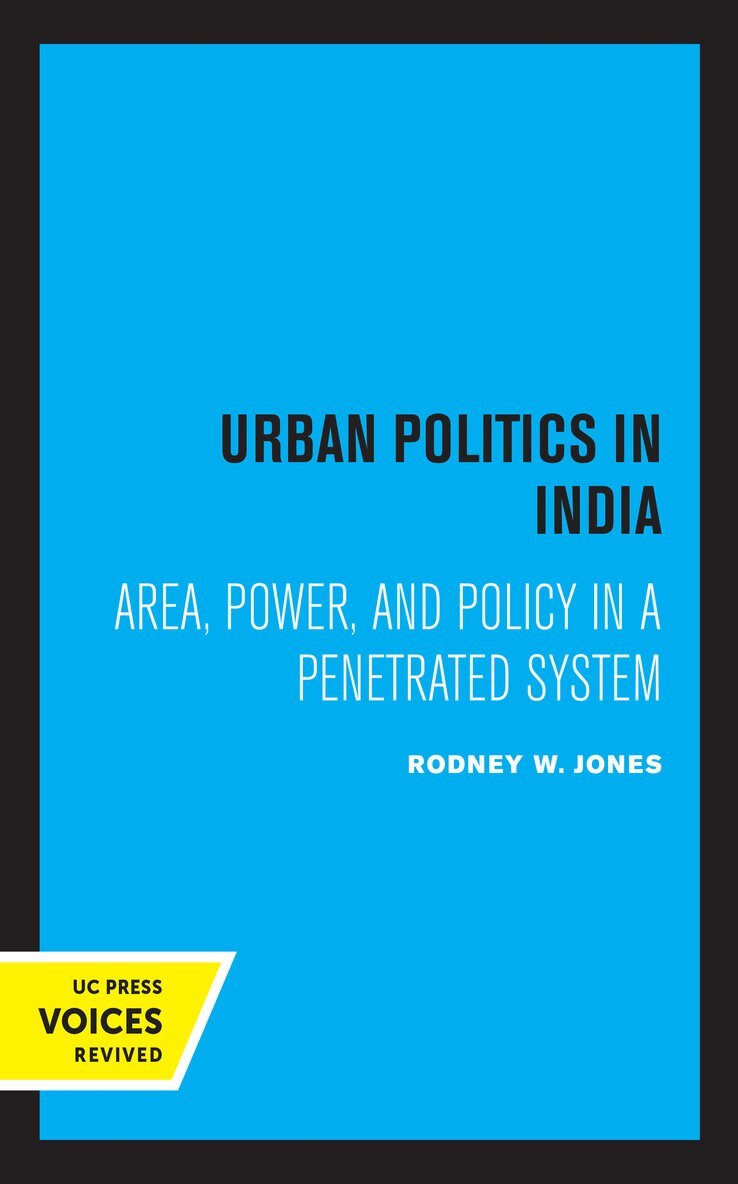
Urban Politics in India: Area, Power, and Policy in a Penetrated System by Rodney W. Jones provides a rare, ground-level study of how politics actually functions in a medium-sized Indian city. Focusing on Indore in the late 1960s, Jones situates local struggles within broader state and national contexts, demonstrating how urban politics is “penetrated” by outside forces—bureaucratic agencies, state governments, and national parties—that continually reshape municipal power. His analysis follows the city’s historical legacy as a princely capital, its post-independence integration into Congress Party networks, and its industrial expansion, which created fertile ground for union organizing, labor machine politics, and factional conflict. By moving across multiple arenas—municipal governance, planning bureaucracies, labor struggles, and community organizations—Jones maps a political system fragmented yet tightly bound to larger structures of authority.The study combines archival sources, newspapers, and intensive fieldwork, including extended interviews with politicians, administrators, union leaders, and community figures. This methodological depth allows Jones to reconstruct Indore’s authority structures, the shifting alignments of Congress factions, and the interplay of class, caste, and ethnicity in everyday politics. Especially vivid is his account of the municipal corporation’s supersession by the state government, which illustrates the vulnerability of local institutions to external intervention. At once a case study and a theoretical exploration, Urban Politics in India advances the comparative study of urban systems by examining how power is organized, contested, and exercised in a penetrated polity. It is indispensable reading for scholars of Indian politics, urban studies, and development, offering insights into how democratic practices are shaped by the constant negotiation between local actors and larger centers of authority.This title is part of UC Press's Voices Revived program, which commemorates University of California Press’s mission to seek out and cultivate the brightest minds and give them voice, reach, and impact. Drawing on a backlist dating to 1893, Voices Revived makes high-quality, peer-reviewed scholarship accessible once again using print-on-demand technology. This title was originally published in 1974.
665 kr
Skickas inom 3-6 vardagar
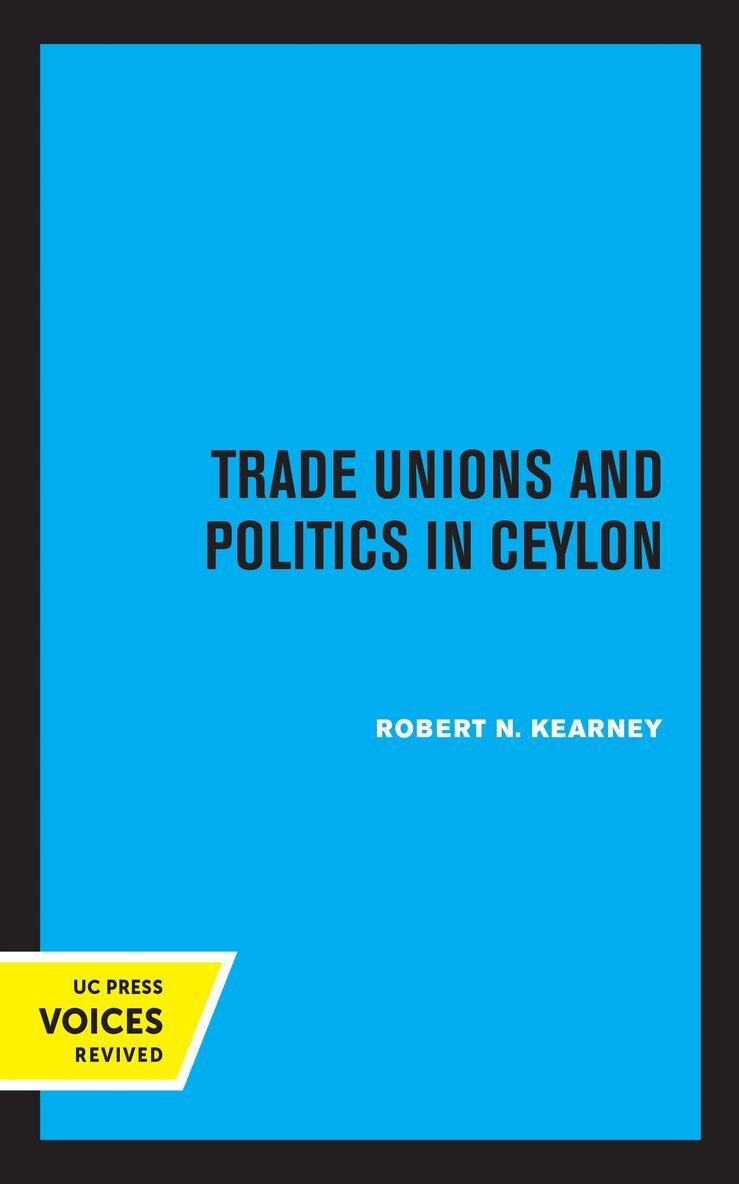
Trade Unions and Politics in Ceylon offers the first sustained analysis of how a rapidly expanding labor movement helped shape—and was shaped by—the politics of a newly independent, modernizing society. Tracing trade union growth from the late colonial period through the first post-independence decade, Robert N. Kearney shows how Ceylon’s unions combined “economic” functions (wages, conditions, dispute resolution) with explicitly partisan roles that recruited, socialized, and mobilized workers for electoral politics. Against a backdrop of universal suffrage, an interventionist state, and extensive wage-setting and arbitration machinery, Kearney explains why unions gravitated toward party alliances and why leaders often pursued transformative political victories over incremental bargaining wins. The result is a finely grained portrait of organizations that were simultaneously fragmented and indispensable—organizationally weak yet among the few mass, voluntary associations articulating modern occupational interests.Drawing on comparative theories of political development and rich institutional detail, Kearney maps the full spectrum of union–party relationships—distinguishing party-sponsored, party-oriented, and uncommitted unions—and shows how each type navigated strikes, industrial tribunals, Cabinet-centric governance, and a rule-bound bureaucracy. Case sketches illuminate the contrasting strategies of public-sector associations and private-sector unions; thematic chapters assess the political consequences of industrial conflict and the centripetal/centrifugal effects of partisanship on movement unity. This is essential reading for scholars of South Asian politics, labor history, and comparative development: it reframes Ceylon (Sri Lanka) as a key instance of how democratization, state intervention, and Marxist and non-Marxist party competition produced a distinctive style of trade unionism—deeply political, often polarized, and profoundly consequential for policy and participation. Kearney’s clear typology and comparative lens make the book an invaluable guide for understanding labor’s political role across postcolonial contexts.This title is part of UC Press's Voices Revived program, which commemorates University of California Press’s mission to seek out and cultivate the brightest minds and give them voice, reach, and impact. Drawing on a backlist dating to 1893, Voices Revived makes high-quality, peer-reviewed scholarship accessible once again using print-on-demand technology. This title was originally published in 1971.
Traditional Authority, Islam, and Rebellion
A Study of Indonesian Political Behavior
Inbunden, Engelska, 2021
1 469 kr
Skickas inom 3-6 vardagar
Traditional Authority, Islam, and Rebellion by Karl D. Jackson offers a groundbreaking analysis of political integration and rural political behavior in Indonesia through a close study of the Dar’ul Islam rebellion in West Java (1948–1962). Rather than focusing exclusively on the rebellion itself, Jackson uses it as a laboratory to test broader theories of Indonesian politics, exploring why some villages supported the rebellion, others remained neutral, and still others fought alongside the national government. His central argument is that Sundanese village politics cannot be explained solely by ideology, religion, or economic conditions. Instead, enduring systems of traditional authority—dyadic, personal, and affect-laden superior–subordinate bonds—played the decisive role in shaping village political alignments. In this model, villagers acted not primarily out of class interest or religious conviction, but from binding obligations to respected elders and bapak leaders who linked local communities to wider national currents.Drawing on intensive fieldwork, interviews, and archival research, Jackson systematically tests and challenges explanations based on deprivation, education, exposure to mass media, and ideological belief, demonstrating that none of these variables alone explains village-level choices during the rebellion. Instead, political outcomes emerged from networks of traditional authority that enabled village leaders to commit entire communities to political courses with far-reaching consequences. The study moves from a detailed history of the rebellion and micro-level village case studies to a broader typology of political integration, contrasting the reliance on coercion and traditional authority in “traditional” societies with the emphasis on persuasion and economic incentives in transitional and modern contexts. By situating Sundanese politics within both Indonesian history and comparative political theory, Traditional Authority, Islam, and Rebellion makes a major contribution to Southeast Asian studies, political anthropology, and the study of state-building, offering enduring insights into how local authority structures shape national integration and rebellion.This title is part of UC Press's Voices Revived program, which commemorates University of California Press’s mission to seek out and cultivate the brightest minds and give them voice, reach, and impact. Drawing on a backlist dating to 1893, Voices Revived makes high-quality, peer-reviewed scholarship accessible once again using print-on-demand technology. This title was originally published in 1980.
1 469 kr
Skickas inom 3-6 vardagar
Urban Politics in India: Area, Power, and Policy in a Penetrated System by Rodney W. Jones provides a rare, ground-level study of how politics actually functions in a medium-sized Indian city. Focusing on Indore in the late 1960s, Jones situates local struggles within broader state and national contexts, demonstrating how urban politics is “penetrated” by outside forces—bureaucratic agencies, state governments, and national parties—that continually reshape municipal power. His analysis follows the city’s historical legacy as a princely capital, its post-independence integration into Congress Party networks, and its industrial expansion, which created fertile ground for union organizing, labor machine politics, and factional conflict. By moving across multiple arenas—municipal governance, planning bureaucracies, labor struggles, and community organizations—Jones maps a political system fragmented yet tightly bound to larger structures of authority.The study combines archival sources, newspapers, and intensive fieldwork, including extended interviews with politicians, administrators, union leaders, and community figures. This methodological depth allows Jones to reconstruct Indore’s authority structures, the shifting alignments of Congress factions, and the interplay of class, caste, and ethnicity in everyday politics. Especially vivid is his account of the municipal corporation’s supersession by the state government, which illustrates the vulnerability of local institutions to external intervention. At once a case study and a theoretical exploration, Urban Politics in India advances the comparative study of urban systems by examining how power is organized, contested, and exercised in a penetrated polity. It is indispensable reading for scholars of Indian politics, urban studies, and development, offering insights into how democratic practices are shaped by the constant negotiation between local actors and larger centers of authority.This title is part of UC Press's Voices Revived program, which commemorates University of California Press’s mission to seek out and cultivate the brightest minds and give them voice, reach, and impact. Drawing on a backlist dating to 1893, Voices Revived makes high-quality, peer-reviewed scholarship accessible once again using print-on-demand technology. This title was originally published in 1974.
983 kr
Skickas
Trade Unions and Politics in Ceylon offers the first sustained analysis of how a rapidly expanding labor movement helped shape—and was shaped by—the politics of a newly independent, modernizing society. Tracing trade union growth from the late colonial period through the first post-independence decade, Robert N. Kearney shows how Ceylon’s unions combined “economic” functions (wages, conditions, dispute resolution) with explicitly partisan roles that recruited, socialized, and mobilized workers for electoral politics. Against a backdrop of universal suffrage, an interventionist state, and extensive wage-setting and arbitration machinery, Kearney explains why unions gravitated toward party alliances and why leaders often pursued transformative political victories over incremental bargaining wins. The result is a finely grained portrait of organizations that were simultaneously fragmented and indispensable—organizationally weak yet among the few mass, voluntary associations articulating modern occupational interests.Drawing on comparative theories of political development and rich institutional detail, Kearney maps the full spectrum of union–party relationships—distinguishing party-sponsored, party-oriented, and uncommitted unions—and shows how each type navigated strikes, industrial tribunals, Cabinet-centric governance, and a rule-bound bureaucracy. Case sketches illuminate the contrasting strategies of public-sector associations and private-sector unions; thematic chapters assess the political consequences of industrial conflict and the centripetal/centrifugal effects of partisanship on movement unity. This is essential reading for scholars of South Asian politics, labor history, and comparative development: it reframes Ceylon (Sri Lanka) as a key instance of how democratization, state intervention, and Marxist and non-Marxist party competition produced a distinctive style of trade unionism—deeply political, often polarized, and profoundly consequential for policy and participation. Kearney’s clear typology and comparative lens make the book an invaluable guide for understanding labor’s political role across postcolonial contexts.This title is part of UC Press's Voices Revived program, which commemorates University of California Press’s mission to seek out and cultivate the brightest minds and give them voice, reach, and impact. Drawing on a backlist dating to 1893, Voices Revived makes high-quality, peer-reviewed scholarship accessible once again using print-on-demand technology. This title was originally published in 1971.