Clarendon Law Lectures - Böcker
Visar alla böcker i serien Clarendon Law Lectures. Handla med fri frakt och snabb leverans.
16 produkter
16 produkter
1 191 kr
Skickas inom 7-10 vardagar
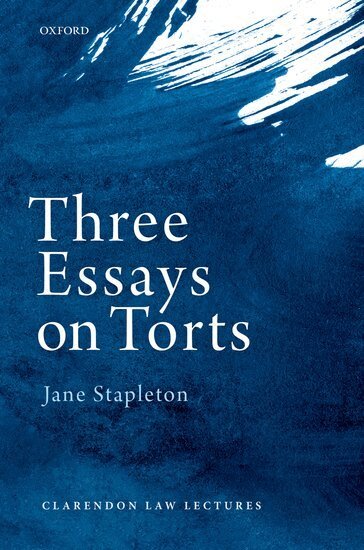
This book of essays champions tort scholarship that puts judges at centre stage: what they do, how they understand their role, the heterogeneous reasons they give for their decisions, and their constitutional responsibility to identify and articulate the 'living' and 'evolving' common law. This is 'reflexive tort scholarship'. Reflexive tort scholars seek dialogue with Bench and Bar. Their approach is very different from the currently fashionable academic search for 'grand theories' that descriptively assert that tort law is fundamentally 'all about one thing', a unifying idea that alone explains and justifies the whole of tort law. This book illustrates the advantages and pay-offs of the reflexive style of scholarship by showing how it illuminates key features of tort law. The first essay contrasts the reflexive approach with the Grand Theory approach, while the second essay identifies a principle of tort law (the 'cooperative principle'), that is latent in the cases and that vindicates the value of collaborative human arrangements. Identifying this principle calls into question, in disputes between commercial parties, the reasoning used to support one of the most entrenched lines of authority in tort law - that based on the famous case of Hedley Byrne v Heller. The final essay deploys the reflexive method to argue that the iconic 'but-for' test of factual causation is inadequate and narrower than the concept actually utilized in the cases. Application of the method also prompts a reassessment of the 'scope of duty' concept and of the appropriate characterisation of the much-discussed decision in SAAMCO. These essays, based on the 2018 Clarendon Law Lectures given at Oxford University, clearly demonstrate the value of scholarship that 'takes the judges seriously'.
1 025 kr
Skickas inom 5-8 vardagar
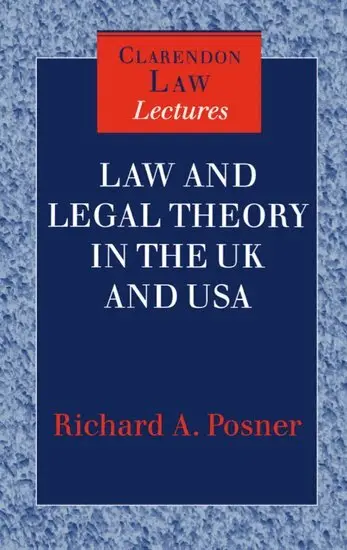
Richard Posner is famous throughout the legal world for his pioneering and controversial espousal of the belief that the study of law cannot be divorced from the study of economics. Here, in this volume of essays based upon his Clarendon Lectures, he explores the relationship between the legal systems of the UK and USA. The essays in this volume range widely over themes which will be familiar to many students and teachers of law. In the first essay he compares the work of the two most prominent writers on jurisprudence in the second half of this century, one English (HLA Hart) and one American (Ronald Dworkin). His controversial conclusion that trying to define "law" is futile, distracting and illustrative of the impoverishment of traditional legal theory will fascinate students of legal theory.In the second lecture he examines a number of English cases drawn primarily from the two fields in which English and American law overlap most completely - torts and contracts. Here he argues that while in general English judges use their common sense effectively to approximate the results that an economic analyst would recommend they would do even better if they were more receptive to the economic approach to the common law -- if they were, in other words, a little more like American judges.In the third lecture he examines the differences between the English and American legal systems at the administrative or operational level as distinct from the jurisprudential and doctrinal levels. The conclusions drawn from his analysis challenge traditional orthodoxy. His concluding advice to law reformers in both jurisdictions is that piecemeal reform of either system is to be avoided.In this short and highly readable work readers will find much that will delight, stimulate and challenge them.
943 kr
Skickas inom 5-8 vardagar
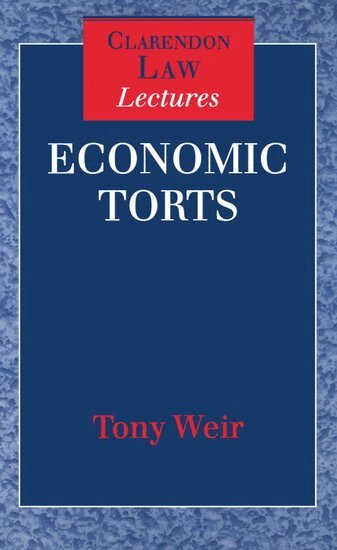
This book is based closely on the lectures delivered by Tony Weir in 1996 as part of the Clarendon Law lectures series sponsored by Oxford University Press. It is an exciting and provocative book which contains a number of controversial propositions, defended with vigour by its author. The three lectures reproduced here deal with liability in tort for intentionally inflicted economic loss. They are characterized by a very unusual combination of bold leading statements and multi-layered supporting analysis. There are also useful Appendices containing full case transcripts of recent, significant cases, including Millar v Bassey and de Voto v Pacific. This book will be irresistible to all scholars of the law of tort, and the author's reputation alone will ensure this book is well-received.
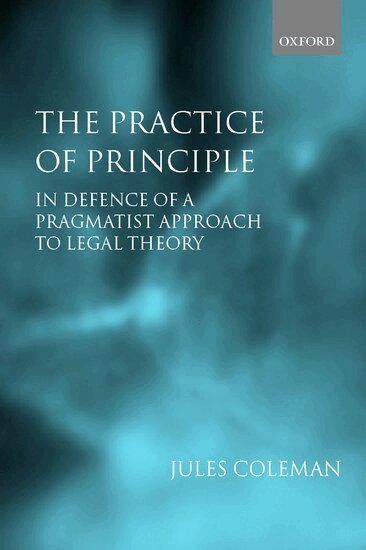
The Practice of Principle
In Defence of a Pragmatist Approach to Legal Theory
Inbunden, Engelska, 2001
1 147 kr
Skickas inom 5-8 vardagar
Jules Coleman, one of the world's most influential philosophers of law here expounds his recent views on a range of important issues in legal theory. Coleman offers for the first time an explicit account of the pragmatist method that has long informed his work, and takes on the views of highly respected contemporaries such as Ronald Dworkin and Joseph Raz.The first part of the book builds on Coleman's well-known 'corrective justice' account of tort law, highlighting the sophisticated pragmatist methodology that he brings to bear on legal theory and presing further his critique of the law and economics school of legal analysis. The second part advances a new articulation of the jurisprudential view associated most closely with Coleman - Inclusive Legal Positivism. Many of Coleman's most controversial claims are here defended as part of a comprehensive new account of law as a conventional practice. The third part takes up the question whether conceptual analysis of the law - an approach that has long dominated philosophical thinking on the topic - is even possible. Rejecting recent arguments that it must be replaced by a normative or naturalized jurisprudence, Coleman defends his distinctive form of pragmatist conceptual analysis.
1 601 kr
Skickas inom 5-8 vardagar
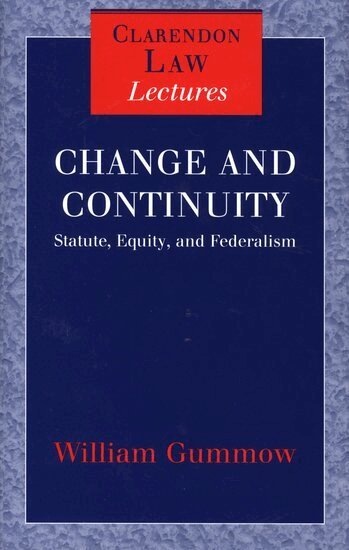
This volume is based closely on the lectures delivered by The Hon. Justice W. M. C. Gummow at Oxford University in 1999 as part of the Clarendon law lectures series, sponsored by Oxford University Press. These lectures take up themes of continuity and change in the law, particularly as they appear in the great common law jurisdictions. The tension between continuity and change appears from a consideration of the interaction between statute and the case law which interprets it, of the interaction between equity and statute, and finally of the operation of that constitutional arrangement known as federalism. Statute speaks to the state of affairs at the time of enactment. That state of affairs is dynamic; the statute, at least in form, is static. Conversely, in its development the common law may be informed by changes effected by statute. The extent to which the common law may or should respond in this way is a matter of controversy. Further, the accommodation of an apparently rigid statutory structure to individual circumstances has, for centuries, been assisted by the leavening effect of equitable doctrines and remedies. Finally, in federal systems with a division of governmental power and authority by a written supreme law, tensions between continuity, perceived in terms of original intent, and changed circumstances which were unforeseen, may become acute. Is Britain in the process of becoming a federal state or, indeed, a component of a European federal state? In all these situations, the doctrines developed by the courts assist the passage of society from the past, through the present and into the future. This invites an inquiry, considered in these lectures, as to the requirements of legal scholarship in a court of ultimate appeal in a common law system.
1 152 kr
Skickas inom 5-8 vardagar
Legal history helps us to understand our modern law. It explains why the law has become what it is. It lays open the premises on which the modern law is based. It constitutes a rich source of experience which is as valuable for the development of modern legal doctrines as for law reform. It may also reveal where a wong turn has been taken and thus prevent us from repeating an error. Today, however, historical legal scholarship has acquired an added significance in view of the Europeanization of private law and private law scholarship. It enables us to see the common ground between our modern national legal sustems and to understand existing differences. It makes us aware of the fact that the law has not developed in national isolation and can, therefore, not properly be understood under purely national auspices. It constitutes the foundation for scholarship in comparative law and paves the way towards re-establishing a European legal culture. The focus of these Clarendon lectures is on the "vital connection that ties the present to the past" (Savigny) and on the link between legal history, modern legal doctrine, and comparative law. They aim to recreate an awareness of a fundamental intellectual unity based on a common tradition. Such awareness is of central importance to sustain the process of a Europeanization of private law which we experience today. Lecture One: The End of an Era: Transformation of Scholarship in Roman Law Lecture Two: The Transition from Civil Law to Civil Code: Dawn of a New Era? Lecture Three: A Change in Perspective: European Private Law and its Historical Foundations
1 378 kr
Skickas inom 7-10 vardagar
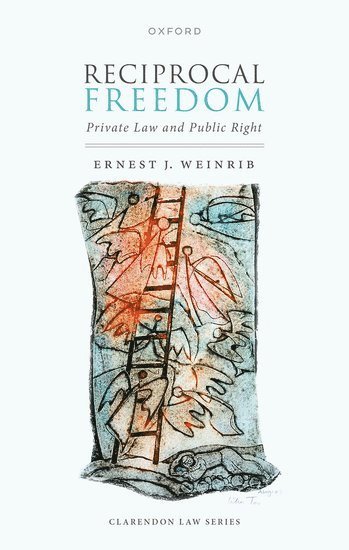
Reciprocal Freedom elucidates the relationship between private law and the state, presenting reciprocal freedom as the normative idea underlying a legal order in which private law occupies a distinctive place. Weinrib develops a set of interconnected conceptions of private law, corrective justice, rights, ownership, the role of legal institutions, distributive justice, the relationship of constitutional rights to private law, and the rule of law. The book is explicitly Kantian in inspiration; it presents a non-instrumental account of law that is geared to the juridical character of the modern liberal state. Combining legal and philosophical analysis, it offers a sequenced and legally informed argument for understanding law as necessary to our co-existence as free beings.
751 kr
Skickas inom 5-8 vardagar
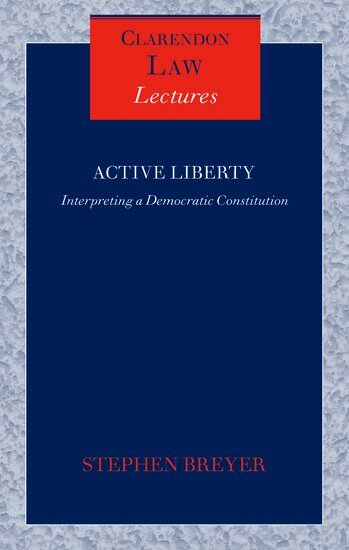
What role should courts play in a modern democracy? How should fundamental provisions of a democratic constitution be interpreted? These questions have divided constitutional theorists and those responsible for interpreting and applying constitutional law including, notoriously, the current U.S. Supreme Court. Justice Breyer is the most prominent liberal voice in the Supreme Court, this book distils his experience of interpreting the U.S. constitution and outlines a general liberal theory of the role of constitutional courts.Breyer argues that the primary role of a democratic constitution is to preserve and encourage 'Active Liberty': citizen participation in shaping government and its laws. The book argues that promoting active liberty requires judicial modesty and deference to legislative bodies; it also requires the recognition of the changing needs and demands of the populace. Breyer makes a powerful case against treating constitutions as a static guide for a world that has passed into history.Throughout the book, active liberty is employed as a foundational concept to illuminate the interpretation of key constitutional questions, and recent Supreme Court controversies, such as the scope of free speech and racial equality protection.For this revised, international edition of the book, Justice Breyer extends his discussion of democratic theory to examine topical questions in European constitutional law, including the legitimacy of the European Union, religious freedom under the European Convention on Human Rights.
1 182 kr
Skickas inom 5-8 vardagar
The common law is almost universally regarded as a system of case-law, increasingly supplemented by legislation, but this is only partly true. There is an extensive body of lawyers' law which has a real existence outside the formal sources but is seldom acknowledged or discussed either by theorists or legal historians. This will still be so even when every judicial decision is electronically accessible. In the heyday of the inns of court, this second body of law was partly expressed in `common learning'. a corpus of legal doctrine handed on largely by oral tradition and a system of education informing the mind of every common lawyer. That common learning emanated from a law school in which the judges actively participated, and in which the lecturers of one generation provided the judiciary of the next. Some of it was written down, though the texts were until recently forgotten, and its importance was overlooked by historians as a result of changes in the common-law system during the early-modern period. Other forms of informal law may be seen at work in other times and contexts. Although judicial decisions will always remain prime sources of legal history, as well as of law, the other body of legal thought and practice is equally `law' in that it influences lawyers and has real consequences. Neither the history nor the present working of the common law can be understood without acknowledging its importance.
903 kr
Skickas inom 5-8 vardagar
This book contains a slightly expanded version of the Clarendon Lectures in Law given in Oxford in 2001. It deals with major contributions made by the English Courts in the Twentieth Century to three important areas of English contract law. The first is the variation of contracts by subsequent agreement, where developments in the doctrines of consideration and estoppel are discussed in the light of Williams v Roffey Bros and Nicholls (Contractors) Ltd and the High Trees case. The second is the battle over privity of contract, discussed mainly in the light of the Midlands Silicone case and Beswick v Beswick; much of this discussion retains its practical importance even after the Contracts (Rights of Third Parties) Act 1999. The third is the development of different types of contractual terms: starting with the distinction between 'conditions' and 'warranties', this discussion traces the development of 'intermediate' or 'innominate' terms in the light of the Hong Kong Fir case and later authorities; it also considers the development and continuing significance of the concept of the 'fundamental' term.
807 kr
Skickas inom 5-8 vardagar
Intellectual property rights (IPRs) are increasingly significant elements of economic policy: they are vital to developed countries in an age of global trade. Today's astounding new technologies, stemming from the digital and biotechological revolutions are creating new problems. William Cornish focusses upon the major dilemmas that currently enmesh the subject: the omnipresent spread of IPRs across some recent technologies, the distraction caused by rights that achieve little of their intended purpose, and the seeming irrelevance of IPRs in the face of new technologies such as the internet. What IPRs are good for, and what they should achieve depends upon the law which defines them. There is great international, as well as national pressure for new laws, and in Europe, the EU is now the dominant force in shaping IP policy. Against this background, William Cornish surveys current arguments over legal policy in this field. How can the the issues raised by advances in human genetics be reconciled with the potential for diagnostic and therapeutic advances, and the patenting of molecules, genes, and even organisms by biotechnology and pharmaceutical companies? How can this new field be fairly protected through the existing requirements of patent law; and who should be responsible for effecting this result?Copyright is the traditional buttress of publishing, computer programming, and record and film production. It now faces a life-sapping threat from free and ready access to material via the Internet and other digital resources. How can a mixture of legal rights and technological barriers to access give reasonable protection to investment in new intellectual products without becoming an inordinate instrument of control?Trade marks are the crux of branding: a cornerstone of marketing that often eclipses even the very things being sold. How can we reconcile the tension between those intent on legal protection for every element of investment in branding, and those concerned to balance freedom to compete against the drive for 'fair trading'?
607 kr
Skickas inom 5-8 vardagar
Jules Coleman, one of the world's most influential philosophers of law here expounds his recent views on a range of important issues in legal theory. Coleman offers for the first time an explicit account of the pragmatist method that has long informed his work, and takes on the views of highly respected contemporaries such as Ronald Dworkin and Joseph Raz. The first part of the book builds on Coleman's well-known 'corrective justice' account of tort law, highlighting the sophisticated pragmatist methodology that he brings to bear on legal theory and pressing further his critique of the law and economics school of legal analysis. The second part advances a new articulation of the jurisprudential view associated most closely with Coleman - Inclusive Legal Positivism. Many of Coleman's most controversial claims are here defended as part of a comprehensive new account of law as a conventional practice. The third part takes up the question whether conceptual analysis of the law - an approach that has long dominated philosophical thinking on the topic - is even possible. Rejecting recent arguments that it must be replaced by a normative or naturalized jurisprudence, Coleman defends his distinctive form of pragmatist conceptual analysis.
807 kr
Skickas inom 5-8 vardagar
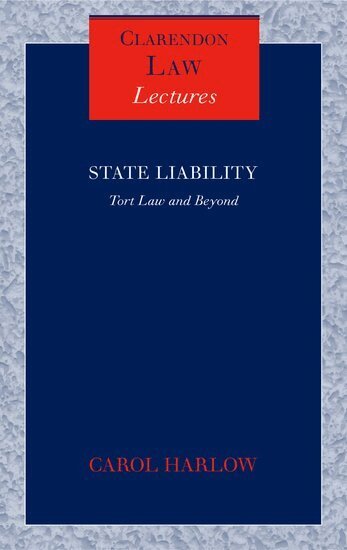
The lectures presented in this volume examine the fast-growing compensation culture and the consequential pressure on courts to widen the range of situations in which individuals can claim damages from the State. Within domestic legal systems, there has been a considerable extension of tortious liability which is impinging on the State and its resources. These lectures address statutory and administrative compensation, and examine the influence of group actions and of globalization. Pressure on domestic legal systems has been increased by transnational courts, notably the Court of Human Rights and the European Court of Justice. Carol Harlow argues that this trend towards judicialization is undesirable, and that greater use should be made of extrajudicial remedies. She contends that the issue of compensation is too important to be left to the courts.
711 kr
Skickas inom 5-8 vardagar
Based on the 2005 Oxford Clarendon Lectures in Law, this book deals with the remarkable change in society's attitude to homosexuality over the last half century. Until 1967 homosexual acts were punished by the criminal law and as recently as 1988 Parliament forbade teachers from suggesting that homosexuality was an acceptable family relationship. In 2005 Parliament passed the Civil Partnership Act, which creates a framework in which same-sex couples can have their relationship legally recognised in much the same way as marriage. This book looks at the essentials of the civil partnerships contruct, and asks whether it is really creating an institution of 'gay marriage'? If not, the next question to ask is whether civil partnership can satisfy the demands for equality increasingly being made by the gay community? In the United States, the courts have taken an active and progressive stance, holding that to deny marriage to same sex couples and leave them with mere partnership is to create a 'separate but equal' situation historically associated with the racial discrimination now universally recognised as unconstitutional and morally unjustifiable. However, the political climate has risen to a fever pitch with the current administration's push for constitutional amendment to ban outright gay marriage. In the UK the courts have been less activist, but the potential creation of a Supreme Court raises important questions about the boundaries between the roles of judiciary, the legislature, and government; and whether the judiciary should play a more constitutionally active role than has thus far been traditional?
535 kr
Skickas inom 5-8 vardagar
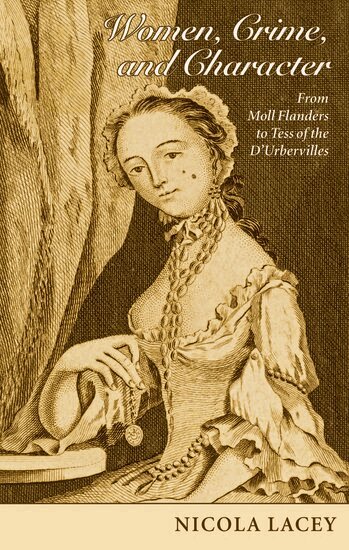
In the early 18th Century, Daniel Defoe found it natural to write a novel whose heroine was a sexually adventurous, socially marginal property offender. Only half a century later, this would have been next to unthinkable. Lacey explores the disappearance of Moll, and her supercession in the annals of literary female offenders by heroines like Tess, serving as a metaphor for fundamental changes in ideas of selfhood, gender and social order in 18th and 19th Century England. Drawing on law, literature, philosophy and social history, she argues that these broad changes underpinned a radical shift in mechanisms of responsibility-attribution, with decisive implications for the criminalisation of women.This book examines how the treatment and understanding of female criminality was changing during the era which saw the construction of the main building blocks of the modern criminal process, and of how these understandings related in turn to broader ideas about gender, social order and individual agency. Lacey tells the story of the shifting relationship between informal codes of norms such as the 'cult of sensibility' and the formal system of criminal justice, and of the impact on women and on understandings of femininity of these complementary systems of discipline. By drawing on a wide variety of sources, it casts light into corners which remain obscure in accounts informed by a single discipline.
1 200 kr
Skickas inom 5-8 vardagar
In this book Hugh Beale examines the case for reforming the law on mistake and non-disclosure of fact to bring English law closer to the law in much of continental Europe. There, and in common law countries like the US, a party may avoid a contract for mistake of fact on a more liberal basis, and a party who deliberately keeps silent knowing that the other party is making a mistake may be guilty of fraud. This is not necessarily the case in England and Wales.Developing a proposal for law reform, the author concedes that the English courts require a law that puts great emphasis on certainty and expects parties to look out for their own interests; but posits that this individualistic approach is not suitable for smaller businesses which are less sophisticated and which are likely to be making low value contracts, so that relative cost of taking advice will be high. He argues that the solution may not be to reform English contract law generally, but to support the development of an optional instrument on contract law, along the lines of the Common European Sales Law recently proposed by the European Commission. This measure is aimed specifically at the needs of small and medium enterprises, and contains the protective rules found in the other jurisdictions. It is aimed primarily at cross-border sales, but Member States would be given the option of adopting it for domestic transactions too. This would give small businesses the choice of using the current "hard-nosed" law or adopting the more protective optional instrument, recognizing that different parties require different things from the law governing their contract.