Confucian Cultures - Böcker
Visar alla böcker i serien Confucian Cultures. Handla med fri frakt och snabb leverans.
7 produkter
7 produkter
768 kr
Skickas inom 7-10 vardagar
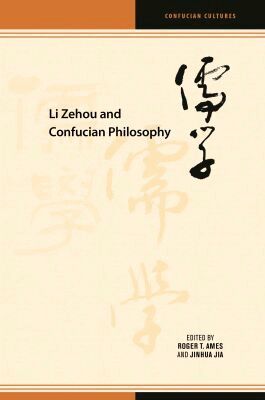
For more than a century scholars both inside and outside of China have undertaken the project of modernizing Confucianism, but few have been as successful or influential as Li Zehou (b. 1930). Since the 1950s, Li’s extensive efforts in this regard have in turn exerted a profound influence on Chinese modernization and resulted in his becoming one of China’s most prominent social critics. To transform Confucianism into a contemporary resource for positive change in China and elsewhere, Li has reinterpreted major ideas and concepts of classical Confucianism, including a rereading of the entire Analects, replete with his own philosophical speculations derived from other Chinese and Western traditions (most notably, the ideas of Kant and Marx), and developed an aesthetical theory that has proved especially far-reaching.Although the authors of this volume hail from East Asia, North America, and Europe and a wide variety of academic backgrounds and fields of study, they are unanimous in their appreciation of Li’s contributions to not only an evolving Confucian philosophy, but also world philosophy. They view Li first and foremost as a sui generis thinker with broad global interests and not one who fits neatly into any one philosophical category, Chinese or Western. This is clearly reflected in the chapters included here, which are organized into three parts: Li Zehou and the Modernization of Confucianism, Li Zehou’s Reconception of Confucian Philosophy, and Li Zehou’s Aesthetical Theory and Confucianism. Together they form a coherent narrative that reveals how Li has, for more than half a century, creatively studied, absorbed, and reconceptualized the Confucian ideational tradition to integrate it with Western philosophical elements and develop his own philosophical insights and original theories. At the same time, he has transformed and modernized Confucianism for the purpose of both coalescing with and reconstructing a new world cultural order.
282 kr
Skickas inom 7-10 vardagar
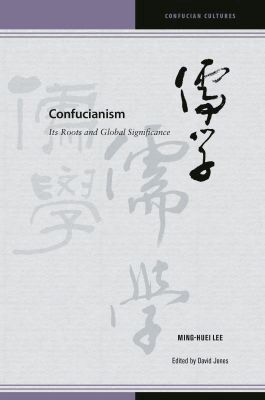
In Confucianism: Its Roots and Global Significance, English-language readers get a rare opportunity to read in a single volume the work of one of Taiwan's most distinguished scholars. Although Ming-huei Lee has published in English before, the corpus of his non-Chinese writings is in German. Readers of this volume will soon discover the hard-mindedness and precision of thinking so associated with German philosophy as they enter into his discussions of Confucianism. As readers progress through this book, they will be constantly reminded that all philosophy should be truly comparative. . . . "The work is divided into three sections: Classical Confucianism and Its Modern Reinterpretations, Neo-Confucianism in China and Korea, and Ethics and Politics. These sections evince just some of the range of Ming-huei Lee's thinking as well as his inclusive reach of Confucian philosophy to the whole of East Asia, especially to Korea. In the Ethics and Politics section, readers will get a taste for the return to his own tradition through the lens of Kantian philosophy with his analysis of Confucius and the virtue ethics debate in Confucian philosophical circles. Lee's thinking through Mou Zongsan's interpretation of Confucianism, Zhu Xi and the Huxiang scholars' debate on ren, and the unfolding of the debates over the 'four buddings' and 'seven feelings' in Korea by Yi Toegye and Gi Gobong sets up the subsequent chapters of the book: a reconstruction of Wang Yangming's philosophy and theories of democracy, and a critique of Jiang Qing's 'political Confucianism.' His work in this book adds a sizable appendage to Confucian scholarship. Moreover, the interrelated ideas and arguments presented in this book are a special contribution to the Confucian project in English-speaking countries across the world." - from the Editor's Foreword
Confucianism and Deweyan Pragmatism
Resources for a New Geopolitics of Interdependence
Inbunden, Engelska, 2021
729 kr
Skickas inom 7-10 vardagar
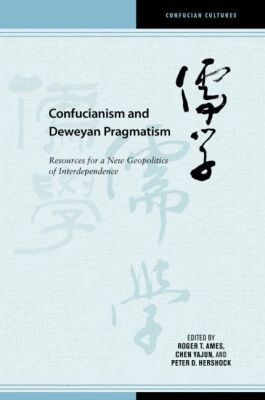
Over the past generation, the rise of East Asia and especially China, has brought about a sea change in the economic and political world order. At the same time, global warming, environmental degradation, food and water shortages, population explosion, and income inequities have created a perfect storm that threatens the very survival of humanity. It is clear now that the Westphalian model of individual sovereign states seeking their own self-interest will not be able to respond effectively to this win-win or lose-lose crisis. In this volume, a cadre of distinguished scholars comes together to reflect on Confucianism and Deweyan pragmatism as possible resources for a new geopolitics that begins from an ontology of interdependence and recognizes the irreducibly ecological nature of the human experience at every level.Both Confucian and Deweyan traditions emphasize the primacy of experience, the importance of vital relationality, and the moral roots of good governance. The potential benefits of conceptually blending the two are many. Indeed, the contemporary Chinese philosopher Tang Junyi provides us with a cosmological understanding of the "idea" of Confucianism that, in parallel to Dewey's "idea" of democracy, can enable us to anticipate the core values, if not the specific contours, of a "Confucian democracy." Just as Dewey's "idea" of democracy is his vision of the flourishing communal life made possible by the contributions of the uniquely distinguished persons that constitute it, Tang Junyi's Confucianism is a pragmatic naturalism directed at achieving the most highly integrated cultural, moral, and spiritual growth for the individual-in-community. In both, we find an affirmation of communal harmony as a process "starting here and going there" through which those involved learn together to do ordinary things in extraordinary ways. Just such a cosmological understanding of democracy is one way of describing what will be needed to address the many predicaments characterizing the environmental, cultural, socioeconomic, and political dynamics of the twenty-first century.
Tianxia in Comparative Perspectives
Alternative Models for a Possible Planetary Order
Inbunden, Engelska, 2023
729 kr
Skickas inom 7-10 vardagar
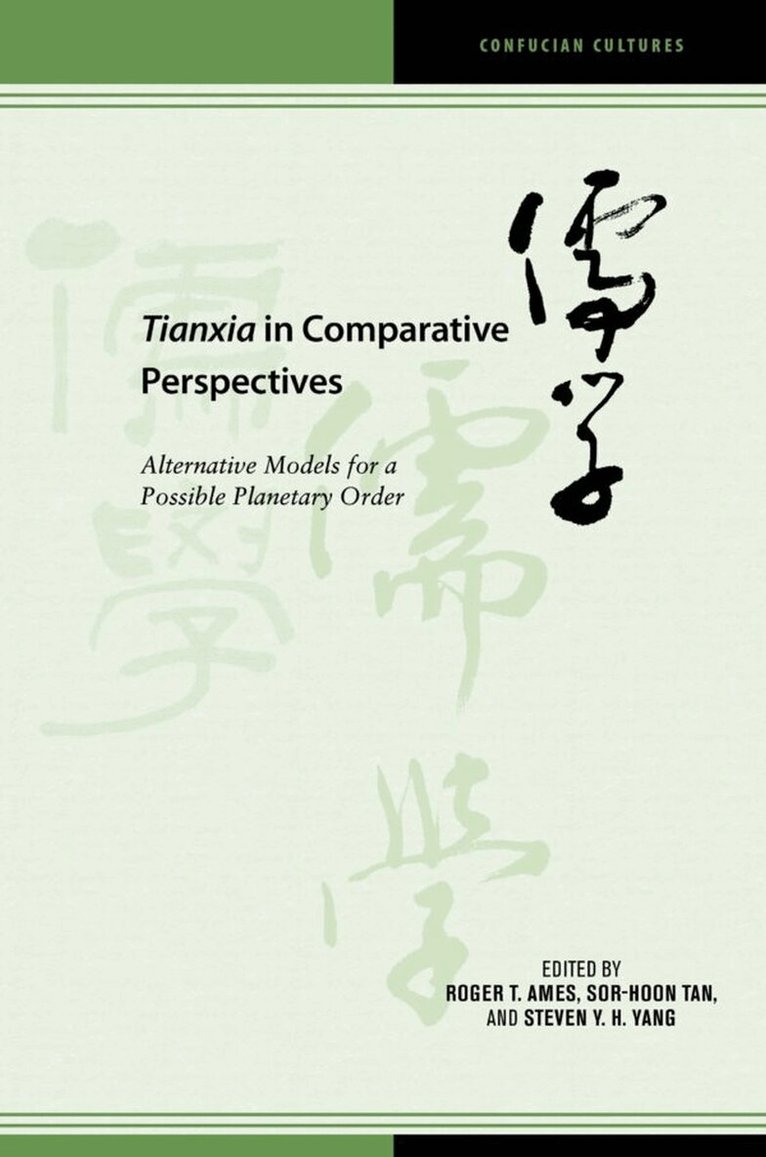
Tianxia—conventionally translated as "all-under-Heaven"—in everyday Chinese parlance simply means "the world." But tianxia is also a geopolitical term found in canonical writings that has a deeper historical and philosophical significance. Although there are many understandings of tianxia in this literature, interpretations within the Chinese process cosmology generally begin with an ecological understanding of intra-national relations that acknowledge the mutuality and interdependence of all economic and political activity.This volume contextualizes the tianxia vision of geopolitical order within a variety of strategies drawn from a broad spectrum of cultures and peoples: Buddhist, Islamic, Indian, African, Confucian, European. The conversation among the contributors is guided by several central questions: Is tianxia the only model of cosmopolitanism? Are there ideas and ideals comparable to tianxia that exist in other cultures? What alternative perspectives of global justice have inspired Western, Indian, Islamic, Buddhist, and African cultural traditions? The fundamental premise here is that in order for a planetary tianxia system to be relevant and significant for the present time and for our vision of the future, it must acknowledge the plurality of moral ideals defining the world’s cultures while at the same time seek practical ways to formulate a minimalist morality that can provide the solidarity needed to bring the world’s people together.
Formulating a Minimalist Morality for a New Planetary Order
Alternative Cultural Perspectives
Inbunden, Engelska, 2025
794 kr
Skickas inom 7-10 vardagar
The Westphalian model of international relations has given us a zero-sum game of winners and losers that has proven to be ineffective in addressing the pressing issues of our times. Philosopher Zhao Tingyang has argued that by conceptualizing international relations from the planetary perspective of tianxia, we can develop a sense of "worldness" that at once acknowledges the plurality of moral ideals defining of the world’s cultures and seeks practical ways to formulate a shared morality for the solidarity needed to bring the world’s people together. In this spirit, political theorist Michael Walzer, in his Thick and Thin: Moral Argument at Home and Abroad, wants "to endorse the politics of difference and, at the same time, to describe and defend a certain sort of universalism." For Walzer "thin" morality does not mean minor or emotionally shallow morality; on the contrary, thin and intensity come together as "morality close to the bone." Turning to alternative philosophies, the contributors to this volume seek to move beyond liberal thinking on a minimalist ethic to include other cultural values—those of the Confucian, Buddhist, Indian, Islamic, Ubuntu, Japanese, European, and Jewish traditions. In order to reconceive of the world as a world, these scholars seek to formulate an answer to the contemporary challenge of a fragmented and failing Westphalian "internationality," and in so doing, to offer possible conceptions of a shared and practicable morality sorely needed at a planetary scale.
Tianxia in Comparative Perspectives
Alternative Models for a Possible Planetary Order
Häftad, Engelska, 2024
309 kr
Skickas inom 7-10 vardagar
Tianxia—conventionally translated as "all-under-Heaven"—in everyday Chinese parlance simply means "the world." But tianxia is also a geopolitical term found in canonical writings that has a deeper historical and philosophical significance. Although there are many understandings of tianxia in this literature, interpretations within the Chinese process cosmology generally begin with an ecological understanding of intra-national relations that acknowledge the mutuality and interdependence of all economic and political activity.This volume contextualizes the tianxia vision of geopolitical order within a variety of strategies drawn from a broad spectrum of cultures and peoples. The conversation among the contributors is guided by several central questions: Is tianxia the only model of cosmopolitanism? Are there ideas and ideals comparable to tianxia that exist in other cultures? What alternative perspectives of global justice have inspired Western, Indian, Islamic, Buddhist, and African cultural traditions? The fundamental premise here is that in order for a planetary tianxia system to be relevant and significant for the present time and for our vision of the future, it must acknowledge the plurality of moral ideals defining the world’s cultures while at the same time seek practical ways to formulate a minimalist morality that can provide the solidarity needed to bring the world’s people together.
Beyond the Nation-State
From Geopolitical Discourse to Civilizational Dialogues
Inbunden, Engelska, 2026
759 kr
Kommande
In an era marked by geopolitical fragmentation and global crises, how can we envision a more stable and inclusive planetary order? This pioneering volume calls for a radical rethinking of international relations—moving beyond the Westphalian state system to embrace a civilizational dialogue rooted in shared histories, values, and mutual concern. The collection brings together leading scholars to explore the idea of tianxia (all under heaven) as a conceptual and moral framework for reimagining global order. Drawing from East Asian traditions and others, contributors interrogate concepts like empire, liberalism, Confucianism, and cosmopolitanism to assess the possibilities of intercultural cooperation in a post-national future. At the heart of the book is a critical yet hopeful proposition: that civilizational dialogues—despite the exclusionary implications of such discourse—can help us imagine planetary futures beyond binaries like "the West and the Rest." Instead of universalizing one worldview, the chapters advocate for "differing for one another," a relational equity that acknowledges diversity and fosters solidarity through accommodation, empathy, and shared planetary concerns such as climate, pandemics, and global justice. With contributions spanning political theory and comparative philosophy to historical reflection and Confucian civic education, Beyond the Nation-State offers not only a critique of current global paradigms but also a constructive path forward.