Constitutional Thinking – serie
Visar alla böcker i serien Constitutional Thinking. Handla med fri frakt och snabb leverans.
14 produkter
14 produkter
Inbunden, Engelska, 2013
599 kr
Skickas inom 5-8 vardagar
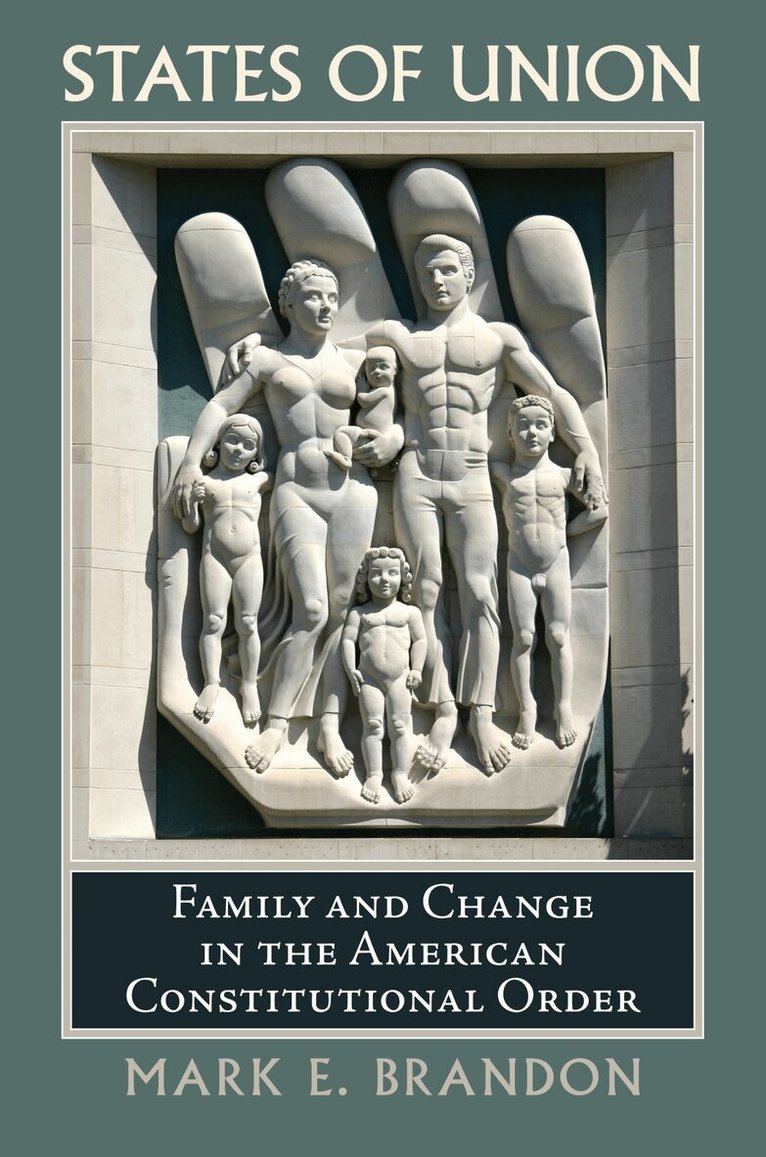
In two canonical decisions of the 1920s—Meyer v. Nebraska and Pierce v. Society of Sisters—the Supreme Court announced that family (including certain relations within it) was an institution falling under the Constitution’s protective umbrella. Since then, proponents of “family values” have claimed that a timeless form of family—nuclear and biological—is crucial to the constitutional order. Mark Brandon’s new book, however, challenges these claims. Brandon addresses debates currently roiling America—the regulation of procreation, the roles of women, the education of children, divorce, sexuality, and the meanings of marriage. He also takes on claims of scholars who attribute modern change in family law to mid-twentieth-century Supreme Court decisions upholding privacy. He shows that the “constitutional” law of family has much deeper roots. Offering glimpses into American households across time, Brandon looks at the legal and constitutional norms that have aimed to govern those households and the lives within them. He argues that, well prior to the 1960s, the nature of families in America had been continually changing—especially during western expansion, but also in the founding era. He further contends that the monogamous nuclear family was codified only at the end of the nineteenth century as a response to Mormon polygamy, communal experiments, and Native American households. Brandon discusses the evolution of familial jurisprudence as applied to disputes over property, inheritance, work, reproduction, the status of women and children, the regulation of sex, and the legal limits to and constitutional significance of marriage. He shows how the Supreme Court’s famous decisions in the latter part of the twentieth century were largely responses to societal change, and he cites a wide range of cases that offer fresh insight into the ways the legal system responded to various forms of family life. More than a historical overview, the book also considers the development of same-sex marriage as a political and legal issue in our time.States of Union is a groundbreaking volume that explains how family came to be “in” the Constitution, what it has meant for family to be constitutionally significant, and what the implications of that significance are for the constitutional order and for families.
Inbunden, Engelska, 2014
668 kr
Skickas inom 10-15 vardagar
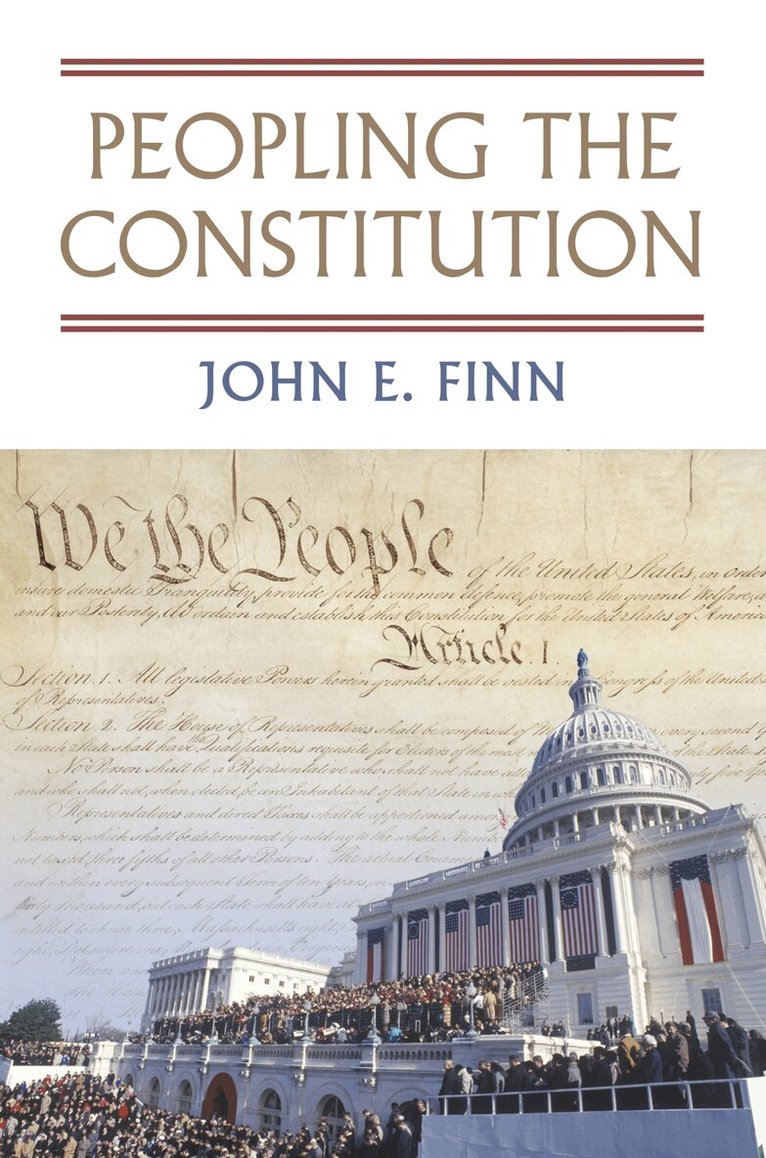
The U.S. Constitution begins with the soaring words “We the People,” but we, the people, have little to do with the document as most of us have come to know it. When most people think of the constitution they think of it as a legal instrument, the province of judges and lawyers, who alone possess the expertise and knowledge necessary to discern its elusive and complex meaning.This book outlines a very different view of the Constitution as a moral and philosophical statement about who we are as a nation. This “Civic Constitution” constitutes us as a civic body politic, transforming “the people” into a singular political entity. Juxtaposing this view with the legal model, the “Juridic Constitution,” John E. Finn offers a comprehensive account of the Civic Constitution as a public affirmation of the shared principles of national self-identity and as a particular vision of political community in which we the people play a significant and ongoing role in achieving a constitutional way of life. The Civic Constitution is the constitution of dialogical engagement, of contested meanings, of political principles, of education, of conversation.Peopling the Constitution seeks nothing less than a new interpretation of the American constitutional project in an effort to revive a robust understanding of citizenship. It considers the entire constitutional project, from its founding and maintenance to its failure, with insights into topics ranging from the practise of deliberative democracy and the meaning of citizenship, to constitutional fidelity, civic virtue, the separation of powers, federalism, and constitutional interpretation. The Civic Constitution, in Finn’s telling, is primarily a political project requiring an active, engaged, and most importantly, constitutionally educated citizenry committed to the civic virtues of civility and tending. When we as citizens are unwilling or unable to tend to and sustain the Constitution, and when constitutional questions reduce to legal questions and obscure civic interests, constitutional rot results. And in post-9/11 America, Finn argues, constitutional rot has begun to set in.With its multi-dimensional vision of constitutional governance, Finn’s book stands as a corrective to accounts that locate the Constitution in and conceive it essentially as a legal instrument, making a powerful and impassioned argument for restoring the people to their rightful place in the politics and practise of the Constitution.
Inbunden, Engelska, 2014
564 kr
Skickas inom 10-15 vardagar
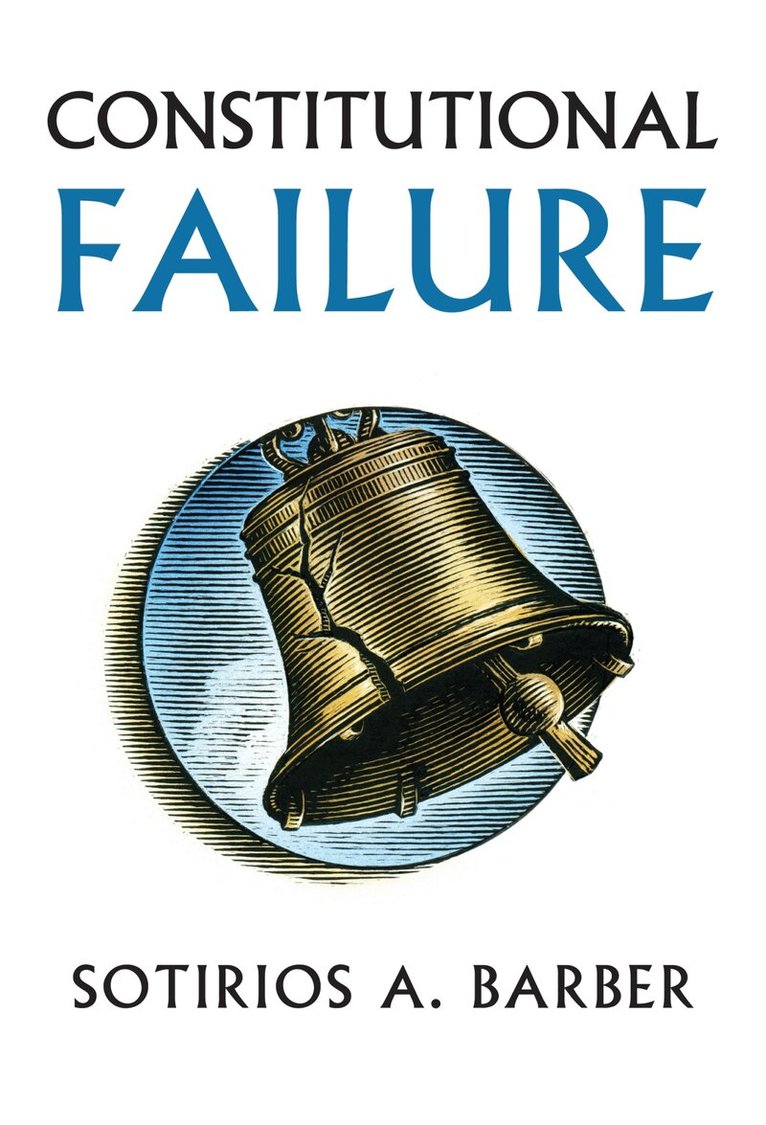
Americans err in thinking that while their politics may be ailing, their Constitution is fine. Sick politics is a sure sign of constitutional failure. This is Sotirios Barber's message in Constitutional Failure. Public attitudes fostered by a consumer culture, constitution worship, the lack of a trusted leadership community, and academic historicism and value skepticism--these, this book tells us in clear and bracing terms, are at the root of our political dysfunction. Barber characterizes the Constitution as a plan of government--a set of means to public purposes like national security and prosperity. He argues that if the government is failing, it's fair to conclude that the plan is failing and that laws that are supposed to serve as means can't in reason continue to bind when they no longer work. He argues further that constitutional success depends ultimately on a stratum of diverse and self-critical citizens, who see each other as moral equals and parts of one national community. These citizens, with the politicians among them, would be good-faith contestants regarding the meaning of the common good and the most effective means to secure it. In this way--showing how the success of a constitutional democracy is more a matter of political attitudes than of institutional performance--Barber's book upends the conventional understanding of constitutional failure. In Barber's analysis, the apparent stability of formal constitutional institutions--usually interpreted as evidence of constitutional health--may actually indicate the defining element of constitutional failure: a mentally inert citizenry no longer capable of constitutional reflection and reform. At once concise and thorough in its analysis of the concept of constitutional failure and its accounts of a ""healthy politics,"" the corrosive impact of Madisonian checks and balances (as a substitute for trust-worthy leadership), and the outlook for meaningful reform, this book offers a carefully reasoned and provocative assessment of the viability of constitutional governance in the United States.
Häftad, Engelska, 2015
374 kr
Skickas inom 10-15 vardagar
The first paperback edition of a classic of American constitutional theory. The book is divided into two parts. In Part I Professor Tushnet appraises the five major competing “grand theories” of constitutional law and interpretation, and, argues that none of them satisfy their own requirements for coherence and judicial constraint. In Part II the author offers a descriptive sociology of constitutional doctrine and raises critical questions as to whether a grand theory is necessary, is it possible to construct a coherent, useful grand theory, and is construction of an uncontroversial grand theory possible? Professor Tushnet’s new Afterword is organized in parallel fashion to the original text. Part I offers a new survey of the contemporary terrain of constitutional interpretation. Part II provides an extended discussion of the most prominent of contemporary efforts to provide an external analysis of constitutional law, the idea of regime politics. This includes discussion of major court decisions, including Bush v. Gore and Citizens United.
Inbunden, Engelska, 2015
505 kr
Skickas inom 5-8 vardagar
If, as many allege, attacking the gap between rich and poor is a form of class warfare, then the struggle against income inequality is the longest running war in American history. To defenders of the status quo, who argue that the accumulation of wealth free of government intervention is an essential feature of the American way, this book offers a forceful answer. While many of those who oppose addressing economic inequality through public policy today do so in the name of freedom, Clement Fatovic demonstrates that concerns about freedom informed the Founding Fathers’ arguments for public policy that tackled economic disparities. Where contemporary arguments against such government efforts conceptualize freedom in economic terms, however, those supporting public policies conducive to greater economic equality invoked a more participatory, republican, conception of freedom. As many of the Founders understood it, economic independence, which requires a wide if imperfect distribution of property, is a precondition of the political independence they so profoundly valued. Fatovic reveals a deep concern among the Founders—including Thomas Jefferson, Thomas Paine, and Noah Webster—about the impact of economic inequality on political freedom. America’s Founding and the Struggle over Economic Inequality traces this concern through many important political debates in Congress and the broader polity that shaped the early Republic—debates over tax policies, public works, public welfare, and the debt from the Revolution. We see how Alexander Hamilton, so often characterized as a cold-hearted apologist for plutocrats, actually favored a more progressive system of taxation, along with various policies aimed at easing the economic hardship of specific groups. In Thomas Paine, frequently portrayed as an advocate of laissez-faire government, we find a champion of a comprehensive welfare state that would provide old-age pensions, public housing, and a host of other benefits as a matter of “right, not charity.” Contrary to the picture drawn by so many of today’s pundits and politicians, this book shows us how, for the first American statesmen, preventing or minimizing economic disparities was essential to the preservation of the new nation’s freedom and practice of self-government.
Häftad, Engelska, 2016
369 kr
Skickas inom 5-8 vardagar
The Missouri legislature passes a bill to flout federal gun-control laws it deems unconstitutional. Texas refuses to recognize same-sex marriages, citing the state's sovereignty. The Tenth Amendment Center promotes the ""Federal Health Care Nullification Act."" In these and many other similar instances, the spirit of nullification is seeing a resurgence in an ever-more politically fragmented and decentralized America. What this means-in legal, cultural, and historical terms-is the question explored in Nullification and Secession in Modern Constitutional Thought. Bringing together a number of distinguished scholars, the book offers a variety of informed perspectives on what editor Sanford Levinson terms ""neo-nullification,"" a category that extends from formal declarations on the invalidity of federal law to what might be called ""uncooperative federalism.""Mark Tushnet, Mark Graber, James Read, Jared Goldstein, Vicki Jackson, and Alison La Croix are among the contributors who consider a strain of federalism stretching from the framing of the Constitution to the state of Texas's most recent threat to secede from the United States. The authors look at the theory and practice of nullification and secession here and abroad, discussing how contemporary advocates use the text and history of the Constitution to make their cases, and how very different texts and histories influence such movements outside of the United States-in Scotland, for instance, or Catalonia, or Quebec, or even England vis-à-vis the European Union. Together these essays provide a nuanced account of the practical and philosophical implications of a concept that has marked America's troubled times, from the build-up to the Civil War to the struggle over civil rights to battles over the Second Amendment and Obamacare.
Inbunden, Engelska, 2023
688 kr
Skickas inom 10-15 vardagar
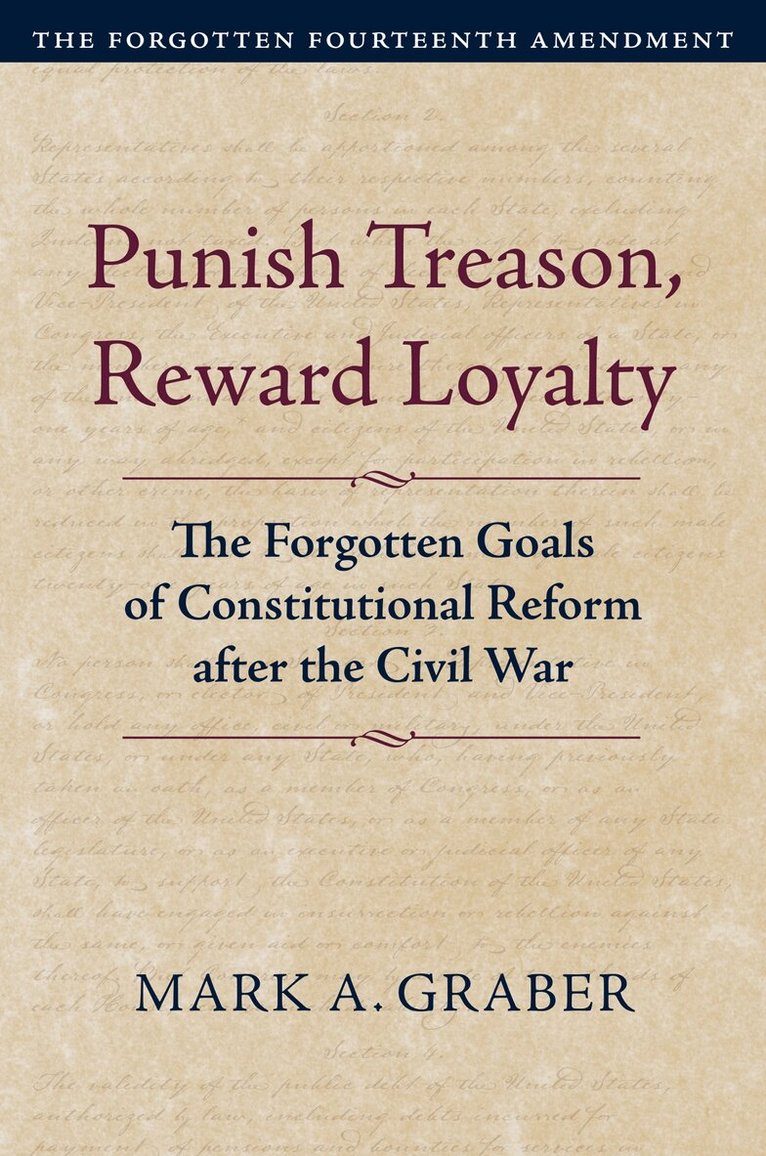
In contemporary constitutional politics, Section 1 of the Fourteenth Amendment—which includes the citizenship, privileges and immunities, due process, and equal protection clauses—is the star of the show. But this was not the focus for the Republican members of the Thirty-Ninth Congress. Their interest was instead in Sections 2, 3, and 4. Today we tend to think the purpose of the Fourteenth Amendment was to protect persons of color. But the Republicans engaged in Reconstruction saw its purpose as preventing “rebel rule” by punishing treason and rewarding loyalty, particularly the loyalty of white men who remained faithful to the Union during the Civil War.In this first of three planned volumes for the University Press of Kansas’s Constitutional Thinking series, Mark A. Graber aims to restore to contemporary memory the Fourteenth Amendment drafted by those Republican and Unionist members of Congress who supported congressional reconstruction.In Punish Treason, Reward Loyalty, Graber breaks new ground researching Reconstruction, the Fourteenth Amendment, and constitutionalism by highlighting the importance of Sections 2, 3, and 4 to the representatives in the Thirty-Ninth Congress and their relative indifference to Section 1. His work underscores the importance and impact that legislative primacy and partisan supremacy had to Republican constitutional thinking about constitutional authority immediately after the Civil War.Centered on Reconstruction and constitutional reform, Graber shows anew the Republican effort to prevent rebel rule by empowering and protecting loyalty.
Häftad, Engelska, 2023
374 kr
Skickas inom 10-15 vardagar
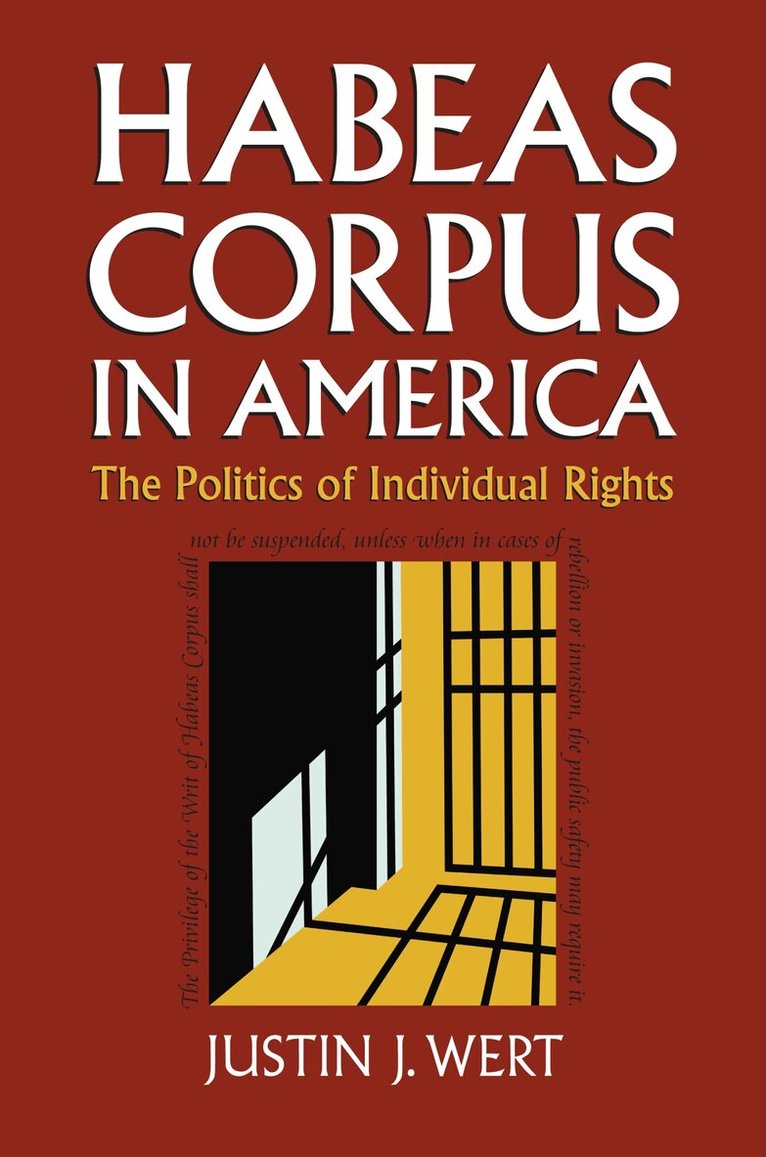
For most Americans, habeas corpus is the cornerstone of our legal system: the principal constitutional check on arbitrary government power, allowing an arrested person to challenge the legality of his detention. In a study that could not be more timely, Justin Wert reexamines this essential individual right and shows that habeas corpus is not necessarily the check that we've assumed. Habeas corpus, it emerges, is as much a tool of politics as it is of law. In this first study of habeas corpus in an American political context, Wert shifts our collective emphasis from the judicial to the political—toward the changes in the writ influenced by Congress, the president, political parties, state governments, legal academics, and even interest groups. By doing so, he reveals how political regimes have used habeas corpus both to undo the legacies of their predecessors and to establish and enforce their own vision of constitutional governance. Tracing the history of the writ from the Founding to Hamdi v. Rumsfeld and Boumediene v. Bush, Wert illuminates crucial developmental moments in its evolution. He demonstrates that during the antebellum period, Reconstruction, Gilded Age, Great Society, and the ongoing war on terrorism, habeas corpus has waxed and waned in harmony with the interests of majoritarian politics. Along the way, Wert identifies and explains the political context of fine points of law that many political scientists and historians may not be aware of—such as the exhaustion rule requiring that a federal habeas participant must first exhaust all possible claims for relief in state court, a maneuver by which the post-Reconstruction Court abandoned supervision of race relations in the South.Especially in light of the new scrutiny of habeas corpus prompted by the Guantnamo detainees, Wert’s book is essential for broadening our understanding of how law and politics continue to intersect after 9/11. Brimming with fresh insights into constitutional development and regime theory, it shows that the Great Writ of Liberty may not be so great as we have supposed—because while it has the potential to enforce conceptions of rights that are consistent with the best ideals of American politics, it also has the potential to enforce its worst aspects as well.
Inbunden, Engelska, 2024
518 kr
Skickas inom 10-15 vardagar
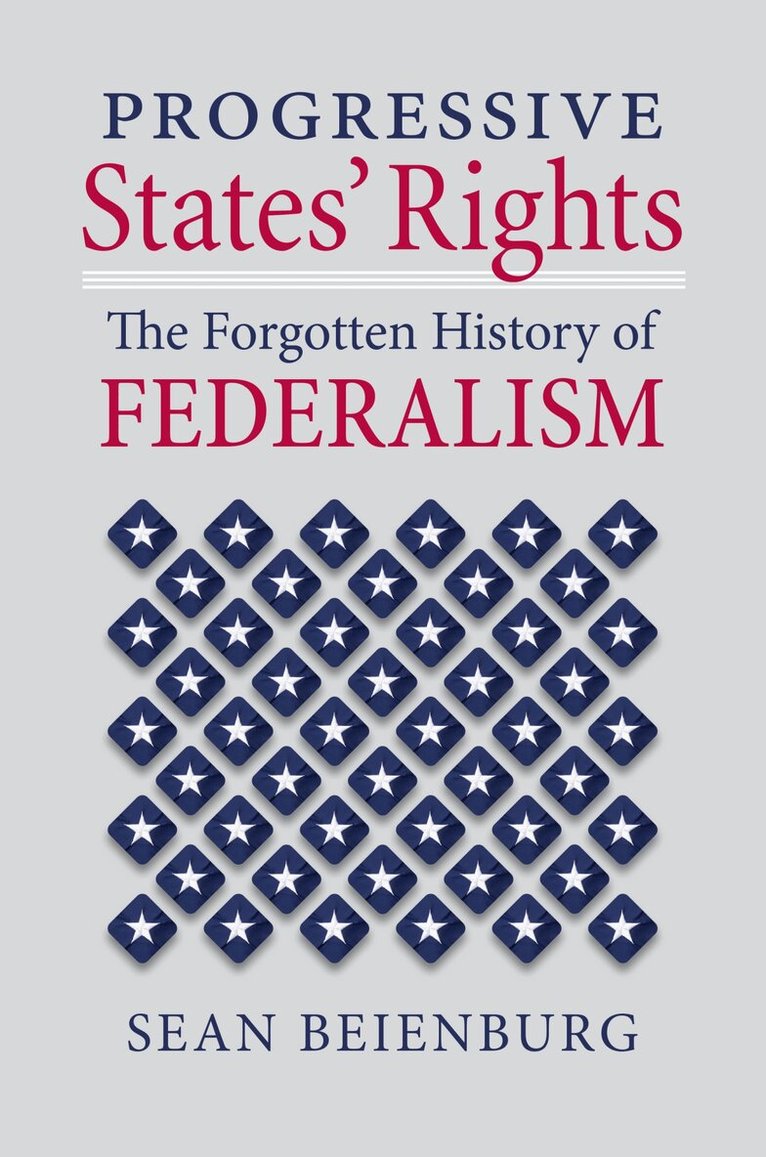
Today, when politicians, pundits, and scholars speak of states’ rights, they are usually referring to Southern efforts to curtail the advance of civil rights policies or to conservative opposition to the federal government under the New Deal, Great Society, and Warren Court. Sean Beienburg shows that this was not always the case, and that there was once a time when federalism—the form of government that divides powers between the state and federal governments—was associated with progressive, rather than conservative, politics.In Progressive States’ Rights, Sean Beienburg tells an alternative story of federalism by exploring states’ efforts in the years before the New Deal of shaping constitutional discourse to ensure that a protective welfare and regulatory governmental regime would be built in the states rather than the national government. These state-level actors not only aggressively participated in constitutional politics and interpretation but also specifically sought to create an alternative model of state-building that would pair a robust state power on behalf of the public good with a traditionally limited national government.Current politics generally collapse policy and constitutional views (where a progressive view on one policy also assumes a progressive view on the other), but Beienburg shows that this was not always true, and indeed many of those most devoted to progressive policy views were deeply committed to a conservative constitutionalism.
Häftad, Engelska, 2025
333 kr
Skickas inom 10-15 vardagar
In contemporary constitutional politics, Section 1 of the Fourteenth Amendment—which includes the citizenship, privileges and immunities, due process, and equal protection clauses—is the star of the show. But this was not the focus for the Republican members of the Thirty-Ninth Congress. Their interest was instead in Sections 2, 3, and 4. Today we tend to think the purpose of the Fourteenth Amendment was to protect persons of color. But the Republicans engaged in Reconstruction saw its purpose as preventing “rebel rule” by punishing treason and rewarding loyalty, particularly the loyalty of white men who remained faithful to the Union during the Civil War.In this first of three planned volumes for the University Press of Kansas’s Constitutional Thinking series, Mark A. Graber aims to restore to contemporary memory the Fourteenth Amendment drafted by those Republican and Unionist members of Congress who supported congressional reconstruction.In Punish Treason, Reward Loyalty, Graber breaks new ground researching Reconstruction, the Fourteenth Amendment, and constitutionalism by highlighting the importance of Sections 2, 3, and 4 to the representatives in the Thirty-Ninth Congress and their relative indifference to Section 1. His work underscores the importance and impact that legislative primacy and partisan supremacy had to Republican constitutional thinking about constitutional authority immediately after the Civil War.Centered on Reconstruction and constitutional reform, Graber shows anew the Republican effort to prevent rebel rule by empowering and protecting loyalty.
Inbunden, Engelska, 2025
564 kr
Skickas inom 10-15 vardagar
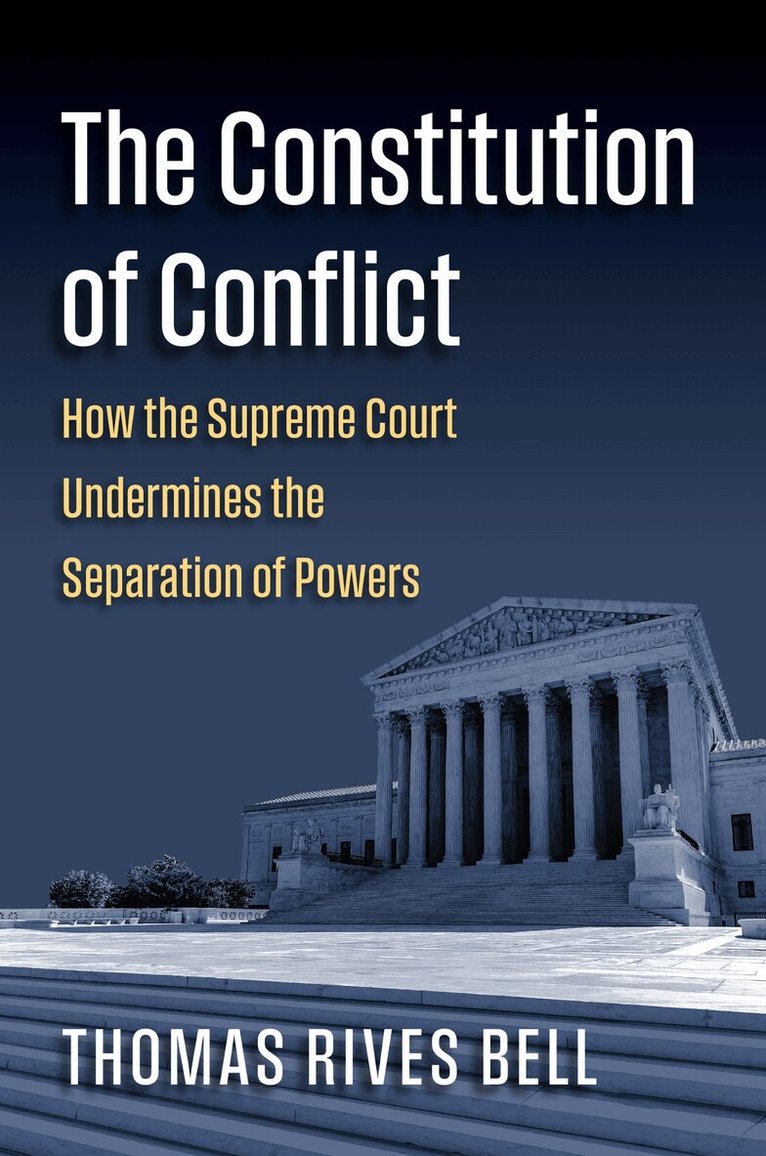
A bold and timely proposal for rethinking the role of the Supreme Court in the separation of powers.There is a widespread sense today that the separation-of-powers system is broken or dysfunctional and has become an obstacle to effective government. The Constitution of Conflict demonstrates that much of the problem comes from attempts to find legal answers to political problems. Challenging long-held assumptions about the Constitution, Thomas Rives Bell boldly argues that a separation-of-powers doctrine enforceable by the Court is inconsistent with the constitutional design. Rather than establishing a legal doctrine, the Constitution set into motion a dynamic political system that governs through conflict within and among differentiated institutional structures.Bell shows that Congress and the president have previously found constitutional solutions to issues like the administrative state, only to be thwarted by the Supreme Court. He critiques the Court’s different methodologies for resolving these disputes, demonstrating that, rhetoric aside, both originalist accounts and functionalist understandings seek primarily to enforce the separation of powers for its own sake rather than understanding the political system as the proper means by which to achieve the Constitution’s aspirations. Judicial superintendence of the separation of powers, moreover, places the Court above rather than within the constitutional framework. Bell proposes that the Court’s role in such disputes should be confined to government actions that directly implicate rights rather than to the policing of interbranch boundaries between Congress and the president.Bell applies his proposed political framework to four case studies: the legislative veto, executive agreements, recess appointments, and congressional oversight and impeachment. These cases illuminate the logic and dynamic of the separation of powers, demonstrating that political conflict, rather than legal settlement, is an essential element of the constitutional design.
Inbunden, Engelska, 2026
564 kr
Skickas inom 10-15 vardagar
A sobering and eyeopening indictment that Congress has consistently been the most dangerous branch of government when it comes to protecting, and undermining, civil liberties—particularly in the wake of military conflict.Why do wartime restrictions on civil liberties outlive their original justifications? Scholars have long argued that the blame lies with the executive branch of government. Their logic is straightforward: during war, lawmakers require (in Alexander Hamilton’s words) “decision, activity, secrecy, and dispatch,” so they choose to enable executive leadership. Executives promise to wield extraordinary powers temporarily, only to entrench them indefinitely. This book tests how these claims hold up in four pivotal moments in US history: the Civil War, World War I, World War II, and Vietnam. Ultimately, it finds them wanting.Harry Blain argues that national legislators are decisive in sustaining postwar restrictions on civil liberties. These elected officials have formidable tools at their disposal, including powers over the rules and membership of their own institution, the funding and personnel of the executive branch, the jurisdiction of federal courts, and the priorities of state and local governments. These tools make Congress, not the executive, the primary institutional threat to civil liberties in the aftermath of war. For example, the House used its exclusion power to refuse to seat the socialist Victor Berger, disenfranchising voters in the process; Congress used its power to compel testimony during the Red Scares in an effort to discredit and humiliate their political enemies; and legislators have removed, or threatened to remove, Supreme Court jurisdiction over habeas corpus petitions throughout US history.In a time where the president and the Supreme Court are seen as the most dangerous branches of government, Legislating Against Liberties is a sober reminder that Congress has historically been at the vanguard of undermining democracy and liberty.
Häftad, Engelska, 2026
453 kr
Skickas inom 5-8 vardagar
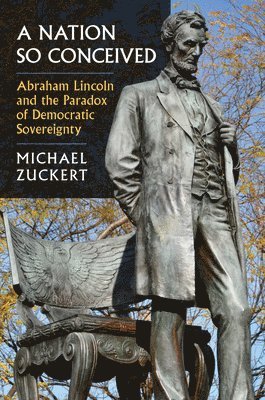
The culmination of years of work on Abraham Lincoln’s political thought, Michael P. Zuckert’s A Nation So Conceived argues for a coherent center to Lincoln’s political ideology, a core idea that unifies his thought and thus illuminates his deeds as a political actor. That core idea is captured in the term “democratic sovereignty.” Zuckert provides invaluable guidance to understanding both Lincoln and the politics of the United States between 1845 and Lincoln’s death in 1865 by focusing on roughly a dozen speeches that Lincoln made during his career. This reader-friendly chronological organization is motivated by Zuckert’s emphasis on Lincoln as a practical politician who was always fully aware of the political context of the moment within which he was speaking.According to Lincoln’s speech at Gettysburg, America was new precisely because it was born in dedication to the first premise of the theory of democratic sovereignty: that all men are created equal. Lincoln’s thought consisted in an ever-deepening meditation on the grounds and implications of that proposition, both in its constructive and in its destructive potential. The goodness of the American regime is derived from that ground and the chief dangers to the regime emanate from the same soil.Covering all significant speeches and writings of Lincoln both in his pre-presidential and presidential days, A Nation So Conceived is devoted to exploring the paradoxical duality of “created equal.” In a nearly comprehensive study of Lincoln’s thought, Zuckert uses lessons he learned from decades of teaching to reveal how Lincoln understood both its truth and its pathological consequences while offering an assessment of his aims and achievements as a statesman.
Inbunden, Engelska, 2026
351 kr
Kommande
An essential history of how both parties fought for control of the Supreme Court—and how Republicans have seized the advantage.In Supreme Control, leading Supreme Court scholar Lucas A. Powe, Jr. explains how the United States arrived at the Republican-dominated Roberts Court that is transforming constitutional law and reshaping everyday American life. What once seemed unthinkable, a Court willing to overturn long-settled precedent to advance a single political vision, has become reality.Powe argues that today’s Court fulfills a decades-long Republican project: the creation of a reliably conservative Supreme Court. Built through a carefully orchestrated strategy culminating in the judicial appointments made during Donald Trump’s presidency, the Roberts Court represents an unprecedented concentration of power within one political coalition. Placing these developments in historical context, Powe shows how the current Court is only the latest in a long battle for partisan dominance of American law.The struggle to control the Supreme Court, Powe demonstrates, is as old as the republic itself. From Washington, Adams, and Jefferson to Lincoln, Grant, and FDR, presidents have sought a Court that would secure their constitutional priorities. After a string of controversial liberal rulings in the 1960s and 1970s by the Warren Court, conservatives launched a sustained, long-term effort to reverse that legacy. That campaign advanced unevenly for decades until it finally succeeded in the twenty-first century with Donald Trump’s first term.Today, the consequences are unmistakable. The Court’s recent decisions on abortion, gun rights, religion, affirmative action, and executive power have thrust it into the center of American political life, with sweeping implications for democracy, governance, and individual rights.As Americans continue to grapple with the Court’s immense authority, Supreme Control provides the clearest explanation yet of how we reached this critical moment in history and what it means for the nation’s future.