• Fri frakt över 249 kr
  • •
  • Snabba leveranser
  • •
  • Billiga böcker
Kundservice

Du är på sajten för privatpersoner.

Företag, bibliotek eller offentlig verksamhet?

Du handlar på classic.bokus.com, där alla dina funktioner finns intakta.
Till classic.bokus.com
Bokus logotyp. Gå till startsidan.
  • Erbjudanden
  • Nyheter
  • Student
  • Topplistor
  • Barn & ungdom
  • Bokus Play
  • E-böcker
  • Pocketböcker
  • Spel & pussel

10% rabatt på allt med kod: NYSTART10 →

Sidfot

Mina sidor

    Hjälp

    • Kundservice
    • Vanliga frågor och svar
    • Frakt och leverans
    • Retur vid ångerrätt
    • Reklamera vara
    • Betalning
    • Köpvillkor
    • Allmänna villkor
    • Information om webbplatsens tillgänglighet

    Om Bokus

    • Om oss
    • Pressrum
    • För studenter
    • För företag
    • För bibliotek och offentlig verksamhet
    • För leverantörer
    • Hållbarhet

    Populärt

    • Aktuella erbjudanden
    • Presentkort
    • Studentlitteratur
    • Nya böcker
    • Topplistor
    • Signerade böcker
    • Engelska böcker

    Inspiration

    • Boktips
    • BookTok
    • Populära bokserier
    • Barnbokskaraktärer
    • Populära författare
    Logotyp för Bokus
    Följ oss på Facebook (extern länk)Följ oss på Instagram (extern länk)Följ oss på YouTube (extern länk)Följ oss på TikTok (extern länk)
    bokus @ CookiesAnpassa cookiesIntegritetspolicyKöpvillkor
    Till Citymail hemsida (extern länk)Till Budbee hemsida (extern länk)Till Postnord hemsida (extern länk)Till Schenker hemsida (extern länk)Till Early Bird hemsida (extern länk)Till Walleys hemsida (extern länk)
    1. Samhälle och politik
    2. Politik och statsskick
    3. Centralt styre och förvaltning

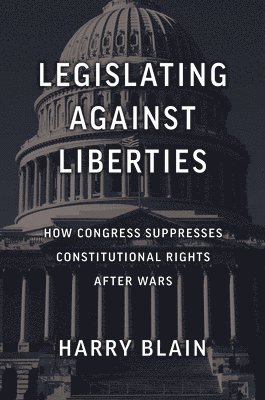
    Legislating Against Liberties

    How Congress Suppresses Constitutional Rights After Wars

    AvBlain Harry

    Inbunden, Engelska, 2026

    Del i serien Constitutional Thinking

    569 kr

    Beställningsvara. Skickas inom 10-15 vardagar. Fri frakt över 249 kr.

    Beskrivning

    A sobering and eyeopening indictment that Congress has consistently been the most dangerous branch of government when it comes to protecting, and undermining, civil liberties—particularly in the wake of military conflict.Why do wartime restrictions on civil liberties outlive their original justifications? Scholars have long argued that the blame lies with the executive branch of government. Their logic is straightforward: during war, lawmakers require (in Alexander Hamilton’s words) “decision, activity, secrecy, and dispatch,” so they choose to enable executive leadership. Executives promise to wield extraordinary powers temporarily, only to entrench them indefinitely. This book tests how these claims hold up in four pivotal moments in US history: the Civil War, World War I, World War II, and Vietnam. Ultimately, it finds them wanting.Harry Blain argues that national legislators are decisive in sustaining postwar restrictions on civil liberties. These elected officials have formidable tools at their disposal, including powers over the rules and membership of their own institution, the funding and personnel of the executive branch, the jurisdiction of federal courts, and the priorities of state and local governments. These tools make Congress, not the executive, the primary institutional threat to civil liberties in the aftermath of war. For example, the House used its exclusion power to refuse to seat the socialist Victor Berger, disenfranchising voters in the process; Congress used its power to compel testimony during the Red Scares in an effort to discredit and humiliate their political enemies; and legislators have removed, or threatened to remove, Supreme Court jurisdiction over habeas corpus petitions throughout US history.In a time where the president and the Supreme Court are seen as the most dangerous branches of government, Legislating Against Liberties is a sober reminder that Congress has historically been at the vanguard of undermining democracy and liberty.

    Produktinformation

    • Utgivningsdatum:2026-03-20
    • Mått:152 x 229 x undefined mm
    • Format:Inbunden
    • Språk:Engelska
    • Serie:Constitutional Thinking
    • Antal sidor:272
    • Förlag:University Press of Kansas
    • ISBN:9780700641055

    Utforska kategorier

    • Centralt styre och förvaltning inom Samhälle och politik
    • Politiskt förtryck inom Samhälle och politik
    • Grundlagar, konstitution inom Juridik

    Mer om författaren

    Harry Blain is assistant professor of political science at California State University, Sacramento.

    Recensioner i media

    "Wars are often marked by executive overreach, congressional acquiescence, and sweeping violations of civil liberties. But rest assured, we are told, for once peace returns, Congress steps in to restore the constitutional order and roll back the damage. Not so fast, cautions Harry Blain in this exhaustive and sobering book. While postwar congresses reassert their authority, they do not always serve as agents of repair. On the contrary, Blain persuasively argues, they often deepen the very harms wars leave behind."—William Howell, coauthor of Trajectory of Power: The Rise of the Strongman Presidency"Successfully challenging conventional wisdom that places primary blame on the president for restrictions on civil liberties in times of military conflict, Harry Blain demonstrates that the framers of the Constitution were correct to think Congress, particularly in the aftermath of war, is the most restrictive branch. This thesis is both original, important, and correct. I am not aware of another work that documents the repressive tendencies of the national legislature during war and the aftermath of war. Blain’s emphasis on repressive legislatures calls for a rethinking of contemporary wisdom that places much of the blame for democratic decline in the United States and elsewhere on overreaching executives. Law professors, political scientists, and historians will need to read and take into consideration the thesis of Legislating Against Liberties."—Mark A. Graber, author of Punish Treason, Reward Loyalty: The Forgotten Goals of Constitutional Reform after the Civil War"Although we have good reason to focus on how presidents violate civil liberties during wartime, it is dangerous to stop there when we consider threats to civil liberties. Harry Blain covers vital new ground as he traces how Congress, too, has been implicated when the federal government suppresses liberties, a danger that doesn’t end when peace returns. Those who can be made to appear as ‘the others’—whether they be immigrant radicals, peace activists, or even unreconstructed white supremacists—have faced repression at the hands of the legislative branch that is every bit as severe as that imposed by the executive. Blain’s work is revisionist in the best sense by forcing us to see what we have chosen for too long to ignore."—Andrew Polsky, editor of The Eisenhower Presidency: Lessons for the TwentyFirst Century

    Innehållsförteckning

    • Series ForewordAcknowledgmentsIntroduction: The Most Dangerous Branch1. Repressive Legislation2. Independent Tools3. Congress and the Executive4. Congress and the Judiciary5. Congress and the States6. The Vietnam AnomalyConclusionEpilogue: Civil Liberties in the Age of TrumpNotesBibliographyIndex