Contemporary Issues in Buddhist Studies - Böcker
Visar alla böcker i serien Contemporary Issues in Buddhist Studies. Handla med fri frakt och snabb leverans.
3 produkter
3 produkter
482 kr
Skickas inom 7-10 vardagar
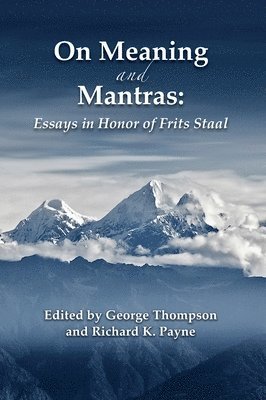
The late Johan Frederik (known as Frits) Staal (November 3, 1930–February 19, 2012), was born in Amsterdam and said of his home country, “There was no religion there.” While his academic interests included philosophy, Staal’s education focused on the study of mathematics, physics, astronomy, and logic. His approach to the study of Vedic religion and ritual was informed by this background, expressed in his assertion that he was not interested in the humanities but in the human sciences. Staal’s studies led him to India, where he completed a dissertation, “Advaita and Neoplatonism: A Critical Study in Comparative Philosophy,” at the University of Madras. In this period he also pursued research on South Indian Vedic recitation, which culminated in the publication of his first book, Nambudiri Veda Recitation. This laid the groundwork for his massive study of the agnicayana ritual conducted in Kerala in 1975, and the 1983 publication of his two-volume Agni: The Vedic Ritual of the Fire Altar. Staal’s research and writings had a wide-ranging influence on many different academic fields, including Vedic studies, Sanskrit studies, linguistics, and ritual studies. In addition to his academic contributions in those fields, he was a founding member of the Department of South and Southeast Asian Studies at the University of California, Berkeley. He also contributed to the founding of the Group in Buddhist Studies, which from its advent was intended to balance South and East Asian languages and cultures. This reflects Staal’s methodological concern that East Asian Buddhism must be connected to Indian studies, and that Indian studies must also include Buddhism. He said of the Buddha that he “was either India’s greatest son or one of two the other being Panini” (“There is No Religion There,” in Jon R. Stone, ed., The Craft of Religious Studies).This collection brings together 32 contributions by personal friends and leading figures in the fields of Vedic, Sanskrit, Indian and ritual studies honoring the life and work of the late Frits Staal. The essays compiled here are by Greg Bailey, Dipak Bhattacharya, Kamaleswar Bhattacharya, Philo Bregstein, Johannes Bronkhorst, Jean Michel Delire, Madhav M. Deshpande, Silvia D’Intino, Finnian M. M. Gerety, Robert Goldman, Sally J. Sutherland Goldman, Phyliss Granoff, Stephanie W. Jamison, Joanna Jurewicz, P. Pratap Kumar, Jeffery D. Long, Thennilapuram Mahadevan, Boris Oguibénine, Carl Olson, André Padoux, Sudalaimuthu Palaniappan, Asko Parpola, Richard K. Payne, Alessandra Petrocchi, Peter M. Scharf, Arvind Sharma, Frederick M. Smith, Romila Thapar, George Thompson, Laurens van Krevelen, Michael Witzel, Hiram Woodward.
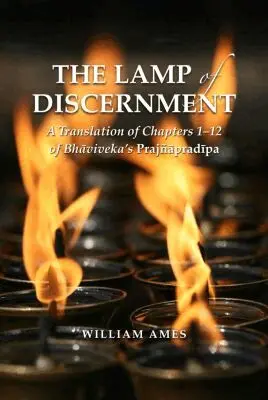
Lamp of Discernment
A Translation of Chapters 1-12 of Bhāvaviveka's Prajñāpradīpa
Inbunden, Engelska, 2019
583 kr
Skickas inom 11-20 vardagar
The Buddhist thinkers of medieval India addressed many of the issues that are still central to Buddhist praxis in the present. One of the most important of those thinkers is Bhāviveka, author of the work known as the Prajñāpradīpa. Over several years, William (Bill) Ames translated, carefully and precisely, the first twelve chapters of that work, which he has compiled and revised for consistency in this volume.The Prajñāpradīpa is a commentary on Nagārjuna’s famous, and in the view of many famously difficult, Mūlamadhyamakārikā—Root Verses on the Middle Way. Central to all Buddhist thought in one form or another is an understanding that the common entities of our experience are transitory and, therefore, unreliable as grounds upon which to base our own happiness, satisfaction, security, and even our own sense of self. As Ames explains in his Introduction, the Madhyamaka pursues this insight further, asserting that all existing entities are lacking in (empty of, śūnyatā) any "intrinsic nature (svabhāva)."As systematized by later Tibetan scholastics, the Madhyamaka school is understood to have developed into two different forms, the Svātantrika and the Prāsaṅgika, a textbook style simplification that has had lasting influence. In this intellectual historiography where movements require specific founders, Bhāviveka is identified as the founder of the Svātantrika.Part of the neo-Romantic rhetoric popular in the second half of the twentieth century was that meditation practice was by itself capable of leading to full awakening, or rather to an unimpeded, direct experience of the true and the real. That view has become increasingly untenable, as meditators have themselves attempted to understand the significance of their own experiences. Those who have turned to the teachings of the Buddhist tradition for that understanding are often confronted by the (only) apparent difficulty of understanding emptiness. Ames’ translation of this key work of the Madhyamaka school can contribute to untangling much of the confusion surrounding these ideas.
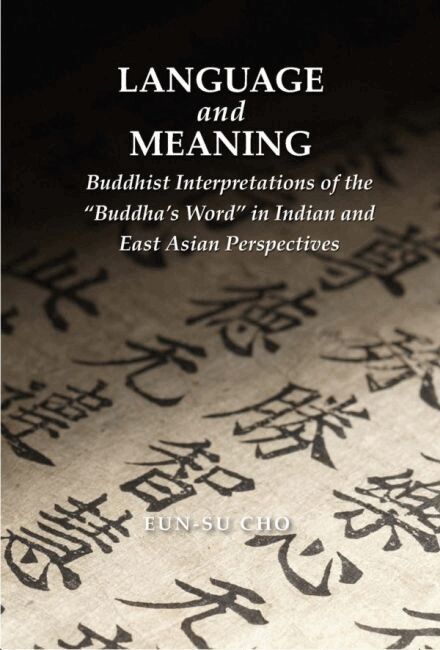
Language and Meaning
Buddhist Interpretations of the "Buddha’s Word" in Indian and East Asian Perspectives
Inbunden, Engelska, 2020
587 kr
Skickas inom 7-10 vardagar
The nature of the Buddha’s speech, buddhavacana, has been discussed by Buddhist thinkers from soon after the Buddha’s lifetime. In modern Buddhist scholarship it seems natural to focus on the textual record of the Buddha’s teachings, but overemphasizing that aspect risks losing sight of the potency of the Buddha’s speech to effect liberation. Comparing Abhidharma and Chinese Buddhist conceptions of the Buddha’s word, Eun-su Cho’s study addresses the transmission and reinterpretation of theories of language and opens a doorway to Buddhist philosophical thought in East Asia. This is particularly important because technical Buddhist philosophical thought in East Asia has long been neglected, and has become overshadowed by academic and popular attention to Tibetan Buddhist philosophical thought. In contrast to the perception of greater legitimacy accorded to Tibetan thought through its association with Indian Buddhism, the doctrinally dense works of East Asian Buddhism have not been the object of equally intense study, yet such works exist and continue to deserve greater attention. Cho’s Language and Meaning offers an important pathway into these discourses.