Cornell Yeats - Böcker
Visar alla böcker i serien Cornell Yeats. Handla med fri frakt och snabb leverans.
10 produkter
10 produkter
1 489 kr
Skickas inom 11-20 vardagar
From reviews of The Cornell Yeats series:"For students of Yeats the whole series is bound to become an essential reference source and a stimulus to important critical re-readings of Yeats's major works. In a wider context, the series will also provide an extraordinary and perhaps unique insight into the creative process of a great artists."—Irish Literary Supplement"I consider the Cornell Yeats one of the most important scholarly projects of our time."—A. Walton Litz, Princeton University, coeditor of The Collected Poems of William Carols Williams and Personae: The Shorter Poems of Ezra Pound"The most ambitious of the many important projects in current studies of Yeats and perhaps of modern poetry generally.... The list of both general and series editors, as well as prospective preparers of individual volumes, reads like a Who's Who of Yeats textual studies in North America. Further, the project carries the blessing of Yeats's heirs and bespeaks an ongoing commitment from a major university press.... The series will inevitably engender critical studies based on a more solid footing than those of any other modern poet.... Its volumes will be consulted long after gyres of currently fashionable theory have run on."—Yeats Annual (1983)Written during a period of illness in 1935–1936, Yeats's play combines frank sexual content with bizarre imagery from the Indian and tribal Irish traditions. This edition provides a full transcription of the only extant manuscript version of the play.
1 889 kr
Skickas inom 7-10 vardagar
Based on a folktale called "The Priest's Soul," which Yeats first encountered in 1888, The Hour-Glass was written as both a play in prose and a drama in verse over the course of more than thirty years. This volume brings together all extant manuscripts of The Hour-Glass, from a handwritten three-page fragment of the 1902 prose version to Yeats's typescripts of the 1922 verse rendition.
1 467 kr
Skickas inom 7-10 vardagar
Words upon the Window Pane, first staged in 1930, is W. B. Yeats's most powerful and brilliant dramatic exploration of the occult, in which he had a lifelong interest, and an affirmation of Anglo-Irish Protestant cultural ascendancy. Written at Lady Gregory's Coole Park estate, it features a séance in which Jonathan Swift's voice is projected through a medium. Like Yeats, Swift was both politician and poet, and taking Swift as his subject allowed Yeats to cloak a political message under personal character.Quite probably based on an obscure one-act play called Swift and Stella by Charles Edward Lawrence, Lady Gregory's editor, the play is centered on a romantic triangle involving Jonathan Swift and two women, Vanessa and Stella. Yeats's use of a séance as a frame permits him to compare the present with the past by putting twentieth-century Dubliners side by side with Swift's contemporaries. This volume of the Cornell Yeats contains transcriptions and photographic reproductions of the drafts of Words upon the Window Pane, with variant readings from proofs, typescripts, and notebook entries, as well as other materials pertaining to its writing, publication, and performance.
1 613 kr
Skickas inom 11-20 vardagar
The Land of Heart's Desire, staged at the Avenue Theatre in London in 1894, marks W. B. Yeats's first use of Irish folklore in a play produced in the commercial theater, with important consequences for his career as a dramatist. This book includes transcriptions and photographs of the surviving holograph manuscripts of the play, reproductions of Yeats's own notes and revisions, and other materials related to stage productions and the resulting changes he made to the text.After Maud Gonne refused his offer of marriage in the summer of 1893, Yeats coped with his disappointment by burying himself in work. He composed a number of poems based on Irish folklore that would not see publication until 1899 and took steps to shape a literary renaissance in Ireland. In many of the pieces he wrote at this time, he developed the idea, sustained and refined throughout his life, that folklore was the foundation of a living mythology.
2 145 kr
Skickas inom 7-10 vardagar
"He has chosen death: Refusing to eat or drink, that he may bring Disgrace upon me; for there is a custom, An old and foolish custom, that if a man Be wronged, or think that he is wronged, and starve Upon another's threshold till he die, The common people, for all time to come, Will raise a heavy cry against that threshold, Even though it be the King's."—from The King's Threshold The King's Threshold was first performed in Dublin by the Irish National Theatre Society in 1903 and first published in New York in 1904. The Cornell Yeats edition of this play about a bard's hunger strike includes the preliminary notes and first prose drafts dictated by Yeats to his patron and collaborator, Lady Gregory, in March and April 1903. As well as providing an outline of the play, these preliminary notes identify contemporary persons on whom some of the characters were based.Other features of this edition of The King's Threshold include Yeats's first blank verse drafts, heavily revised and corrected typescripts and galley proofs, and notes for the changes made between 1904 and 1906. A major revision added a tragic ending to the version published in 1922, and this ending has remained in place ever since. Uniquely, this edition presents all four versions of the play, spanning thirty years of Yeats's efforts to perfect it. Declan Kiely presents the biographical and historical context of the play's genesis and Yeats's revisions, and gives accounts of several productions and revivals of the play. The Introduction also explores the relationship between theatrical production and textual revision.
Collaborative One-Act Plays, 1901–1903 ("Cathleen Ni Houlihan," "the Pot of Broth," "the Country of the Young," "Heads or Harps")
Manuscript Materials
Inbunden, Engelska, 2007
1 330 kr
Skickas inom 7-10 vardagar
From reviews of The Cornell Yeats series:"For students of Yeats the whole series is bound to become an essential reference source and a stimulus to important critical re-readings of Yeats's major works. In a wider context, the series will also provide an extraordinary and perhaps unique insight into the creative process of a great artist."—Irish Literary Supplement"I consider the Cornell Yeats one of the most important scholarly projects of our time."—A. Walton Litz, Princeton University, coeditor of The Collected Poems of William Carols Williams and Personae: The Shorter Poems of Ezra Pound"The most ambitious of the many important projects in current studies of Yeats and perhaps of modern poetry generally.... The list of both general and series editors, as well as prospective preparers of individual volumes, reads like a Who's Who of Yeats textual studies in North America. Further, the project carries the blessing of Yeats's heirs and bespeaks an ongoing commitment from a major university press.... The series will inevitably engender critical studies based on a more solid footing than those of any other modern poet.... Its volumes will be consulted long after gyres of currently fashionable theory have run on."—Yeats Annual (1983)The four short works collected in this book were among the earliest plays to be authored collaboratively by W. B. Yeats and Lady Gregory. Written in the pivotal years during which the "Irish Literary Theatre" experiment of 1899–1901 began to evolve into what would become the Abbey Theatre, they show both writers engaging with questions central to the early Irish dramatic movement: How should "Irishness" be represented on the stage? To what extent should artists engage directly with Nationalist politics? And what role might literature play in the creation of a new Ireland? The manuscripts presented here chart the evolution of two plays published over Yeats's name: "Cathleen ni Houlihan"—the pair's most successful collaboration, and the work that confirmed Yeats's credentials as a Nationalist writer—and the "peasant" farce "The Pot of Broth." This book also includes manuscript material for "The Country of the Young" and "Heads or Harps," which the writers left unpublished and unproduced during their lifetimes.
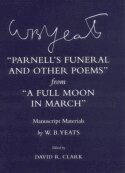
"Parnell's Funeral and Other Poems" from "a Full Moon in March"
Manuscript Materials
Inbunden, Engelska, 2003
1 375 kr
Skickas inom 7-10 vardagar
From reviews of The Cornell Yeats series:"For students of Yeats the whole series is bound to become an essential reference source and a stimulus to important critical re-readings of Yeats's major works. In a wider context, the series will also provide an extraordinary and perhaps unique insight into the creative process of a great artist."—Irish Literary Supplement"I consider the Cornell Yeats one of the most important scholarly projects of our time."—A. Walton Litz, Princeton University, coeditor of The Collected Poems of William Carols Williams and Personae: The Shorter Poems of Ezra Pound"The most ambitious of the many important projects in current studies of Yeats and perhaps of modern poetry generally.... The list of both general and series editors, as well as prospective preparers of individual volumes, reads like a Who's Who of Yeats textual studies in North America. Further, the project carries the blessing of Yeats's heirs and bespeaks an ongoing commitment from a major university press.... The series will inevitably engender critical studies based on a more solid footing than those of any other modern poet.... Its volumes will be consulted long after gyres of currently fashionable theory have run on."—Yeats Annual (1983)The manuscripts transcribed and reproduced in this volume of the Cornell Yeats were written from spring 1933 through December 1934. "Parnell's Funeral and Other Poems" is the third section of W. B. Yeats's book A Full Moon in March (1935), following the two plays "A Full Moon in March" and "The King of the Great Clock Tower." David R. Clark's introduction relates biographical events to what the manuscripts show about the chronological order in which the poems were written. The poems, which illuminate such facets of Yeats's life as the poet's flirtations with fascism and Hinduism and his concern, at age sixty-eight, that his poetic powers were waning, are presented in the order in which they appeared in A Full Moon in March.Of the twenty-one poems here, eighteen are called songs. Only "Parnell's Funeral" itself is un-songlike, a somber and powerful declaration made by a Parnellite. Each poem is accompanied by comments on its content and its manuscripts. Ninety-nine illustrations show Yeats's handwritten drafts, typescripts, and revisions. Because of the poems' exotic references, a long section of the introduction provides relevant material from Yeats's letters and commentary and an independent analysis of each poem. Early in his career Yeats, with his fellow poets in the Rymers' Club, had "taken delight in poetry that was, before all else, speech or song, and could hold the attention of a fitting audience like a good play or a good conversation." Throughout "Parnell's Funeral and Other Poems," Yeats's desire for a direct lyrical urge is evident.
1 863 kr
Skickas inom 11-20 vardagar
From reviews of The Cornell Yeats series:"For students of Yeats the whole series is bound to become an essential reference source and a stimulus to important critical re-readings of Yeats's major works. In a wider context, the series will also provide an extraordinary and perhaps unique insight into the creative process of a great artists."—Irish Literary Supplement"I consider the Cornell Yeats one of the most important scholarly projects of our time."—A. Walton Litz, Princeton University, coeditor of The Collected Poems of William Carols Williams and Personae: The Shorter Poems of Ezra Pound"The most ambitious of the many important projects in current studies of Yeats and perhaps of modern poetry generally.... The list of both general and series editors, as well as prospective preparers of individual volumes, reads like a Who's Who of Yeats textual studies in North America. Further, the project carries the blessing of Yeats's heirs and bespeaks an ongoing commitment from a major university press.... The series will inevitably engender critical studies based on a more solid footing than those of any other modern poet.... Its volumes will be consulted long after gyres of currently fashionable theory have run on."—Yeats Annual (1983)Yeats is a poet as much of fact as of feeling. Every work of his has a source—whether from folklore, legend, mythology, the occult, or history: each a source that for him had a definite objective reality. The demands of this world and of that other world of Yeatsian spiritual reality often conflict. His play The Only Jealousy of Emer, particularly in its early drafts, offers a vivid portrayal of such a struggle. It marks one of the turning points of Yeats's career, because in its final form it is a synthesis of two profound experiences that were to shape his later work: his marriage to Georgie Hyde-Lees in 1917 brought him a certain degree of contentment with the joys of this world, while her automatic script provided a philosophical framework for his poems and plays.Fighting the Waves—a prose version of The Only Jealousy of Emer staged at the Abbey Theatre in 1929 and revived in London in 1930, but never performed again—is an integral part of the history of Yeats's composition and revision of The Only Jealousy of Emer, and its manuscript drafts are therefore shown in this volume as part of the direct sequence of the composition of The Only Jealousy of Emer, even though Yeats himself ultimately considered Fighting the Waves a lesser work.
2 923 kr
Skickas inom 11-20 vardagar
George Moore involved W. B. Yeats personally in the revision of a novel of Moore's that contained a character based on Yeats; this involvement led to the pair's collaboration in writing a play based on Diarmuid and Grania, one of the best-known tragic tales of Celtic mythology. At the late stages of composition, the authors decided to add songs, and Edward Elgar provided the music. The play opened at the Gaiety Theatre in Dublin on October 21, 1901.Although the collaboration had been difficult—Yeats and Moore disagreed frequently, mainly about style—the production was well received. Controversy arose, however, because English actors played these most Irish of characters. After the play was produced, Yeats, whose commitment had occasionally seemed to waver, defended it against all criticism. The manuscript materials included in the Cornell Yeats edition of Diarmuid and Grania provide a full record of the disputes and revisions that culminated in the final draft. In his Introduction, J. C. C. Mays writes, "If one looks beyond words or passages that can be tagged with an author's name and a specific date, one can see signatures of each author no less clearly than such tags afford and perhaps see each writer more pervasively inhabiting the characters and situations of the play."
2 130 kr
Skickas inom 11-20 vardagar
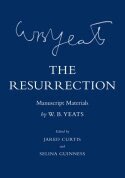
The Resurrection was first performed at the Abbey Theatre on 30 July 1934. Yeats had sketched the play's first scenarios in 1925, and worked on it intermittently for the next nine years. For the author, the work was a kind of study piece for communicating to a general audience his investigations into patterns of historical recurrence. In The Resurrection Yeats asks how the avatar of a new era can be dramatized as a true anomaly, capable of revitalizing a declining civilization through the power of magic or miracle. The play takes the form of a series of questions and answers between three interlocutors (the Greek, the Hebrew, and the Syrian) as they confront the miracle of the risen Christ. As the play ends, Yeats emphasizes the political implications of miracle, which has the sublime and terrifying power to undo the existing but exhausted order and usher in a new epoch. The Cornell Yeats edition presents photographs and transcriptions of the manuscripts, typescripts, and proof pages by which we may trace the author's textual revisions for The Resurrection, leading to its publication in 1932 in Stories of Michael Robartes and His Friends and two years later in Wheels and Butterflies and Collected Plays. The drafts of the Introduction to the play are presented, as well. An Appendix presents images of Arthur Duff's score for the songs of The Resurrection. Jared Curtis and Selina Guinness preface the text with a census of manuscripts and an introduction discussing the content of the play and the long history of its composition, including the First Version (1925/6–1927), the Second Version (1929–1934), and the Introduction (1931–1934). The arduous process of revision through which the author humanized his characters and dramatized the dry theological arguments of the early drafts is revealed with remarkable clarity.