Design Thinking, Design Theory - Böcker
Visar alla böcker i serien Design Thinking, Design Theory. Handla med fri frakt och snabb leverans.
18 produkter
18 produkter
255 kr
Tillfälligt slut
379 kr
Tillfälligt slut
Design, When Everybody Designs
An Introduction to Design for Social Innovation
Inbunden, Engelska, 2015
255 kr
Tillfälligt slut
The role of design, both expert and nonexpert, in the ongoing wave of social innovation toward sustainability.In a changing world everyone designs: each individual person and each collective subject, from enterprises to institutions, from communities to cities and regions, must define and enhance a life project. Sometimes these projects generate unprecedented solutions; sometimes they converge on common goals and realize larger transformations. As Ezio Manzini describes in this book, we are witnessing a wave of social innovations as these changes unfold—an expansive open co-design process in which new solutions are suggested and new meanings are created. Manzini distinguishes between diffuse design (performed by everybody) and expert design (performed by those who have been trained as designers) and describes how they interact. He maps what design experts can do to trigger and support meaningful social changes, focusing on emerging forms of collaboration. These range from community-supported agriculture in China to digital platforms for medical care in Canada; from interactive storytelling in India to collaborative housing in Milan. These cases illustrate how expert designers can support these collaborations—making their existence more probable, their practice easier, their diffusion and their convergence in larger projects more effective. Manzini draws the first comprehensive picture of design for social innovation: the most dynamic field of action for both expert and nonexpert designers in the coming decades.
317 kr
Tillfälligt slut
327 kr
Skickas
A more powerful innovation, which seeks to discover not how things work but why we need things.The standard text on innovation advises would-be innovators to conduct creative brainstorming sessions and seek input from outsiders—users or communities. This kind of innovating can be effective at improving products but not at capturing bigger opportunities in the marketplace. In this book Roberto Verganti offers a new approach—one that does not set out to solve existing problems but to find breakthrough meaningful experiences. There is no brainstorming—which produces too many ideas, unfiltered—but a vision, subject to criticism. It does not come from outsiders but from one person's unique interpretation.The alternate path to innovation mapped by Verganti aims to discover not how things work but why we need things. It gives customers something more meaningful—something they can love. Verganti describes the work of companies, including Nest Labs, Apple, Yankee Candle, and Philips Healthcare, that have created successful businesses by doing just this. Nest Labs, for example, didn't create a more advanced programmable thermostat, because people don't love to program their home appliances. Nest's thermostat learns the habits of the household and bases its temperature settings accordingly.Verganti discusses principles and practices, methods and implementation. The process begins with a vision and proceeds through developmental criticism, first from a sparring partner and then from a circle of radical thinkers, then from external experts and interpreters, and only then from users.Innovation driven by meaning is the way to create value in our current world, where ideas are abundant but novel visions are rare. If something is meaningful for both the people who create it and the people who consume it, business value follows.
441 kr
Tillfälligt slut
398 kr
Tillfälligt slut
328 kr
Tillfälligt slut
Being and the Screen
How the Digital Changes Perception. Published in one volume with <i>A Short Treatise on Design</i>
Inbunden, Engelska, 2019
286 kr
Tillfälligt slut
243 kr
Skickas
255 kr
Tillfälligt slut
How organizations can use practices developed by expert designers to solve today's open, complex, dynamic, and networked problems. When organizations apply old methods of problem-solving to new kinds of problems, they may accomplish only temporary fixes or some ineffectual tinkering around the edges. Today's problems are a new breed—open, complex, dynamic, and networked—and require a radically different response. In this book, Kees Dorst describes a new, innovation-centered approach to problem-solving in organizations: frame creation. It applies “design thinking,” but it goes beyond the borrowed tricks and techniques that usually characterize that term. Frame creation focuses not on the generation of solutions but on the ability to create new approaches to the problem situation itself.The strategies Dorst presents are drawn from the unique, sophisticated, multilayered practices of top designers, and from insights that have emerged from fifty years of design research. Dorst describes the nine steps of the frame creation process and illustrates their application to real-world problems with a series of varied case studies. He maps innovative solutions that include rethinking a store layout so retail spaces encourage purchasing rather than stealing, applying the frame of a music festival to understand late-night problems of crime and congestion in a club district, and creative ways to attract young employees to a temporary staffing agency. Dorst provides tools and methods for implementing frame creation, offering not so much a how-to manual as a do-it-yourself handbook—a guide that will help practitioners develop their own approaches to problem-solving and creating innovation.
410 kr
Skickas
722 kr
Skickas inom 5-8 vardagar
483 kr
Skickas
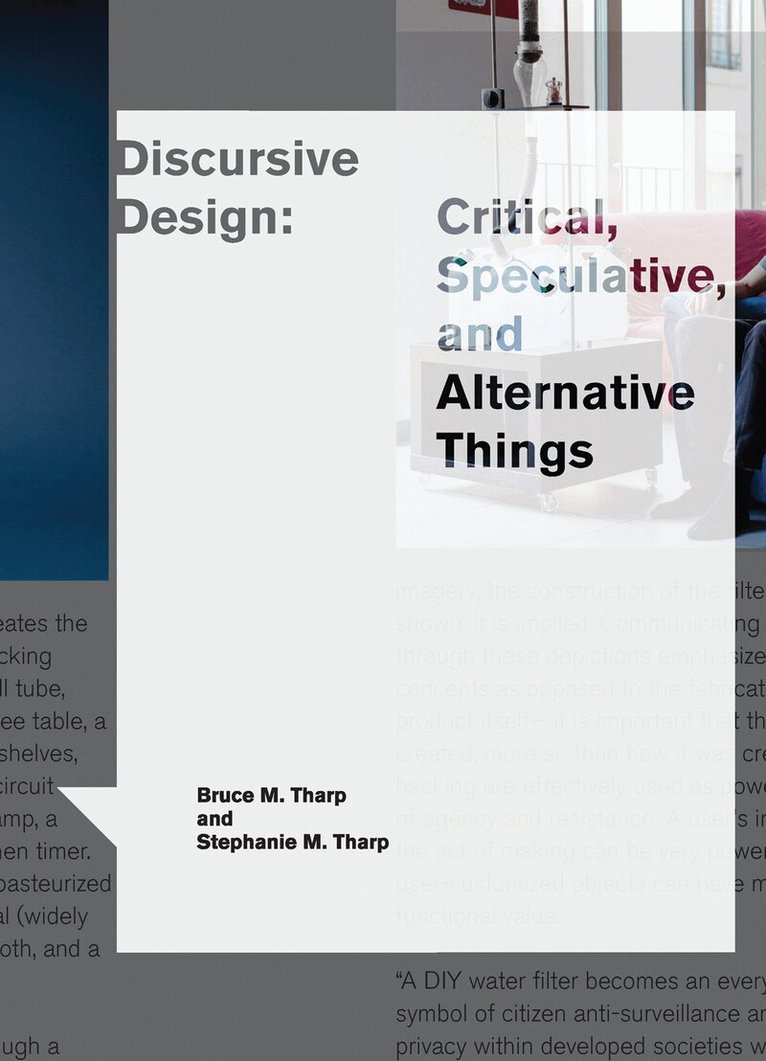
Exploring how design can be used for good—prompting self-reflection, igniting the imagination, and affecting positive social change.Good design provides solutions to problems. It improves our buildings, medical equipment, clothing, and kitchen utensils, among other objects. But what if design could also improve societal problems by prompting positive ideological change? In this book, Bruce and Stephanie Tharp survey recent critical design practices and propose a new, more inclusive field of socially minded practice: discursive design. While many consider good design to be unobtrusive, intuitive, invisible, and undemanding intellectually, discursive design instead targets the intellect, prompting self-reflection and igniting the imagination. Discursive design (derived from “discourse”) expands the boundaries of how we can use design—how objects are, in effect, good(s) for thinking.Discursive Design invites us to see objects in a new light, to understand more than their basic form and utility. Beyond the different foci of critical design, speculative design, design fiction, interrogative design, and adversarial design, Bruce and Stephanie Tharp establish a more comprehensive, unifying vision as well as innovative methods. They not only offer social criticism but also explore how objects can, for example, be used by counselors in therapy sessions, by town councils to facilitate a pre-vote discussions, by activists seeking engagement, and by institutions and industry to better understand the values, beliefs, and attitudes of those whom they serve. Discursive design sparks new ways of thinking, and it is only through new thinking that our sociocultural futures can change.
419 kr
Skickas inom 5-8 vardagar
Taking [A]part
The Politics and Aesthetics of Participation in Experience-Centered Design
Häftad, Engelska, 2024
587 kr
Skickas inom 5-8 vardagar
730 kr
Skickas inom 5-8 vardagar
250 kr
Skickas
The role of design, both expert and nonexpert, in the ongoing wave of social innovation toward sustainability. In a changing world everyone designs: each individual person and each collective subject, from enterprises to institutions, from communities to cities and regions, must define and enhance a life project. Sometimes these projects generate unprecedented solutions; sometimes they converge on common goals and realize larger transformations. As Ezio Manzini describes in this book, we are witnessing a wave of social innovations as these changes unfold an expansive open co-design process in which new solutions are suggested and new meanings are created. Manzini distinguishes between diffuse design (performed by everybody) and expert design (performed by those who have been trained as designers) and describes how they interact. He maps what design experts can do to trigger and support meaningful social changes, focusing on emerging forms of collaboration. These range from community-supported agriculture in China to digital platforms for medical care in Canada; from interactive storytelling in India to collaborative housing in Milan. These cases illustrate how expert designers can support these collaborations making their existence more probable, their practice easier, their diffusion and their convergence in larger projects more effective. Manzini draws the first comprehensive picture of design for social innovation: the most dynamic field of action for both expert and nonexpert designers in the coming decades.