Early Modern Literary Geographies - Böcker
Visar alla böcker i serien Early Modern Literary Geographies. Handla med fri frakt och snabb leverans.
14 produkter
14 produkter
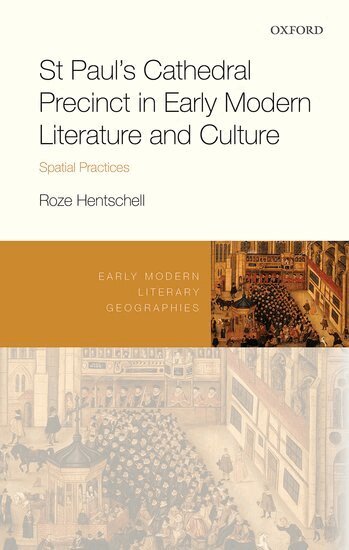
St Paul's Cathedral Precinct in Early Modern Literature and Culture
Spatial Practices
Inbunden, Engelska, 2020
1 286 kr
Skickas inom 7-10 vardagar
Prior to the 1666 fire of London, St Paul's Cathedral was an important central site for religious, commercial, and social life in London. The literature of the period - both fictional and historical - reveals a great interest in the space, and show it to be complex and contested, with multiple functions and uses beyond its status as a church. St Paul's Cathedral Precinct in Early Modern Literature and Culture: Spatial Practices animates the cathedral space by focusing on the every day functions of the building, deepening and sometimes complicating previous works on St Paul's.St Paul's Cathedral Precinct in Early Modern Literature and Culture is a study of London's cathedral, its immediate surroundings, and its everyday users in early modern literary and historical documents and images, with special emphasis on the late sixteenth and early seventeenth centuries. It discusses representations of several of the seemingly discrete spaces of the precinct to reveal how these spaces overlap with and inform one another spatially, and argues that specific locations should be seen as mutually constitutive and in a dynamic and ever-evolving state. The varied uses of the precinct, including the embodied spatial practices of early modern Londoners and visitors, are examined, including the walkers in the nave, sermon-goers, those who shopped for books, the residents of the precinct, the choristers, and those who were devoted to church repairs and renovations.
1 839 kr
Skickas inom 7-10 vardagar
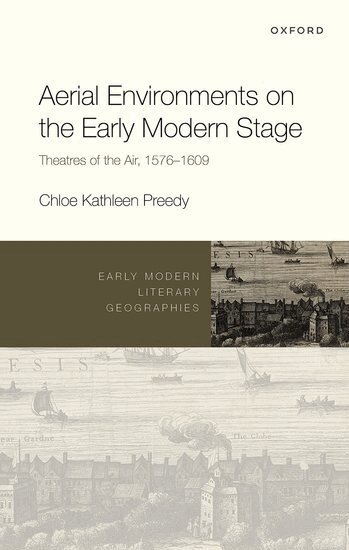
During the early days of the professional English theatre, dramatists including Dekker, Greene, Heywood, Jonson, Marlowe, Middleton, and Shakespeare wrote for playhouses that, though enclosed by surrounding walls, remained open to the ambient air and the sky above. The drama written for performance at these open-air venues drew attention to and reflected on its own relationship to the space of the air. At a time when theories of the imagination emphasized dramatic performance's reliance upon and implication in the air from and through which its staged fictions were presented and received, plays written for performance at open-air venues frequently draw attention to the nature and significance of that elemental relationship. Aerial Environments on the Early Modern Stage considers the various ways in which the air is brought into presence within early modern drama, analyzing more than a hundred works that were performed at the London open-air playhouses between 1576 and 1609, with reference to theatrical atmospheres and aerial encounters. It explores how various theatrical effects and staging strategies foregrounded early modern drama's relationship to, and impact on, the actual playhouse air. In considering open-air drama's pervasive and ongoing attention to aerial imagery, actions, and representational strategies, the book suggest that playwrights and their companies developed a dramaturgical awareness that extended from the earth to encompass and make explicit the space of air.
1 442 kr
Skickas inom 5-8 vardagar
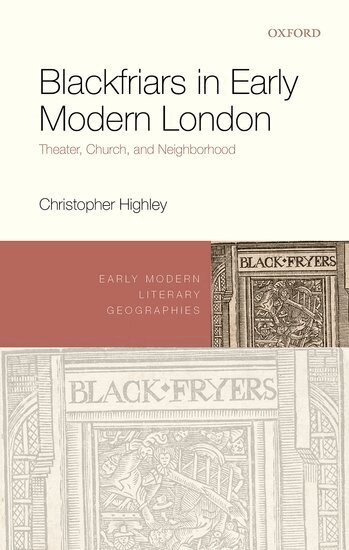
Blackfriars: Theater, Church, and Neighborhood in Early Modern London is a cultural history of an urban enclave best known in the later sixteenth and seventeenth centuries for the incongruous juxtaposition of playing and godly preaching. As the former site of one of London's great religious houses, the post-Reformation Blackfriars was a Liberty free from mayoral control. The legal exemptions and privileges enjoyed by its residents helped attract an unusual mix of groups and activities. Zealous preachers and puritan parishioners mingled with playhouse workers and playgoers, as well as with the immigrant 'strangers' who settled here. The book focuses on local playhouse-church relations and asks how a theatrical culture was able to flourish in a parish dominated by committed puritans. Physically, the church of St Anne's and the playhouse were virtually next-door, but ideologically they seemed poles apart. Yet despite the occasional efforts of some residents to close the playhouse, godly religion and commercial playing managed to coexist. In explanation, the book examines the conflicting economic and ideological priorities of residents and the overriding desire to promote order and neighborliness. More provocatively, I argue that the Blackfriars pulpit and stage could be mutually reinforcing sites of performance. Preachers as well as playwrights exploited the Liberty's vexed relations with authority to air satirical and dissident views of the established church and state. By examining Blackfriars sermons and plays side-by-side, the book reveals a synergy between two institutions usually considered implacable enemies.
1 504 kr
Skickas inom 7-10 vardagar
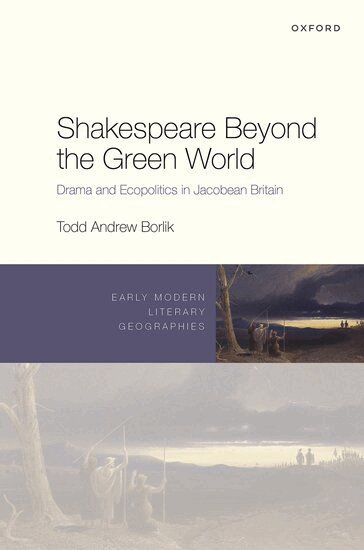
Unpicking the ecopolitics of Shakespeare's plays at the Stuart court, Shakespeare Beyond the Green World establishes that the playwright was remarkably attentive to the environmental issues of his era. As a court dramatist, he designed his plays to captivate a patron deeply involved in both the conservation and exploitation of a burgeoning empire's natural resources. Spurred by James' campaign to unify his kingdoms, the Jacobean Shakespeare ventures beyond the green and pleasant lowlands of England to chart the wild topographies of an expansionist Great Britain: the blasted heath in Macbeth, the caves and mines of Timon of Athens, the overfished North Sea in Pericles, the Welsh mountains in Cymbeline, the Arctic fur country in The Winter's Tale, the fens in The Tempest, overcrowded London and empty Ulster in Measure for Measure and Coriolanus, and the night in Antony and Cleopatra and King Lear. While these plays often simulate a monarch's-eye-view of the natural world, they also reveal that Crown policies were fiercely contested from below. In addition to trekking beyond verdant landscapes, Shakespeare Beyond the Green World seeks to mitigate the Anglocentric and anthropocentric bias of the archive by putting the plays into conversation with texts in which the subaltern wild growls back. Combining deep dives into environmental history with close readings of Shakespearean wordplay, original typography, and original performance conditions, this study re-wilds the Renaissance stage. It spotlights Shakespeare's tendency to humanize beasts and bestialize allegedly godlike monarchs, debunking fantasies of human exceptionalism. By clarifying how the Jacobean plays expose monarchical dominion as ecological tyranny, this study remains scrupulously historicist while reasserting Shakespearean drama's scorching relevance in the Anthropocene.
1 723 kr
Skickas inom 7-10 vardagar
The Absence of America: the London Stage 1576â1642 examines why early modern drama's response to English settlement in the New World was muted, even though the so-called golden age of Shakespeare coincided with the so-called golden age of exploration: no play is set in the Americas; few plays treat colonization as central to the plot; a handful features Native American characters (most of whom are Europeans in disguise). However, advocates of colonialism in the seventeenth century denounced playing companies as enemies on a par with the Pope and the Devil. Instead of writing off these accusers as paranoid cranks, this book takes as its starting point the possibility that they were astute playgoers. By so doing we can begin to see the emergence of a "picture of America," and of the Virginia colony in particular, across a number of plays performed for London audiences: Jonson's Bartholomew Fair, The Staple of News, and his collaboration with Marston and Chapman, Eastward Ho!; Robert Greene's Orlando Furioso; Massinger's The City Madam; Massinger and Fletcher's The Sea Voyage; Middleton and Dekker's The Roaring Girl; Shakespeare's The Tempest, and Fletcher and Shakespeare's Henry VIII. We can glean the significance of this picture, not only for the troubled Virginia Company, but also for London theater audiences. And we can see that the picture that was beginning to form was, as the anti-theatricalists surmised, often slanderous, condemnatory, and, as it were, anti-American.
Dramatic Geography
Romance, Intertheatricality, and Cultural Encounter in Early Modern Mediterranean Drama
Inbunden, Engelska, 2017
1 320 kr
Skickas inom 5-8 vardagar
Focusing on early modern plays which stage encounters between peoples of different cultures, this book asks how a sense of geographical location was created in early modern theatres that featured minimal scenery. While previous studies have stressed these plays' connections to a historical Mediterranean in which England was increasingly involved, this volume demonstrates how their dramatic geography was shaped through a literary and theatrical heritage. Reading canonical plays including The Merchant of Venice, The Jew of Malta, and The Tempest alongside lesser-known dramas such as Soliman and Perseda, Guy of Warwick, and The Travels of the Three English Brothers, Dramatic Geography illustrates how early modern dramatists staging foreign worlds drew upon a romance tradition dating back to the medieval period, and how they responded to one another's plays to create an 'intertheatrical geography'. These strategies shape the plays' wider meanings in important ways, and could only have operated within the theatrical environment peculiar to early modern London: one in which playwrights worked in close proximity, in one instance perhaps even living together while composing Mediterranean dramas, and one where they could expect audiences to respond to subtle generic and intertextual negotiations. In reassessing this group of plays, Laurence Publicover brings into conversation scholarship on theatre history, cultural encounter, and literary geography; the book also contributes to current debates in early modern studies regarding the nature of dramatic authorship, the relationship between genre and history, and the continuities that run between the fourteenth and seventeenth centuries.
1 929 kr
Skickas inom 3-6 vardagar
The Cartographic Revolution in the Renaissance made maps newly precise, newly affordable, and newly ubiquitous. In sixteenth-century Britain, cartographic materials went from rarity to household décor within a single lifetime, and they delighted, inspired, and fascinated people across the socioeconomic spectrum. At the same time, they also unsettled, upset, disturbed, and sometimes angered their early modern readers. Early Modern English Literature and the Poetics of Cartographic Anxiety is the first monograph dedicated to recovering the shadow history of the many anxieties provoked by early modern maps and mapping in the sixteenth and seventeenth centuries. A product of a military arms race, often deployed for security and surveillance purposes, and fundamentally distortive of their subjects, maps provoked suspicion, unease, and even hostility in early modern Britain (in ways not dissimilar from the anxieties provoked by global positioning-enabled digital mapping in the twenty-first century). At the same time, writers saw in the resistance to cartographic logics and strategies the opportunity to rethink the way literature represents space—and everything else. This volume explores three major poems of the period—Edmund Spenser's The Faerie Queene (1590, 1596), Michael Drayton's Poly-Olbion (1612, 1622), and John Milton's Paradise Lost (1667, 1674)—in terms of their vexed and vexing relationships with cartographic materials, and shows how the productive protest staged by these texts redefined concepts of allegory, description, personification, bibliographic materiality, narrative, temporality, analogy, and other elemental components of literary representations.
1 881 kr
Skickas inom 5-8 vardagar
Katarzyna Lecky explores how early modern British poets paid by the state adapted inclusive modes of nationhood charted by inexpensive, small-format maps. She explores chapbooks ('cheapbooks') by Edmund Spenser, Samuel Daniel, Ben Jonson, William Davenant, and John Milton alongside the portable cartography circulating in the same retail print industry. Domestic pocket maps were designed for heavy use by a broad readership that included those on the fringes of literacy. The era's de facto laureates all banked their success as writers appealing to this burgeoning market share by drawing the nation as the property of the commonwealth rather than the Crown.This book investigates the accessible world of small-format cartography as it emerges in the texts of the poets raised in the expansive public sphere in which pocket maps flourished. It works at the intersections of space, place, and national identity to reveal the geographical imaginary shaping the flourishing business of cheap print. Its placement of poetic economies within mainstream systems of trade also demonstrates how cartography and poetry worked together to mobilize average consumers as political agents. This everyday form of geographic poiesis was also a strong platform for poets writing for monarchs and magistrates when their visions of the nation ran counter to the interests of the government.
1 420 kr
Skickas inom 5-8 vardagar
Thinking Through Place on the Early Modern English Stage argues that environment and embodied thought continually shaped one another in the performance of early modern English drama. It demonstrates this, first, by establishing how characters think through their surroundings — not only how they orient themselves within unfamiliar or otherwise strange locations, but also how their environs function as the scaffolding for perception, memory, and other forms of embodied thought. It then contends that these moments of thinking through place theorise and thematise the work that playgoers undertook in reimagining the stage as the setting of the dramatic fiction. By tracing the relationship between these two registers of thought in such plays as The Malcontent, Dido Queen of Carthage, Tamburlaine, King Lear, The Knight of the Burning Pestle, and Bartholomew Fair, this book shows that drama makes visible the often invisible means by which embodied subjects acquire a sense of their surroundings. It also reveals how, in doing so, theatre altered the way that playgoers perceived, experienced, and imagined place in early modern England.
1 442 kr
Skickas inom 5-8 vardagar
Geographies of Embodiment in Early Modern England gathers essays from prominent scholars of English Renaissance literature and history who have made substantial contributions to the study of early modern embodiment, historical phenomenology, affect, cognition, memory, and natural philosophy. It provides new interpretations of the geographic dimensions of early modern embodiment, emphasizing the transactional and dynamic aspects of the relationship between body and world. The geographies of embodiment encompass both cognitive processes and cosmic environments, and inner emotional states as well as affective landscapes. Rather than always being territorialized onto individual bodies, ideas about early modern embodiment are varied both in their scope and in terms of their representation. Reflecting this variety, this volume offers up a range of inquiries into how early modern writers accounted for the exchanges between the microcosm and macrocosm. It engages with Gail Kern Paster's groundbreaking scholarship on embodiment, humoralism, the passions, and historical phenomenology throughout, and offers new readings of Edmund Spenser, William Shakespeare, Thomas Nashe, John Milton, and others. Contributions consider the epistemiologies of navigation and cartography, the significance of geohumoralism, the ethics of self-mastery, theories of early modern cosmology, the construction of place memory, and perceptions of an animate spirit world.
1 380 kr
Skickas inom 5-8 vardagar
Placing Elysium in Renaissance Britain: Poetry, Politics, Theology, Eros is the first study of Elysium as a place in English Renaissance culture. The absence of such a study in the fields of literature and geography is surprising: from its captivating origin in the oceanic margins of Homer's Odyssey to its presence in the Eden of Milton's Paradise Lost, Elysium is a destination to be desired: it is the land of the blessed. As such, Elysium becomes a geographical site for an author's most valued space. In Britannia, Camden provides leadership for this project by citing Plutarch as locating the blessed place in Britain. Following Camden, Spenser centralizes the idea of Britain as Elysium. Subsequently, English authors make the Elysian place the site of a liberating sublimity as the height of artistic renown. This authorial template becomes the site for literary inflections in the realms of politics, theology, and eros. However, Kyd and Marlowe darken the Spenserian project, recalling Virgil's geographical positioning of Elysium next to Hell. In turn, Drayton, Chapman, and Marston champion the Spenserian idea of Britain as Elysium. As this conversation suggests, English authors make Elysium the central place of the 'Renaissance' period concept, and they do so in the nation-building genre of epic. In The Muses Elizium, Drayton crowns the Spenserian tradition by making the blessed place the monomyth of national poetry. At the centre of the monomyth is the cherished ideal of Renaissance culture: the Elysian capacity of the human to become divine.
1 613 kr
Skickas inom 5-8 vardagar
The Lithic Imagination from More to Milton explores how stones, rocks, and the broadermineral realm play a vital role in early modern England's religious and cultural systems, a role that, in turn, informs the period's poetic and visual imagination. The scale of the human lifespan and the gyre-like turns of England's long Reformation provide a conceptual framework for the various stony textual and visual archives this book studies. The texts and images participate in specifically English histories (literary, artistic, political, religious) although Continental influences are frequently in dialogue. The religious orbit encompasses the Christian rivalry with Jewish culture, touches on Christianity's tension with Islam, but most intently centers on the antagonism between Catholic and variants of Protestant and Reformed belief.The volume features canonical writers such as Shakespeare, Spenser, Donne, Wroth, Herbert, Milton and Pulter, but puts them in company with lesser-known religious polemicists, alchemists, anatomists, painters, mothers and stonemasons. Accordingly, the multimedia archive includes drama, lyric and prose as well as biblical illustrations, tapestries, church furniture, paintings, anatomical drawings and statues. The lithic too is capaciously construed as a continuum of rocky as well as mineral forms ranging from bodily encrustations like the kidney and bezoar stone, to salt, iron, limestone, marble, flint and silicon. The assemblage of materials bears witness to aspirational imperial fantasies and looming colonial conquests; it engages in both syncretism and supersession; upholds and subverts gender hierarchies; limns the race-making category of hue with desire; and supports, and sometimes thwarts, elitist ideologies of an elect, chosen people. All come together via the storied pathways of stone as densely material and as a foundation for the abstract imaginary along the scala naturae. Across the lithic-human fold, stone promises, fascinates, betrays. As alpha and omega, stone can herald salvation or it can threaten with damnation.
Colonial Failure and Theatrical Form in Early Modern England
Stages of Unsettlement
Inbunden, Engelska, 2025
1 208 kr
Skickas inom 5-8 vardagar
Colonial Failure and Theatrical Form in Early Modern England shows how early modern English dramatists preserved and instrumentalized the early history of England's failed conquests of the Americas in the formal techniques they used to stage fictional worlds. Scholars have long noted that early English drama was interested in representing colonial ventures, largely emphasizing references, themes, or settings as evidence for this engagement. Through an analysis of the technical features of early English commercial drama, this book establishes that popular Renaissance dramatists such as William Shakespeare, Christopher Marlowe, Ben Jonson, and Thomas Middleton were also sourcing new theatrical tools from contemporary records of colonial failure, recognizing in them a set of techniques for representing geographic disorientation, strandedness, and confusion. During a time when theater's foundational technologies - prop, person, line, and scene - were themselves undergoing a formal transformation, dramatists turned to the narrative and spatial incoherence of these settler accounts, their uncoupling of the link between representation (what is shown) and presentation (how it is shown), as a resource for highlighting the interpretive challenges these changing conventions posed. By demonstrating that popular drama's development was deeply imprinted by the history and textual legacy of England's colonial conquests, not only as setting or theme but as form, this book radically expands the archive of plays that we could call “New World dramas,” allowing plays that don't appear to be “about” colonialism to be understood as borrowing from the rhetorical or narrative structure of colonial texts. Stages of Unsettlement proves that the expansion of the English stage into new settings cannot be understood apart from the colonial strategies for representing place that informed these representations.
1 263 kr
Kommande
Sacred Space and Gender in Early Modern English Literature examines the poetics of locality and spirituality in narrative poetry and drama (specifically comedy) by focusing on Books 1 and 2 of Edmund Spenser's Faerie Queene, Christopher Marlowe's Hero and Leander, William Shakespeare's As You Like It, and the anonymous city comedy The Family of Love. These disparate works are connected by their storytelling, an essential ingredient in the fashioning of spatial perceptions, according to Michel de Certeau. They respond, albeit in different registers, to English clergymen's theories of sacred space that emphasize men's kinetic energy (expended in the search of redemption) and women's emplacement in the godly home (where they provide comfort for peregrinating men). Narrative poetry, aimed at a primarily male audience, celebrates men's salvational mobility while depicting women as static support for peripatetic men. The genre thus cleaves closely to the model advanced by English ministers. By contrast, comedy, a capacious dramatic form capable of providing incongruent perspectives (not least of all because the commercial theatre depended on diverse, paying audiences), departs from the spatial ideals proscribed in theological treatises and offers tales of mobile women whose spiritual and domestic power moves outside the gendered paradigms promoted by England's notable clerics. Despite their conformity with theological premises, Spenser and Marlowe's poems exhibit some formal and ideological differences. The Faerie Queene, a vast epic romance, fully endorses the spatial binary advanced by England's clergy. The speaker of Marlowe's short erotic poem, however, offers sceptical commentary on reformed spatial ideals but ultimately does not challenge them. The plays under discussion work against narrative poetry's gendered duality of masculine movement and feminine stasis. Despite some significant formal differences between them, Shakespeare's As You Like It (a canonical romantic comedy that is aristocratic in focus) and the anonymous Family of Love (a rather obscure city comedy concerned with the 'middling sort') boldly contest theologians' perspectives on sacred space. Instead, they confirm a woman's right to mobility and authority in spatial consecration.