Eric Voegelin Institute Series in Political Philosophy – serie
Visar alla böcker i serien Eric Voegelin Institute Series in Political Philosophy. Handla med fri frakt och snabb leverans.
6 produkter
6 produkter
870 kr
Tillfälligt slut
For much of his career, British political philosopher Michael Oakeshott was identified with Margaret Thatcher's conservative policies. He has been called by some a guru to the Tories, while others have considered him one of the last proponents of British Idealism. Best known for such books as ""Experience and Its Modes"" and ""Rationalism in Politics"", Oakeshott has been the subject of numerous studies, but always with an emphasis on his political thought. Elizabeth Campbell Corey now makes the case that Oakeshott's moral and political philosophies are more informed by religious and aesthetic considerations than has previously been supposed. Hers is the first book-length study of this premise, arguing that Oakeshott's views on aesthetics, religion, and morality are intimately linked in a creative moral personality that underlies his political theorizing. Corey focuses on a wealth of early material from Oakeshott's career that has only recently been published, as well as his acclaimed ""Tower of Babel"" essays, to show that these works illuminate his thinking in ways that could not have been realized prior to their publication. She places Oakeshott squarely in the Augustinian tradition, citing his 1929 essay ""Religion and the World,"" and then identifies his departure from it. She explores Oakeshott's recurring theme of ""living one's life in the present""; examines his explicit discussions of religion, aesthetics, and morality; and then considers his political thought in light of this moral vision. She finally compares his idea of Rationalism to Eric Voegelin's concept of Gnosticism and considers both thinkers' treatment of Hobbes to delineate their philosophical differences. Through this insightful analysis, Corey shows Oakeshott to be not merely a political philosopher but a thinker with humanistic interests - one who throughout his life was deeply interested in the question of what it means to be human and was moved by art, poetry, and religion while recognizing the necessary evil of political arrangements in order for those activities to flourish. Her work is a major step in a reevaluation of Oakeshott, showing that his conservatism has been greatly misunderstood and that he is more properly regarded as a philosopher whose vision of the human condition, while oftentimes detached and skeptical, is also romantic and inspired.
469 kr
Skickas inom 7-10 vardagar
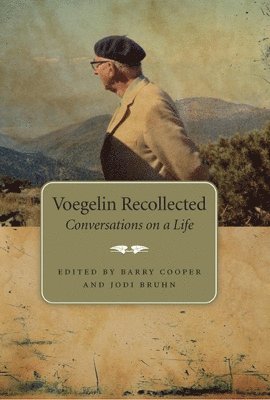
Although his contributions to philosophy are revered and his writings have been collected, Eric Voegelin's persona will inevitably fade with the memories of those who knew him. This book preserves the human element of Voegelin by capturing those valuable personal recollections. Barry Cooper and Jodi Bruhn conducted intensive interviews with Voegelin's wife, his closest friends, and his first-generation students - many of whom have since passed on - in order to bring to print everything important about his life and personality. American scholars will especially appreciate the glimpses provided by Voegelin's German colleagues into his life in Munich, as well as the thoughts of his students in Vienna. Reflections of people such as Paul Caringella, Bruno Schlesinger, and Heinz Barazon capture Voegelin's greatness and shortcomings alike and also shed new light on his philosophical quest for truth. By descending progressively further into the past, the book takes readers deeper into the essence of Voegelin as reminiscences become more dramatic. Ranging widely from America back to Germany - with recollections of Gestapo intimidation and eventual emigration - episodes of pathos, humor, fear, rivalry, and ambition are interwoven throughout the accounts. We witness Voegelin's persistent and partly self-imposed communication problems and impatience with administrative duties, his respect for prudent political actors and public servants, and his genuine affection not only for his colleagues and best students but also for diligent secretaries and empathetic nurses. Through these recollections, key elements of his personality repeatedly emerge: his intelligence, optimism, and integrity, combined with an acute perception of the significance of his work. This is the most revealing and comprehensive biographical work yet available on a man known to be captivating as a thinker - and now shown to be equally fascinating as a human being. His own publications attest to his mind and methods; ""Voegelin Recollected"" provides a deeper understanding of the man himself.
260 kr
Skickas inom 7-10 vardagar
As reports of genocide, terrorism, and political violence fill today's newscasts, more attention has been given to issues of human rights - but all too often the sound bytes seem overly simplistic. Many Westerners presume that non-Western peoples yearn for democratic rights, while liberal values of toleration give way to xenophobia.This book shows that the identification of rights with contemporary liberal democracy is inaccurate and questions the assumptions of many politicians and scholars that rights are self-evident in all circumstances and will overcome any conflicts of thought or interest. ""Rethinking Rights"" offers a radical reconsideration of the origins, nature, and role of rights in public life, interweaving perspectives of leading scholars in history, political science, philosophy, and law to emphasize rights as a natural outgrowth of a social understanding of human nature and dignity.The authors argue that every person comes to consciousness in a historical and cultural milieu that must be taken into account in understanding human rights, and they describe the omnipresence of concrete, practical rights in their historical, political, and philosophical contexts. By rooting our understanding of rights in both history and the order of existence, they show that it is possible to understand rights as essential to our lives as social beings but also open to refinement within communities.An initial group of essays retraces the origins and historical development of rights in the West, assessing the influence of such thinkers as Locke, Burke, and the authors of the ""Declaration of Independence"" to clarify the experience of rights within the Western tradition. A second group addresses the need to rethink our understanding of the nature of existence if we are to understand rights and their place in any decent life, examining the ontological basis of rights, the influence of custom on rights, the social nature of the human person, and the importance of institutional rights.Steering a middle course between radical individualist and extreme egalitarian views, ""Rethinking Rights"" proposes a new philosophy of rights appropriate to today's world, showing that rights need to be rethought in a manner that brings them back into accord with human nature and experience so that they may again truly serve the human good. By engaging both the history of rights in the West and the multicultural challenge of rights in an international context, ""Rethinking Rights"" offers a provocative and coherent new argument to advance the field of rights studies.
263 kr
Skickas inom 7-10 vardagar
Throughout his philosophical career, Eric Voegelin had much to say about literature in both his published work and his private letters. Many of his most trenchant comments regarding the analysis of literature appear in his correspondence with critic Robert Heilman, and, through his familiarity with that exchange, Charles Embry has gained extraordinary insight into Voegelin’s literary views.The Philosopher and the Storyteller is the first book-length study of the literary dimensions of Voegelin’s philosophy—and the first to use his philosophy to read specific novels. Bringing to bear a thorough familiarity with both Voegelin and great literature, Embry shows that novels—like myths, philosophy, and religious texts—participate in the human search for the truth of existence, and that reading literature within a Voegelinian framework exposes the existential and philosophical dimensions of those works.Embry focuses on two key elements of Voegelin’s philosophy as important for reading literature: metaxy, the in-between of human consciousness, and metalepsis, human participation in the community of being. He shows how Voegelin’s philosophy in general is rooted in literary-symbolic interpretation and, therefore, provides a foundation for the interpretation of literature. And finally he explores Voegelin’s insistence that the soundness of literary criticism lies in the consciousness of the reader.Embry then offers Voegelinian readings that vividly illustrate the principles of this approach. First he considers Graham Swift’s Waterland as an example of the human search for meaning in the modern world, then he explores the deformation and recovery of reality in Heimito von Doderer’s long and complex novel The Demons, and finally he examines how Flannery O’Connor’s The Violent Bear It Away mythically expresses the flux of divine presence in what Voegelin calls the Time of the Tale.The Philosopher and the Storyteller unites fiction and philosophy in the common quest to understand our nature, our world, and our cosmos. A groundbreaking exploration of the connection between Voegelin and twentieth-century literature, this book opens a new window on the philosopher’s thought and will motivate readers to study other novels in light of this approach.
Transcendence and History
The Search for Ultimacy from Ancient Societies to Postmodernity
Häftad, Engelska, 2020
205 kr
Skickas inom 7-10 vardagar
Transcendence and History is an analysis of what philosopher Eric Voegelin described as 'the decisive problem of philosophy': the dilemma of the discovery of transcendent meaning and the impact of this discovery on human self-understanding. The explicit recognition and symbolization of transcendent meaning originally occurred in a few advanced civilizations worldwide during the first millennium. The world's major religious and wisdom traditions are built upon the recognition of transcendent meaning, and our own cultural and linguistic heritage has long since absorbed the postcosmological division of reality into the two dimensions of 'transcendence' and 'immanence.' But the last three centuries in the West have seen a growing resistance to the idea of transcendent meaning; contemporary and 'postmodern' interpretations of the human situation - both popular and intellectual - indicate a widespread eclipse of confidence in the truth of transcendence.In Transcendence and History, Glenn Hughes contributes to the understanding of transcendent meaning and the problems associated with it and assists in the philosophical recovery of the legitimacy of the notion of transcendence. Depending primarily on the treatments of transcendence found in the writings of twentieth-century philosophers Eric Voegelin and Bernard Lonergan, Hughes explores the historical discovery of transcendent meaning and then examines what it indicates about the structure of history. Hughes's main focus, however, is on clarifying the problem of transcendence in relation to historical existence. Addressing both layreaders and scholars, Hughes applies the insights and analyses of Voegelin and Lonergan to considerable advantage.Transcendence and History will be of particular value to those who have grappled with the notion of transcendence in the study of philosophy, comparative religion, political theory, history, philosophical anthropology, and art or poetry. By examining transcendent meaning as the key factor in the search for ultimate meaning from ancient societies to the present, the book demonstrates how 'the decisive problem of philosophy' both illuminates and presents a vital challenge to contemporary intellectual discourse.
221 kr
Skickas inom 7-10 vardagar
Many studies have considered the Bible’s relationship to politics, but almost all have ignored the heart of its narrative and theology: the covenant. In this book, Glenn Moots explores the political meaning of covenants past and present by focusing on the theory and application of covenantal politics from the sixteenth through the eighteenth centuries. Moots demands that we revisit political theology because it served as the most important school of politics in early modern Europe and America. He describes the strengths of the covenant tradition while also presenting its limitations and dangers. Contemporary political scientists such as Eric Voegelin, Daniel Elazar, and David Novak are called on to provide insight into both the covenant’s history and its relevance today.Moots’s work chronicles and critiques the covenant tradition while warning against both political ideology and religious enthusiasm. It provides an inclusive and objective outline of covenantal politics by considering the variations of Reformed theology and their respective consequences for political practice. This includes a careful account of how covenant theology took root on the European continent in the sixteenth century and then inspired ecclesiastical and civil politics in England, Scotland, and America. Moots goes beyond the usual categories of Calvinism or Puritanism to consider the larger movement of which both were a part. By integrating philosophy, theology, and history, Moots also invites investigation of broader political traditions such as natural law and natural right.Politics Reformed demonstrates how the application of political theology over three centuries has important lessons for our own dilemmas about church and state. It makes a provocative contribution to understanding foundational questions in an era of rising fundamentalism and emboldened secularism, inspiring readers to rethink the importance of religion in political theory and practice, and the role of the covenant tradition in particular.