
Gandharan Buddhist Texts - Böcker
Visar alla böcker i serien Gandharan Buddhist Texts. Handla med fri frakt och snabb leverans.
3 produkter
3 produkter
Three Early Mahāyāna Treatises from Gandhāra
Bajaur Kharoṣṭhī Fragments 4, 6, and 11
Inbunden, Engelska, 2022
1 567 kr
Skickas inom 7-10 vardagar
The Gandhāran birch-bark scrolls preserve the earliest remains of Buddhist literature known today and provide unprecedented insights into the history of Buddhism. This volume presents three manuscripts from the Bajaur Collection (BC), a group of nineteen scrolls discovered at the end of the twentieth century and named after their findspot in northwestern Pakistan. The manuscripts, written in the Gāndhārī language and Kharoṣṭhī script, date to the second century CE. The three scrolls—BC 4, BC 6, and BC 11—contain treatises that focus on the Buddhist concept of non-attachment. This volume is the first in the Gandhāran Buddhist Texts series that is devoted to texts belonging to the Mahāyāna tradition.There are no known versions of these texts in other Buddhist traditions, and it is assumed that they are autographs. Andrea Schlosser provides an overview of the contents of the manuscripts and discusses their context, genre, possible authorship, physical layout, paleography, orthography, phonology, and morphology. Transliteration and translation of the texts are accompanied by notes on difficult terminology, photographs of the reconstructed scrolls, an index of Gāndhārī words with Sanskrit and Pali equivalents, and a preliminary transliteration of the scroll BC 19.The ebook edition of Three Early Mahāyāna Treatises of Gandhāra is openly available at DOI 10.6069/9780295750750.
1 567 kr
Skickas inom 7-10 vardagar
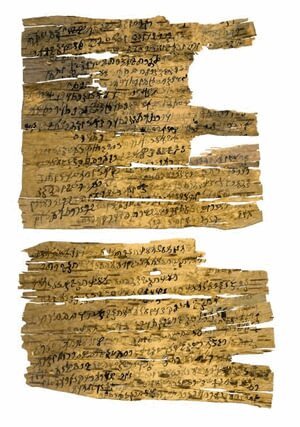
Winner of the 2025 Toshihide Numata Book Award in Buddhism, sponsored by the Numata Center for Buddhist Studies at the University of California, BerkeleyEarly Buddhist manuscript recording a previously unknown scholastic text about existenceThis volume offers a transcription, edition, translation, and analysis of a previously unknown scholastic text, an important discovery for scholars of early Indian Buddhist doctrine. British Library Kharoṣṭhī Fragment 28, from the first or second century CE and written in the Gāndhārī language and Kharoṣṭhī script, provides critical insight into the early development of Buddhist thought, particularly concerning the existence of past, present, and future factors. The text critiques Sarvāstivāda arguments that “everything exists,” while referring to a range of positions on the dynamics of causality.The work’s deeply researched chapters introduce the text and explore its historical and doctrinal contexts, situating it among other early Buddhist writings. A complete commentary accompanies the translation, along with a transcription, edition, and detailed notes on the linguistic features of the text. High-resolution images of the manuscript and an index linking Gāndhārī, Sanskrit, and Pali terms further enhance the volume’s academic value.A Gāndhārī Abhidharma Text significantly advances the study of early Indian Buddhist scholasticism, transforming our understanding of foundational doctrinal debates. Ideal for specialists in Buddhism, early Indian religions, and manuscript studies, it brings groundbreaking perspectives to the discourse on Buddhist scholastic practice and doctrine.
Three Gandhari Ekottarikagama-Type Sutras
British Library Kharosthi Fragments 12 and 14
Inbunden, Engelska, 2001
1 802 kr
Skickas inom 7-10 vardagar
Three Gandhari Ekottarikagama-Type Sutras continues the Gandharan Buddhist Texts studies of the first-century A.D. birch bark scrolls in the British Library's Kharosthi manuscript collection. It describes the text found on two fragments which constitute the lower part of a scroll and consists of the remnants of three sutras. All three sutras are relatively short and have an association with the number four, which suggests that they are from a Gandhar- Ekottarikagama, a collection of short discourses grouped according to numerical principles and one of the major collections of writings in the Buddhist canon.The first sutra records a discussion in which a brahman asks the Buddha four questions. The second su-tra, like the third, depicts the Buddha preaching to monks. The structure of this sutra is based on the four postures: walking, standing, sitting, and lying down. The Buddha’s discourse in the third sutra concerns the four efforts (or abandonings).The book describes the condition of the scroll and its reconstruction; examines in detail the literary and textual background of the sutras, comparing them with other extant versions and parallels in other languages; and presents a transcription of the extant text, a reconstruction, and an English translation. It includes chapters on the paleography, orthography, phonology, and morphology of the text, and offers a detailed analytic commentary.For more information go to the Early Buddhist Manuscript Project web site at http://www.ebmp.org/