Handbook of Defeasible Reasoning and Uncertainty Management Systems – serie
Visar alla böcker i serien Handbook of Defeasible Reasoning and Uncertainty Management Systems. Handla med fri frakt och snabb leverans.
14 produkter
14 produkter
Inbunden, Engelska, 1998
3 225 kr
Skickas inom 10-15 vardagar
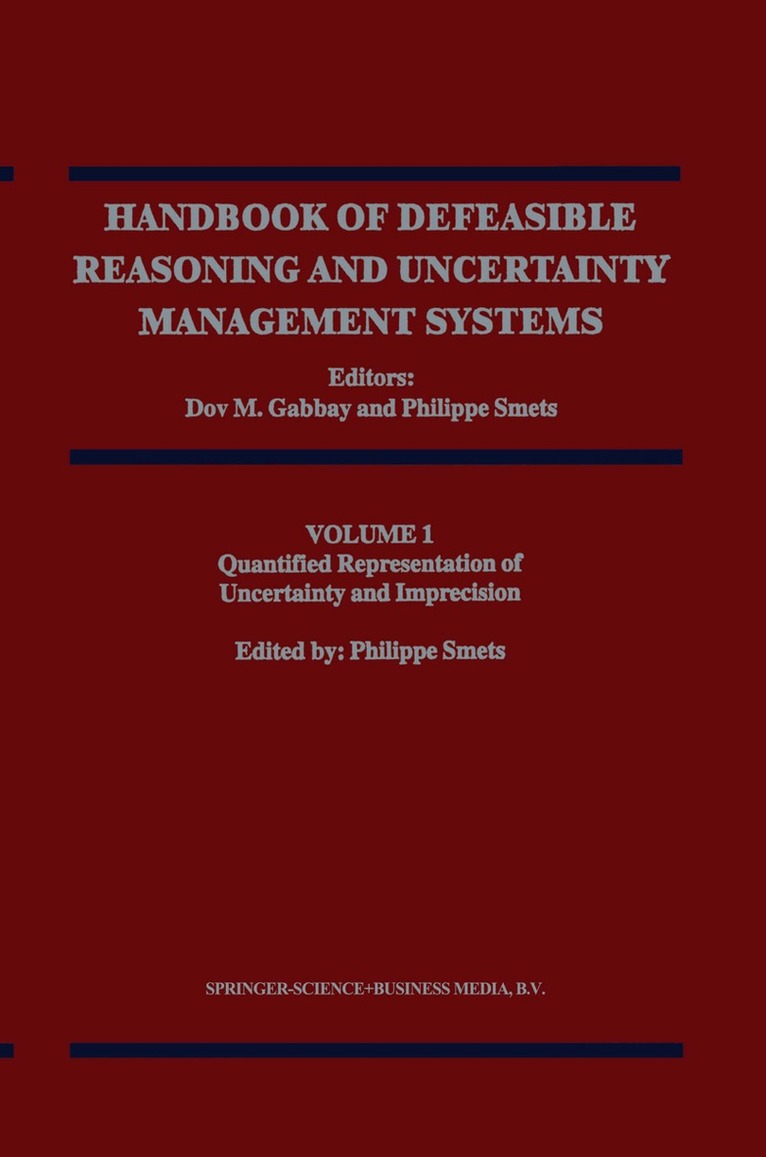
We are happy to present the first volume of the Handbook of Defeasible Reasoning and Uncertainty Management Systems. Uncertainty pervades the real world and must therefore be addressed by every system that attempts to represent reality. The representation of uncertainty is a ma jor concern of philosophers, logicians, artificial intelligence researchers and com puter sciencists, psychologists, statisticians, economists and engineers. The present Handbook volumes provide frontline coverage of this area. This Handbook was produced in the style of previous handbook series like the Handbook of Philosoph ical Logic, the Handbook of Logic in Computer Science, the Handbook of Logic in Artificial Intelligence and Logic Programming, and can be seen as a companion to them in covering the wide applications of logic and reasoning. We hope it will answer the needs for adequate representations of uncertainty. This Handbook series grew out of the ESPRIT Basic Research Project DRUMS II, where the acronym is made out of the Handbook series title. This project was financially supported by the European Union and regroups 20 major European research teams working in the general domain of uncertainty. As a fringe benefit of the DRUMS project, the research community was able to create this Hand book series, relying on the DRUMS participants as the core of the authors for the Handbook together with external international experts.
Inbunden, Engelska, 1998
1 616 kr
Skickas inom 10-15 vardagar
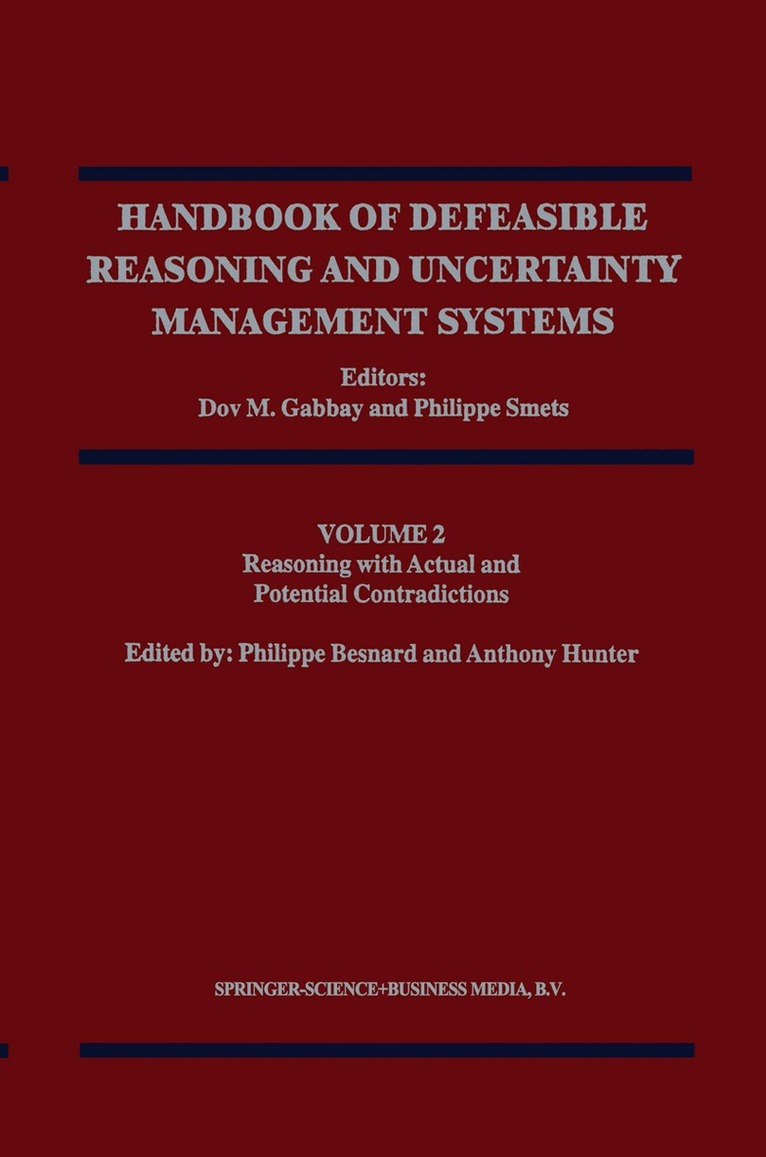
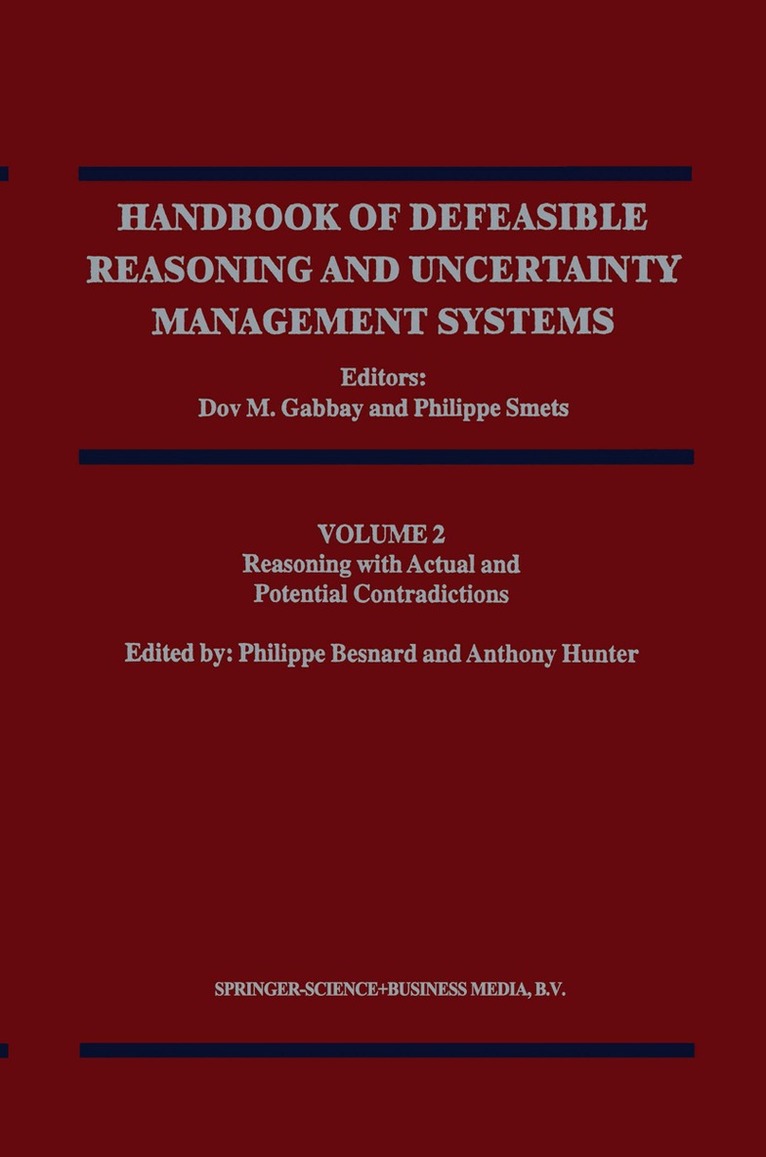
We are happy to present the second volume of the Handbook of Defeasible Reasoning and Uncertainty Management Systems. Uncertainty pervades the real world and must therefore be addressed by every system that attempts to represent reality. The representation of un certainty is a major concern of philosophers, logicians, artificial intelligence researchers and computer sciencists, psychologists, statisticians, economists and engineers. The present Handbook volumes provide frontline coverage of this area. This Handbook was produced in the style of previous handbook series like the Handbook of Philosophical Logic, the Handbook of Logic in Computer Science, the Handbook of Logic in Artificial Intelligence and Logic Programming, and can be seen as a companion to them in covering the wide applications of logic and reasoning. We hope it will answer the needs for adequate representations of uncertainty. This Handbook series grew out of the ESPRIT Basic Research Project DRUMS II, where the acronym is made out of the Handbook series title. This project was financially supported by the European Union and regroups 20 major European research teams working in the general domain of uncer tainty. As a fringe benefit of the DRUMS project, the research community was able to create this Handbook series, relying on the DRUMS partici pants as the core of the authors for the Handbook together with external international experts.
Inbunden, Engelska, 1998
2 152 kr
Skickas inom 10-15 vardagar
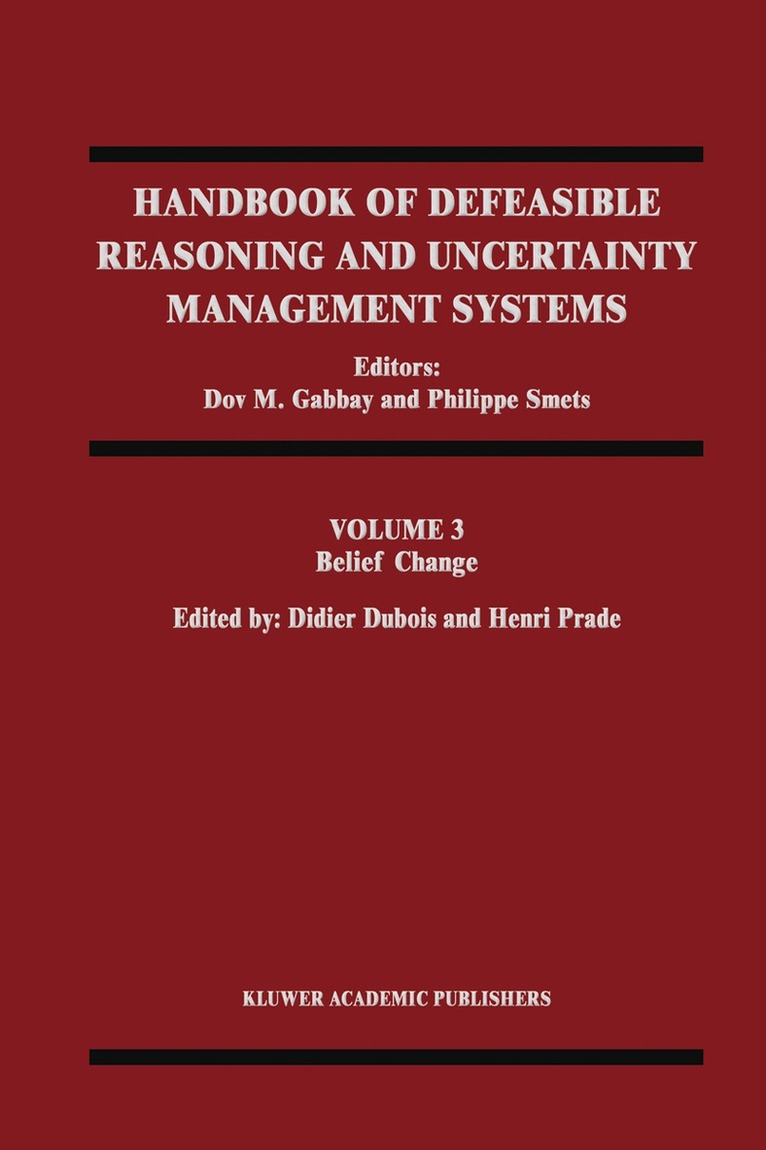
Belief change is an emerging field of artificial intelligence and information science dedicated to the dynamics of information, and this text provides a picture of its formal foundations. It deals with the addition, deletion and combination of pieces of information and, more generally, with the revision, updating and fusion of knowledge bases. The book offers coverage of, and seeks to reconcile, two traditions in the kinematics of belief that often ignore each other - the symbolic and the numerical (often probabilistic) approaches. Moreover, the work encompasses both revision and fusion problems, even though these two are also commonly investigated by different communities. Finally, the book presents the numerical view of belief change, beyond the probabilistic framework, covering such approaches as possibility theory, belief functions and convex gambles. The work thus presents a unified view of belief change operators, drawing from a widely scattered literature embracing philosophical logic, artificial intelligence, uncertainty modelling and database systems.The material constitutes a guide to the literature on the dynamics of epistemic states, knowledge bases and uncertain information.
Del 4 - Handbook of Defeasible Reasoning and Uncertainty Management Systems
Abductive Reasoning and Learning
Inbunden, Engelska, 2000
2 152 kr
Skickas inom 10-15 vardagar
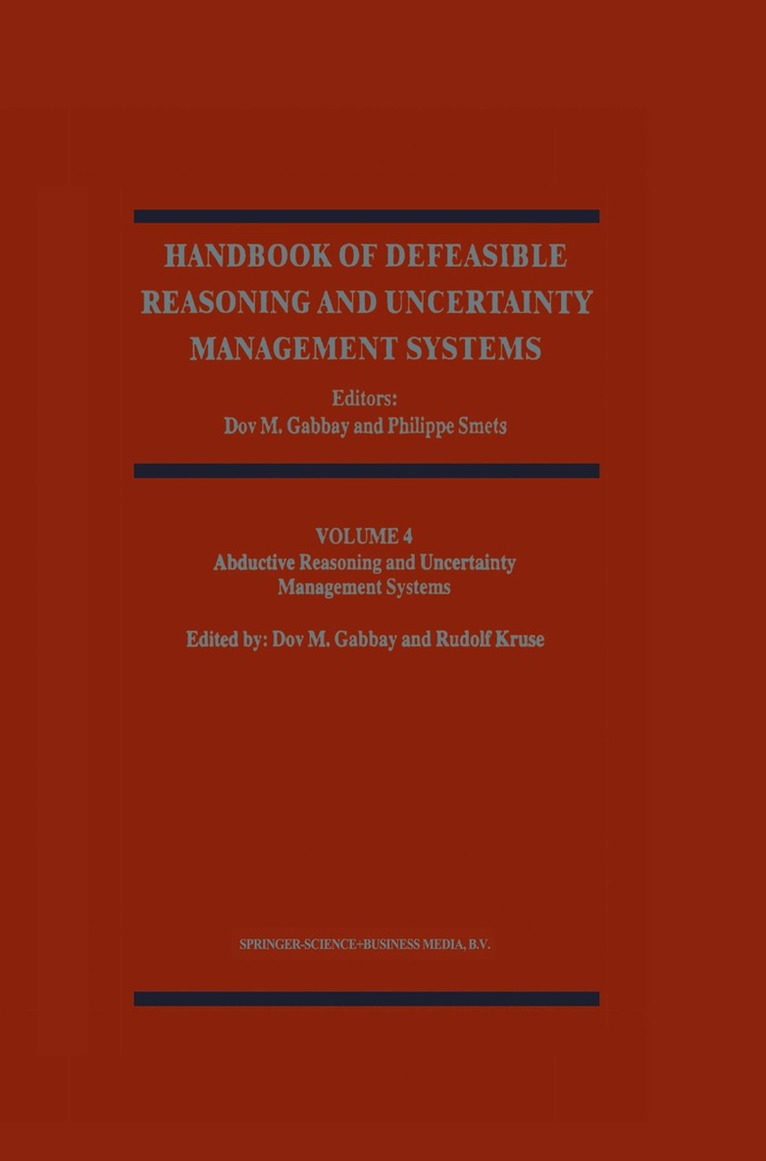
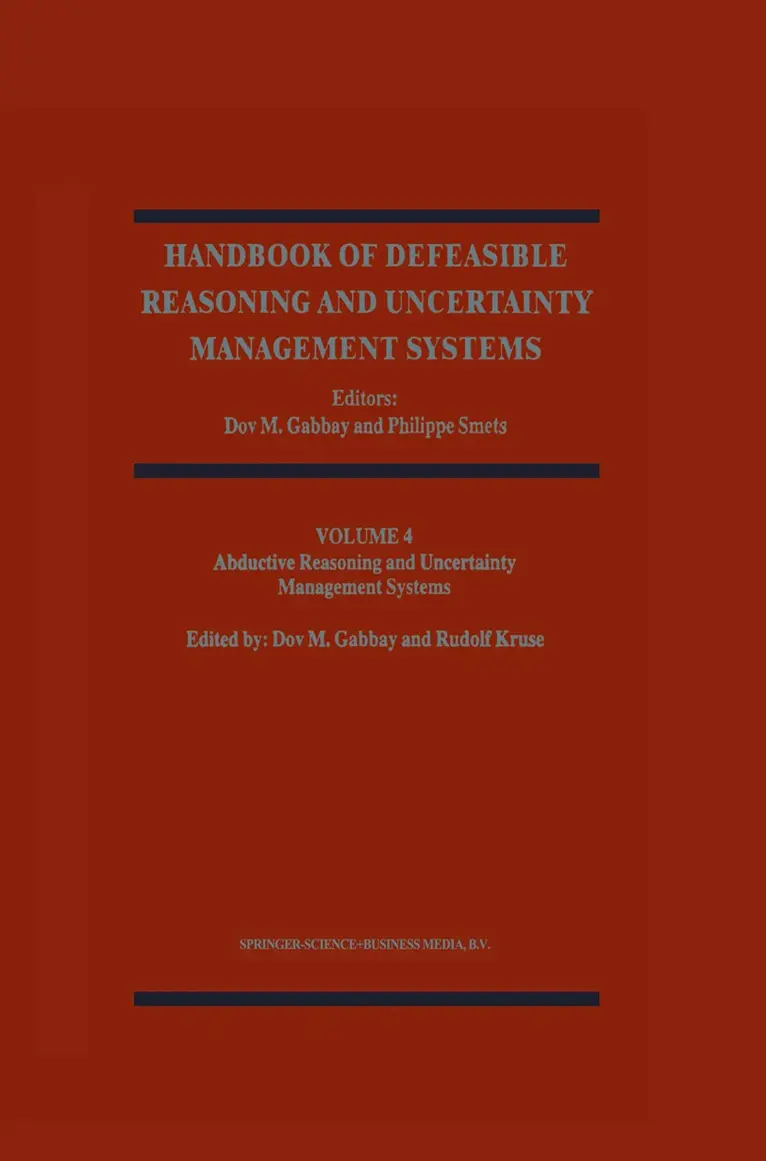
This book contains leading survey papers on the various aspects of Abduction, both logical and numerical approaches. Abduction is central to all areas of applied reasoning, including artificial intelligence, philosophy of science, machine learning, data mining and decision theory, as well as logic itself.
Inbunden, Engelska, 2000
2 152 kr
Skickas inom 10-15 vardagar
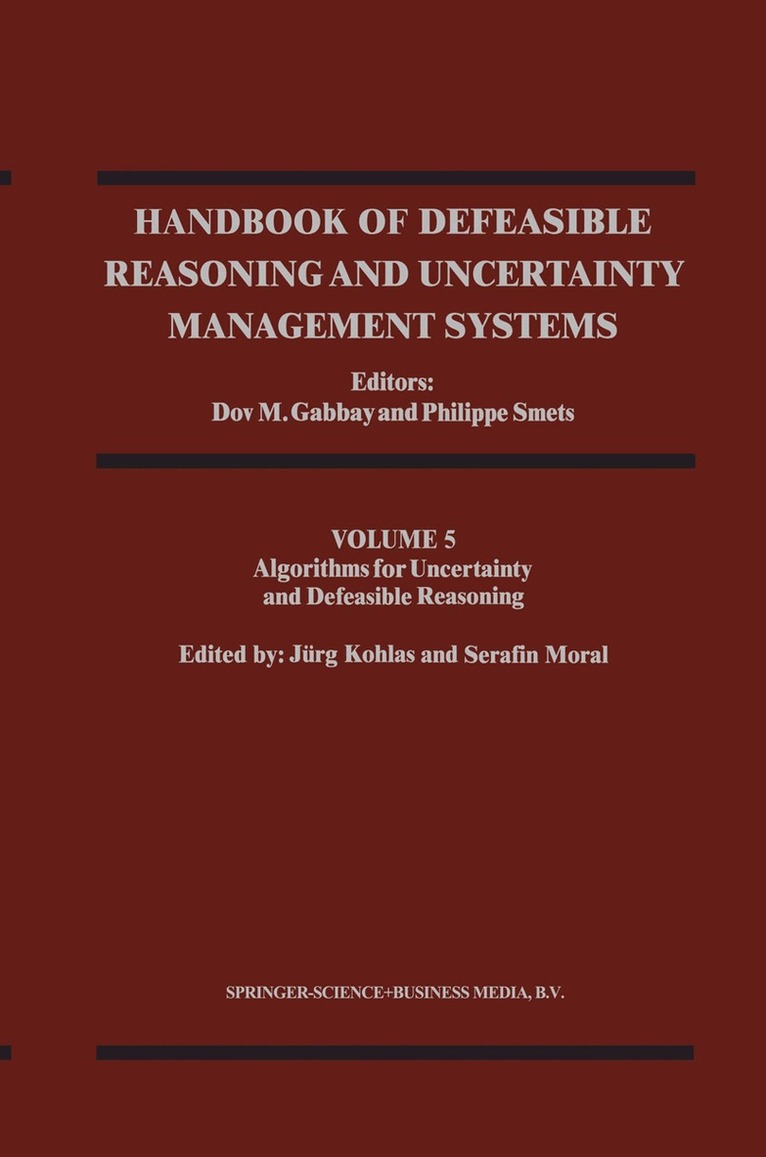
This handbook surveys the computational and algorithmic problems of systems of applied reasoning. The various theoretical and modelling aspects of defeasible reasoning were dealt with in the first four volumes, and this volume now turns to the algorithmic aspect. Topics covered include: Computation in valuation algebras; consequence finding algorithms; possibilistic logic; probabilistic argumentation systems, networks and satisfiability; algorithms for imprecise probabilities, for Dempster-Shafer, and network based decisions.
Inbunden, Engelska, 2001
1 080 kr
Skickas inom 10-15 vardagar
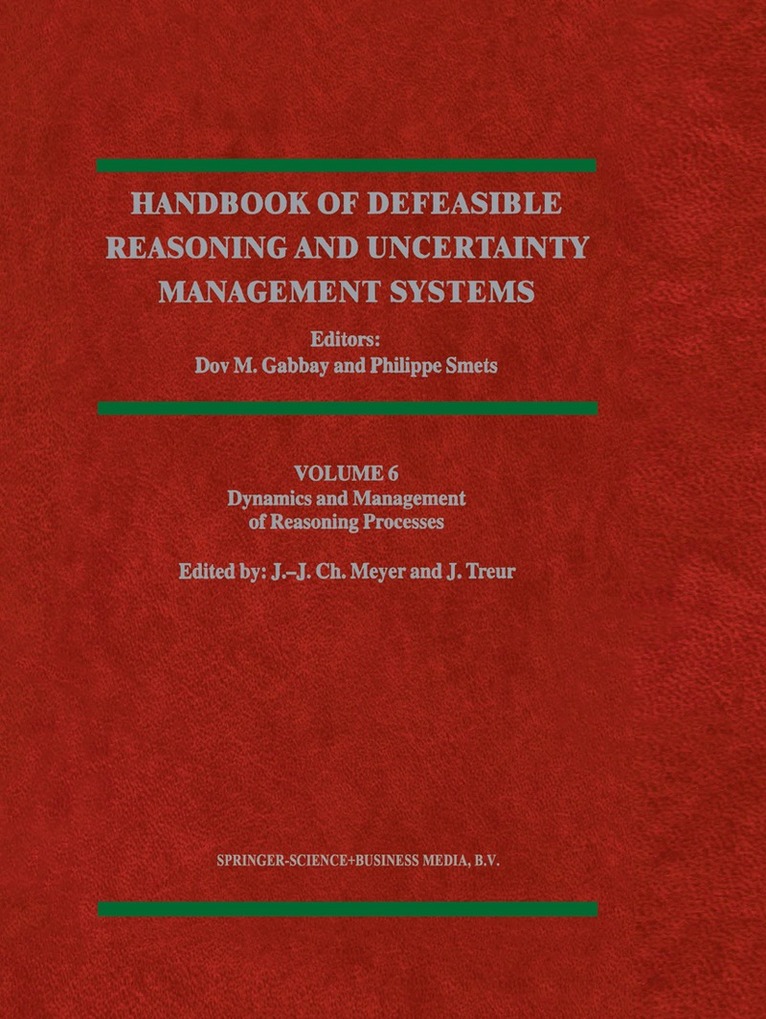
This volume is focused on the dynamics of reasoning processes. It covers both the topics of the dynamics of reasoning, where reasoning is viewed as a process, and reasoning about dynamics, which must be understood as pertaining to how both designers of, and agents within dynamic systems may reason about these systems. In this volume real-life applications of the modelling techniques are also considered, as the research during the DRUMS (Defeasible Reasoning and Uncertainty Management Systems) project was aimed at bridging the gap between theory and practice. In order to give the book a broader perspective, a number of well-known researchers outside the project but working on similar topics, have been invited to contribute.
Inbunden, Engelska, 2002
2 152 kr
Skickas inom 10-15 vardagar
This last volume of the Handbook of Defeasible Reasoning and Uncertainty Management Systems is - together with Volume 6 - devoted to the topics Reasoning and Dynamics, covering both the topics of "Dynamics of Reasoning", where reasoning is viewed as a process, and "Reasoning about Dynamics", which must be understood as pertaining to how both designers of, and agents within dynamic systems may reason about these systems. The present volume presents work done in this context and is more focused on "reasoning about dynamics", viz. how (human and artificial) agents reason about (systems in) dynamic environments in order to control them. In particular modelling frameworks and generic agent models for modelling these dynamic systems and formal approaches to these systems such as logics for agents and formal means to reason about agent-based and compositional systems, and action & change more in general are considered.
Häftad, Engelska, 2010
3 258 kr
Skickas inom 10-15 vardagar
We are happy to present the first volume of the Handbook of Defeasible Reasoning and Uncertainty Management Systems. Uncertainty pervades the real world and must therefore be addressed by every system that attempts to represent reality. The representation of uncertainty is a ma jor concern of philosophers, logicians, artificial intelligence researchers and com puter sciencists, psychologists, statisticians, economists and engineers. The present Handbook volumes provide frontline coverage of this area. This Handbook was produced in the style of previous handbook series like the Handbook of Philosoph ical Logic, the Handbook of Logic in Computer Science, the Handbook of Logic in Artificial Intelligence and Logic Programming, and can be seen as a companion to them in covering the wide applications of logic and reasoning. We hope it will answer the needs for adequate representations of uncertainty. This Handbook series grew out of the ESPRIT Basic Research Project DRUMS II, where the acronym is made out of the Handbook series title. This project was financially supported by the European Union and regroups 20 major European research teams working in the general domain of uncertainty. As a fringe benefit of the DRUMS project, the research community was able to create this Hand book series, relying on the DRUMS participants as the core of the authors for the Handbook together with external international experts.
Häftad, Engelska, 2010
1 633 kr
Skickas inom 10-15 vardagar
We are happy to present the second volume of the Handbook of Defeasible Reasoning and Uncertainty Management Systems. Uncertainty pervades the real world and must therefore be addressed by every system that attempts to represent reality. The representation of un certainty is a major concern of philosophers, logicians, artificial intelligence researchers and computer sciencists, psychologists, statisticians, economists and engineers. The present Handbook volumes provide frontline coverage of this area. This Handbook was produced in the style of previous handbook series like the Handbook of Philosophical Logic, the Handbook of Logic in Computer Science, the Handbook of Logic in Artificial Intelligence and Logic Programming, and can be seen as a companion to them in covering the wide applications of logic and reasoning. We hope it will answer the needs for adequate representations of uncertainty. This Handbook series grew out of the ESPRIT Basic Research Project DRUMS II, where the acronym is made out of the Handbook series title. This project was financially supported by the European Union and regroups 20 major European research teams working in the general domain of uncer tainty. As a fringe benefit of the DRUMS project, the research community was able to create this Handbook series, relying on the DRUMS partici pants as the core of the authors for the Handbook together with external international experts.
Del 4 - Handbook of Defeasible Reasoning and Uncertainty Management Systems
Abductive Reasoning and Learning
Häftad, Engelska, 2010
2 174 kr
Skickas inom 10-15 vardagar
This book contains leading survey papers on the various aspects of Abduction, both logical and numerical approaches. Abduction is central to all areas of applied reasoning, including artificial intelligence, philosophy of science, machine learning, data mining and decision theory, as well as logic itself.
Del 5 - Handbook of Defeasible Reasoning and Uncertainty Management Systems
Handbook of Defeasible Reasoning and Uncertainty Management Systems
Algorithms for Uncertainty and Defeasible Reasoning
Häftad, Engelska, 2010
2 174 kr
Skickas inom 10-15 vardagar
Reasoning under uncertainty is always based on a specified language or for malism, including its particular syntax and semantics, but also on its associated inference mechanism. In the present volume of the handbook the last aspect, the algorithmic aspects of uncertainty calculi are presented. Theory has suffi ciently advanced to unfold some generally applicable fundamental structures and methods. On the other hand, particular features of specific formalisms and ap proaches to uncertainty of course still influence strongly the computational meth ods to be used. Both general as well as specific methods are included in this volume. Broadly speaking, symbolic or logical approaches to uncertainty and nu merical approaches are often distinguished. Although this distinction is somewhat misleading, it is used as a means to structure the present volume. This is even to some degree reflected in the two first chapters, which treat fundamental, general methods of computation in systems designed to represent uncertainty. It has been noted early by Shenoy and Shafer, that computations in different domains have an underlying common structure. Essentially pieces of knowledge or information are to be combined together and then focused on some particular question or domain. This can be captured in an algebraic structure called valuation algebra which is described in the first chapter. Here the basic operations of combination and focus ing (marginalization) of knowledge and information is modeled abstractly subject to simple axioms.
Del 6 - Handbook of Defeasible Reasoning and Uncertainty Management Systems
Dynamics and Management of Reasoning Processes
Häftad, Engelska, 2010
1 091 kr
Skickas inom 10-15 vardagar
This volume, the 6th volume in the DRUMS Handbook series, is part of the after math of the successful ESPRIT project DRUMS (Defeasible Reasoning and Un certainty Management Systems) which took place in two stages from 1989-1996. In the second stage (1993-1996) a work package was introduced devoted to the topics Reasoning and Dynamics, covering both the topics of 'Dynamics of Rea soning', where reasoning is viewed as a process, and 'Reasoning about Dynamics', which must be understood as pertaining to how both designers of and agents within dynamic systems may reason about these systems. The present volume presents work done in this context. This work has an emphasis on modelling and formal techniques in the investigation of the topic "Reasoning and Dynamics", but it is not mere theory that occupied us. Rather research was aimed at bridging the gap between theory and practice. Therefore also real-life applications of the modelling techniques were considered, and we hope this also shows in this volume, which is focused on the dynamics of reasoning processes. In order to give the book a broader perspective, we have invited a number of well-known researchers outside the project but working on similar topics to contribute as well. We have very pleasant recollections of the project, with its lively workshops and other meetings, with the many sites and researchers involved, both within and outside our own work package.
Del 7 - Handbook of Defeasible Reasoning and Uncertainty Management Systems
Agent-Based Defeasible Control in Dynamic Environments
Häftad, Engelska, 2010
2 174 kr
Skickas inom 10-15 vardagar
This volume, the 7th volume in the DRUMS Handbook series, is part of the aftermath of the successful ESPRIT project DRUMS (Defeasible Reasoning and Uncertainty Management Systems) which took place in two stages from 1989- 1996. In the second stage (1993-1996) a work package was introduced devoted to the topics Reasoning and Dynamics, covering both the topics of "Dynamics of Reasoning", where reasoning is viewed as a process, and "Reasoning about Dynamics", which must be understood as pertaining to how both designers of and agents within dynamic systems may reason about these systems. The present volume presents work done in this context extended with some work done by outstanding researchers outside the project on related issues. While the previous volume in this series had its focus on the dynamics of reasoning pro cesses, the present volume is more focused on "reasoning about dynamics', viz. how (human and artificial) agents reason about (systems in) dynamic environments in order to control them. In particular we consider modelling frameworks and generic agent models for modelling these dynamic systems and formal approaches to these systems such as logics for agents and formal means to reason about agent based and compositional systems, and action & change more in general. We take this opportunity to mention that we have very pleasant recollections of the project, with its lively workshops and other meetings, with the many sites and researchers involved, both within and outside our own work package.
Del 3 - Handbook of Defeasible Reasoning and Uncertainty Management Systems
Belief Change
Häftad, Engelska, 2012
2 174 kr
Skickas inom 10-15 vardagar
Belief change is an emerging field of artificial intelligence and information science dedicated to the dynamics of information and the present book provides a state-of-the-art picture of its formal foundations. It deals with the addition, deletion and combination of pieces of information and, more generally, with the revision, updating and fusion of knowledge bases. The book offers an extensive coverage of, and seeks to reconcile, two traditions in the kinematics of belief that often ignore each other - the symbolic and the numerical (often probabilistic) approaches. Moreover, the work encompasses both revision and fusion problems, even though these two are also commonly investigated by different communities. Finally, the book presents the numerical view of belief change, beyond the probabilistic framework, covering such approaches as possibility theory, belief functions and convex gambles. The work thus presents a unified view of belief change operators, drawing from a widely scattered literature embracing philosophical logic, artificial intelligence, uncertainty modelling and database systems. The material is a clearly organised guide to the literature on the dynamics of epistemic states, knowledge bases and uncertain information, suitable for scholars and graduate students familiar with applied logic, knowledge representation and uncertain reasoning.