Health Equity in America - Böcker
Visar alla böcker i serien Health Equity in America. Handla med fri frakt och snabb leverans.
4 produkter
4 produkter
332 kr
Skickas inom 7-10 vardagar
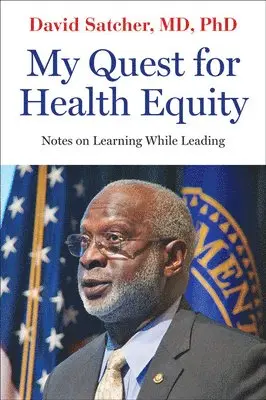
Reading this book is like sitting down with Dr. David Satcher to hear stories of leadership and lessons learned from his lifetime commitment to health equity.Dr. David Satcher is one of the most widely known and well-regarded physicians of our time. A former four-star admiral in the US Public Health Service Commissioned Corps, he served as the assistant secretary for health, the surgeon general of the United States, and the director of the Centers for Disease Control and Prevention before founding the eponymous Satcher Health Leadership Institute at Morehouse School of Medicine. At the core of his impact on public health, he is also a lifelong leader for civil rights and health equity. Born black and poor in the deep South, Dr. Satcher was a victim of an unjust health care system: he almost died of whooping cough at the age of two because Jim Crow laws meant that his black doctor could not admit him to a hospital. That experience was the first of many that shaped him as a leader and a healer deeply attuned to social inequity—someone who was determined to make a positive difference.In My Quest for Health Equity, Dr. Satcher takes an inspiring and instructive look inside his fifty-year career to shed light on the challenge and burden of leadership. Explaining that he has thought of each leadership role—whether in academia, community, or government—as an opportunity to move the needle toward health equity, he shares the hard-won lessons he has learned over a lifetime in the medical field. Drawing on his early memories, medical school days, experience in the civil rights movement, and professional highs and lows, Dr. Satcher touches on a number of topics, including• the essential qualities of leadership• leading from science to policy to practice• the importance of clear communication and continual learning• the need for workplace discipline• confronting failure• specific health issues, including the obesity epidemic, reproductive health, and mental health stigma• team approaches to leadership• and much moreIn this book, readers will discover a template for using leadership roles of all types to eliminate health disparities. My Quest for Health Equity is a vital resource for current and rising leaders.
Unequal Cities
Structural Racism and the Death Gap in America's Largest Cities
Inbunden, Engelska, 2021
474 kr
Skickas inom 7-10 vardagar
Across the United States, Black people have shorter life expectancies than white people—reflecting structural racism and deep-rooted drivers of population health. But are some cities more equal than others?The elimination of racial and ethnic inequities—differences that are avoidable, unnecessary, and unfair—has been one of the overarching health-related goals of the United States for decades. Yet dramatic differences in health outcomes between Black people and white people persist, rooted in structural and social determinants of health. Nationally, a Black baby can expect to live four years less than a white baby. But mortality outcomes and inequities vary widely across cities. In Washington, DC, for example, the average life expectancy for Blacks is twelve years less than that of whites. But in other cities, mortality differences between races are less striking or nonexistent. If health equity can be achieved in some cities, why not all? This is arguably the most important health equity issue of our time.In Unequal Cities, Maureen R. Benjamins and Fernando G. De Maio gather a team of experts to explore these racial inequities, as well as the ten-year gap in life expectancy between our healthiest and unhealthiest big cities. Rigorous analyses give readers access to previously unavailable data on life expectancy, mortality from leading causes of death, and related Black-white inequities for the country's 30 biggest cities. The theoretically grounded essays also explore how characteristics of cities, including their levels of income inequality and racial segregation, impact overall health and Black-white inequities.The first book to specifically examine racial health inequities within and across US cities, Unequal Cities offers a social justice framework for addressing the newly identified inequities, as well as specific case studies to help public health advocates, civic leaders, and other stakeholders envision the steps needed to improve their cities' current health outcomes and achieve racial equity. A powerful call to action for health equity advocates and city leaders alike, this book is essential reading.Contributors: David Ansell, Darlene Oliver Hightower, Jana Hirschtick, Sharon Homan, Ayesha Jaco, Emily LaFlamme, Brittney S. Lange-Maia, Kristin Monnard, Nikhil G. Prachand, Pamela T. Roesch, Michael Rozier, Nazia Saiyed, Eve Shapiro, Abigail Silva, Veenu Verma, the West Side United Metrics Working Group, Ruqaiijah Yearby
236 kr
Skickas inom 7-10 vardagar
Reading this book is like sitting down with Dr. David Satcher to hear stories of leadership and lessons learned from his lifetime commitment to health equity.Dr. David Satcher is one of the most widely known and well-regarded physicians of our time. A former four-star admiral in the US Public Health Service Commissioned Corps, he served as the assistant secretary for health, the surgeon general of the United States, and the director of the Centers for Disease Control and Prevention before founding the eponymous Satcher Health Leadership Institute at Morehouse School of Medicine. At the core of his impact on public health, he is also a lifelong leader for civil rights and health equity. Born black and poor in the deep South, Dr. Satcher was a victim of an unjust health care system: he almost died of whooping cough at the age of two because Jim Crow laws meant that his black doctor could not admit him to a hospital. That experience was the first of many that shaped him as a leader and a healer deeply attuned to social inequity—someone who was determined to make a positive difference.In My Quest for Health Equity, Dr. Satcher takes an inspiring and instructive look inside his fifty-year career to shed light on the challenge and burden of leadership. Explaining that he has thought of each leadership role—whether in academia, community, or government—as an opportunity to move the needle toward health equity, he shares the hard-won lessons he has learned over a lifetime in the medical field. Drawing on his early memories, medical school days, experience in the civil rights movement, and professional highs and lows, Dr. Satcher touches on a number of topics, including• the essential qualities of leadership• leading from science to policy to practice• the importance of clear communication and continual learning• the need for workplace discipline• confronting failure• specific health issues, including the obesity epidemic, reproductive health, and mental health stigma• team approaches to leadership• and much moreIn this book, readers will discover a template for using leadership roles of all types to eliminate health disparities. My Quest for Health Equity is a vital resource for current and rising leaders.
267 kr
Skickas inom 7-10 vardagar
The United States significantly undercounts the number of people who die in law enforcement custody each year. How can we fix this?Deaths resulting from interactions with the US criminal legal system are a public health emergency, but the scope of this issue is intentionally ignored by the very systems that are supposed to be tracking these fatalities. We don't know how many people die in custody each year, whether in an encounter with police on the street, during transport, or while in jails, prisons, or detention centers. In order to make a real difference and address this human rights problem, researchers and policy makers need reliable data. In Death in Custody, Roger A. Mitchell Jr., MD, and Jay D. Aronson, PhD, share the stories of individuals who died in custody and chronicle the efforts of activists and journalists to uncover the true scope of deaths in custody. From Ida B. Wells's enumeration of extrajudicial lynchings more than a century ago to the Washington Post's current effort to count police shootings, the work of journalists and independent groups has always been more reliable than the state's official reports. Through historical analysis, Mitchell and Aronson demonstrate how government at all levels has intentionally avoided reporting death in custody data. Mitchell and Aronson outline a practical, achievable system for accurately recording and investigating these deaths. They argue for a straightforward public health solution: adding a simple checkbox to the US Standard Death Certificate that would create an objective way of recording whether a death occurred in custody. They also propose the development of national standards for investigating deaths in custody and the creation of independent regional and federal custodial death review panels. These tangible solutions would allow us to see the full scope of the problem and give us the chance to truly address it.