Henry L. Stimson Lectures - Böcker
Visar alla böcker i serien Henry L. Stimson Lectures. Handla med fri frakt och snabb leverans.
8 produkter
8 produkter
Financial Crises in Emerging Markets
An Essay on Financial Globalisation and Fragility
Inbunden, Engelska, 2000
729 kr
Skickas inom 5-8 vardagar
In this book an eminent international banking expert grapples with issues that surround the trend toward financial globalization and its potential impact on financial fragility. Does globalization entail the risk of greater financial market instability—perhaps even genuine systemic fragility—or will it lead to a smoother working of markets? How should governments, central banks, and international institutions respond to manifestations of financial fragility?Alexandre Lamfalussy analyzes four major crisis experiences in emerging markets: Latin America in 1982–83, Mexico in 1994–95, East Asia in 1997–98, and Russia since 1998. The author finds that the build-up of short-term indebtedness and asset price bubbles were at the heart of the four crises. And in each case the exuberant behavior of lenders and investors from the developed world played a major role, while financial globalization was an aggravating factor. Lamfalussy offers a series of carefully considered policy recommendations for the future that are both pragmatic and wise.
269 kr
Skickas inom 7-10 vardagar
This now-classic examination of the development of viable political institutions in emerging nations is a major and enduring contribution to modern political analysis. In a new Foreword, Francis Fukuyama assesses Huntington’s achievement, examining the context of the book’s original publication as well as its lasting importance.“This pioneering volume, examining as it does the relation between development and stability, is an interesting and exciting addition to the literature.”—American Political Science Review“’Must’ reading for all those interested in comparative politics or in the study of development.”—Dankwart A. Rustow, Journal of International Affairs
764 kr
Skickas inom 5-8 vardagar
In this timely and important work, eminent political theorist John Dunn argues that democracy is not synonymous with good government. The author explores the labyrinthine reality behind the basic concept of democracy, demonstrating how the political system that people in the West generally view as straightforward and obvious is, in fact, deeply unclear and, in many cases, dysfunctional. Consisting of four thought-provoking lectures, Dunn’s book sketches the path by which democracy became the only form of government with moral legitimacy, analyzes the contradictions and pitfalls of modern American democracy, and challenges the academic world to take responsibility for giving the world a more coherent understanding of this widely misrepresented political institution. Suggesting that the supposedly ideal marriage of liberal economics with liberal democracy can neither ensure its continuance nor even address the problems of contemporary life, this courageous analysis attempts to show how we came to be so gripped by democracy’s spell and why we must now learn to break it.
297 kr
Tillfälligt slut
In the cold winter months that followed Franklin Roosevelt’s election in November 1940 to an unprecedented third term in the White House, he confronted a worldwide military and moral catastrophe. Almost all the European democracies had fallen under the ruthless onslaught of the Nazi army and air force. Great Britain stood alone, a fragile bastion between Germany and American immersion in war. In the Pacific world, Japan had extended its tentacles deeper into China. Susan Dunn dramatically brings to life the most vital and transformational period of Roosevelt’s presidency: the hundred days between December 1940 and March 1941, when he mobilized American industry, mustered the American people, initiated the crucial programs and approved the strategic plans for America’s leadership in World War II. As the nation began its transition into the preeminent military, industrial, and moral power on the planet, FDR laid out the stunning blueprint not only for war but for the American Century.
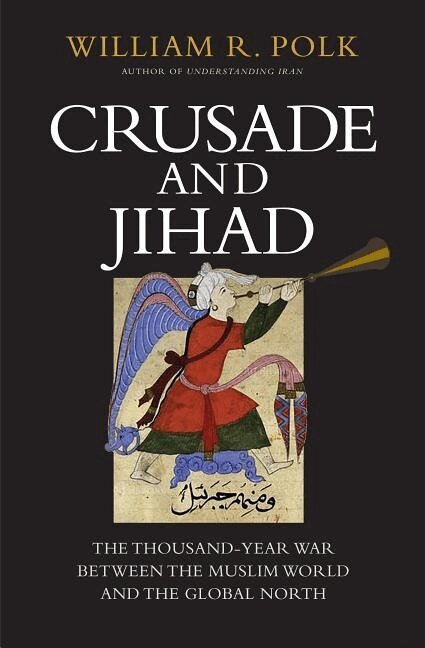
Crusade and Jihad
The Thousand-Year War Between the Muslim World and the Global North
Inbunden, Engelska, 2018
335 kr
Skickas inom 7-10 vardagar
What really happened in the centuries of conflict between Europe, Russia, China, America, and the peoples of the Muslim world Crusade and Jihad is the first book to encompass, in one volume, the entire history of the catastrophic encounter between the Global North—China, Russia, Europe, Britain, and America—and Muslim societies from Central Asia to West Africa. William R. Polk draws on more than half a century of experience as a historian, policy planner, diplomat, peace negotiator, and businessman to explain the deep hostilities between the Muslim world and the Global North and show how they grew over the centuries. Polk shows how Islam arose and spread across North Africa into Europe, climaxed in the vibrant and sophisticated caliphate of al-Andalus in medieval Spain, and was the bright light in a European Dark Age. Simultaneously, Islam spread from the Middle East into Africa, India, and Southeast Asia. But following the Mongol invasions, Islamic civilization entered a decline while Europe began its overseas expansion. Portuguese buccaneers dominated the Indian Ocean; the Dutch and the English established powerful corporations that turned India and Indonesia into colonies; Russian armies pushed down the Volga into Central Asia, destroying its city-states; and the Chinese Qing dynasty slaughtered an entire Central Asian people. Britain crushed local industry and drained off wealth throughout its vast colonies. Defeated at every turn, Muslims tried adopting Western dress, organizing Westernstyle armies, and embracing Western ideas. None of these efforts stopped the conquests. For Europe and Russia, the nineteenth century was an age of colonial expansion, but for the Muslim world it was an age of brutal and humiliating defeat. Millions were driven from their homes, starved, or killed, and their culture and religion came under a century-long assault. In the twentieth century, brutalized and and disorganized native societies, even after winning independence, fell victim to “post-imperial malaise,” typified by native tyrannies, corruption, and massive poverty. The result was a furious blowback. A sobering, scrupulous, and frank account of imperialism, colonialism, insurgency, and terrorism, Crusade and Jihad is history for anyone who wishes to understand the civilizational conflicts of today’s world.
219 kr
Skickas inom 7-10 vardagar
A leading expert on foreign policy reveals how tensions between America, NATO, and Russia transformed geopolitics● A Foreign Affairs Best Book of 2021 and winner of the Pushkin House Book Prize “Sarotte has the receipts, as it were: her authoritative tale draws on thousands of memos, letters, briefs, and other once secret documents—including many that have never been published before—which both fill in and complicate settled narratives on both sides.”—Joshua Yaffa, New Yorker “The most engaging and carefully documented account of this period in East-West diplomacy currently available.”—Andrew Moravcsik, Foreign Affairs Not one inch. With these words, Secretary of State James Baker proposed a hypothetical bargain to Soviet leader Mikhail Gorbachev after the fall of the Berlin Wall: if you let your part of Germany go, we will move NATO not one inch eastward. Controversy erupted almost immediately over this 1990 exchange—but more important was the decade to come, when the words took on new meaning. Gorbachev let his Germany go, but Washington rethought the bargain, not least after the Soviet Union’s own collapse in December 1991. Washington realized it could not just win big but win bigger. Not one inch of territory needed to be off limits to NATO. On the thirtieth anniversary of the Soviet collapse, this book uses new evidence and interviews to show how, in the decade that culminated in Vladimir Putin’s rise to power, the United States and Russia undermined a potentially lasting partnership. Prize-winning historian M. E. Sarotte shows what went wrong.
367 kr
Kommande
With the United States and the world it leads in disarray, how should we construct a new international order?The stable and open international order erected on America’s watch is unraveling. Democracy is losing ground to autocracy; globalized markets are fragmenting; and the era of perpetual peace foreseen at the close of the Cold War has given way to great-power rivalry. This fracture of the international system comes just as many of our greatest challenges, such as climate change, the threat of pandemics, and rapidly changing technologies, require collective action.Charles A. Kupchan diagnoses the sources of global disarray and offers a handbook for building a new order fit for the emerging multipolar world. Drawing on the Concert of Europe, which preserved great-power peace after the Napoleonic Wars, Kupchan proposes a global system of concerts—high-level steering groups that cut across ideological dividing lines—to anchor a regionalized, polycentric world. The mission of order building must begin with the revival of American democracy and the nation’s steady leadership abroad. Only when democracies can outperform illiberal and autocratic alternatives, Kupchan says, will they be able to guide the world through the coming transition and ultimately bend the arc of history back toward freedom.
Our Dollar, Your Problem
An Insider's View of Seven Turbulent Decades of Global Finance, and the Road Ahead
Häftad, Engelska, 2026
196 kr
Kommande
A National Bestseller • Recommended by Financial Times as “What to Read in 2025” “The central argument of Our Dollar, Your Problem—that the greenback’s pre-eminence was never guaranteed and might plausibly be overturned—could hardly be more timely.”—The Economist A leading economist explores the global rise of the U.S. dollar and shows why its future stability is far from assured Our Dollar, Your Problem argues that America’s currency might not have reached today’s lofty pinnacle without a certain amount of good luck. Drawing in part on his own experiences, including with policymakers and world leaders, Kenneth Rogoff animates the remarkable postwar run of the dollar—how it beat out the Japanese yen, the Soviet ruble, and the euro—and the challenges it faces today from crypto and the Chinese yuan, the end of reliably low inflation and interest rates, political instability, and the fracturing of the dollar bloc. Americans cannot take for granted that the Pax Dollar era will last indefinitely, not only because many countries are deeply frustrated with the system, but also because overconfidence and arrogance can lead to unforced errors. Rogoff shows how America’s outsized power and exorbitant privilege can spur financial instability—not just abroad but also at home.