Hermes Books Series - Böcker
Visar alla böcker i serien Hermes Books Series. Handla med fri frakt och snabb leverans.
8 produkter
8 produkter
458 kr
Skickas inom 5-8 vardagar
Pindar has for centuries been the least understood and appreciated of the great classical poets, for the type of composition by which he is now chiefly represent—the ode written on commission to praise a victorious athlete—does not seem to fit our notions of what a lyric poem should be. This book by D.S. Carne-Ross sets out to recover Pindar as a vital presence in the Western tradition. Through critical discussion, comparison with more familiar poets past and present, and selective translation, Carne-Ross demonstrates the craftsmanship and beauty of a Pindaric ode.The first chapter examines the form of the victory ode—an inherited form with its required, recurrent features—and shows how, in Pindar’s hands, its disparate elements compose a complex, harmonious whole. The rest of the book consists of close readings of a dozen odes illustrating different aspects of Pindar’s genius and the wide range of experience that this seemingly limited genre can cover.Written to convey to the general reader the skill and power of Pindar’s poetry, this book assumes no knowledge of the specialist literature. However, a number of Carne-Ross’s interpretations do break fresh critical ground, and thus the book will also be of interest to scholars in the field.
498 kr
Skickas inom 5-8 vardagar
Most studies of the Homeric poems have been dominated by the historical and anthropological views, concentrating on their place in the oral tradition and diverting attention from the nature of the poetry itself. Paolo Vivante offers us an intense look at the Iliad and the Odyssey, focusing on the poetic treatment of story, characters, and nature. Vivante discusses Homer’s sense of time, the capacity to resolve any complex event into the creative moments of its realization. Rather than narrative, Homer presents events in the making, as the story takes shape through the rhythm of successive acts. The recurrent phrases (the “formulas”), far from being an “oral” device, affirm the reality of acts that cannot help but fulfill their allotted moment. Arbitrary description yields to the self-consistency of the human condition. Vivante shows how such a mode of representation results in a sense of truth. Since the story is presented as moment to moment experience, the style itself reflects the clarity of what is possible and convincing. Hence the curtailment of the mythical, the humanization of gods and heroes. Homer’s poetry continually transcends the mythology of the background. The last chapter, “Age and Place of Homer,” relates the poems to the spirit of eighth-century Ionia. Homer is placed at the center of a renaissance, not seen as the ultimate spokesman of a long epic tradition.
438 kr
Skickas inom 5-8 vardagar
Aeschylus can be called the creator of the art of tragedy in the Western tradition. Author of the first dramas that have survived in their entirety, he was also one of the world’s greatest lyric and imaginative poets. This book by John Herington is designed to introduce all aspects of his majestic achievement to the general reader.Herington begins by sketching the background to Aeschylus’ plays. He first explains the very ancient mythical conception of our universe in which Aeschylus was brought up and which continued to shape his dramaturgy and poetic expression throughout his career. Herington next discusses Athens and the momentous transition that it was experiencing during Aeschylus’ later years: the transition from age-old traditional ways of life and thought to the Periclean Enlightenment. The background material concludes with a description of the contemporary Athenian theater, which also was undergoing a crucial transition from a primarily choral performance toward an art that could be described as drama.In the second half of the book, Herington focuses on the plays of Aeschylus, providing many illustrative quotations that he himself has translated. There is a chapter on the poetry of the lost plays as they are revealed in ancient quotations and descriptions. There are then expositions of the seven extant tragedies, all of which were produced in the period between 472 B.C. and Aeschylus’ death in 456. Each play is presented to the reader not so much in summary as in vivid scenario, with concentration on the climactic points at which Aeschylus orchestrated all his poetic, histrionic, musical, and choreographic resources. Herington suggests that the sequence of the extant plays as a whole constitutes a commentary by this very great poet on the intellectual, political, and religious upheaval taking place in Athens during his last years, and that therein lies part of the endless fascination of the plays.
418 kr
Skickas inom 5-8 vardagar
Standing at the very beginning of European literature, the poems and verse fragments that have come down to us under Hesiod’s name tap the vast reservoir of oral tradition constituting Greek wisdom about the ways of gods and men. The Theogony tells of the origins of the gods and the universe, and so of the world-order we know, while the Works and Days offers the first picture of the society and economy of archaic rural Greece.Robert Lamberton provides here an accessible introduction to these works of Hesiod. He discusses the historical background of the poems and the problems of accurately dating them, analyzes the major and subsidiary works, and concludes by tracing the influence of Hesiodic poetry on later Greek and Roman poetry and on Western European literature until after the Renaissance. Throughout, Lamberton restores a sense of the poetry of Hesiod in all the richness of its contradictions. He shows that this body of poetry, which sings of the creation of the universe and the generations of the gods, insists on doing so from the perspective of the humblest of men—a wretched shepherd whom the Muses initiated on Mount Helikon. The poetry speaks through this idiosyncratic, ironic, self-conscious voice, appropriating proverbial wisdom that is clearly the possession of a tradition rather than any individual and transforming it into a discourse that is as much an account of poetry as it is an account of the world.“An important and definitive book. Lamberton combines the sophistication of cultural anthropology with a refined sense for the mechanics and aesthetics of archaic Greek literature and gives Hesiod a fresh and original reading.”—Gregory Nagy, Harvard University
438 kr
Skickas inom 5-8 vardagar
Of all the poets of ancient Rome Ovid had perhaps the most influence on the art and literature of Medieval and Renaissance Europe. Even today he is probably the most accessible of all classical poets to the non-specialist, both in his subject matter and in his style. Ovid is no less fascinated than we are by the human psyche and by the ways men and women relate to each other, and many of his views on these questions seem centuries ahead of his time. Ovid’s interest in narrative technique is so much like ours that modern critical terms such as “reader-response” could have been coined for his experiments with story telling. In the creation of different personae and points of view his ingenuity is endless. For the Amores he invented a posing poet-lover; for the Art of Love, his narrator is a cynical professor of seduction who is convinced, quite wrongly, that he has love down to a science. In the Heroides, a series of verse-letters from the famous women of legend to their lovers, he brilliantly recreated great moments of heroic mythology from the feminine point of view. The longest and most enchanting of his works, the Metamorphoses, an epic-length poem on the infinite changes of mythology and history, afforded him the richest opportunities of all to experiment with narrative techniques. In this book Sara Mack introduces Ovid to the general reader. After considering Ovid’s modernity, Mack surveys his poetry chronologically. Next she examines his most influential poems: the Amores, Heroides, Art of Love, and Metamorphoses. Finally she explores Ovidian wit, concluding with a look at Ovid’s influence on the arts.
438 kr
Skickas inom 5-8 vardagar
Among the greatest names in Roman—and European—poetry has always been that of Horace. Through all the centuries since his death in 8 B.C., his superb poetic craftsmanship has remained unassailable. Yet the full range and depth of his humanity continue to prove curiously elusive, especially for the nonspecialist reader to whom above all this book is directed. In the days when Latin was generally read, Horace was too often seen as the poet of establishments, whether the establishment involved was the imperial Roman court, the aristocracy of Augustan England, or the nineteenth-century educational system, and something of that reputation has lingered on even into our own day. To see him thus is the entire aim of David Armstrong’s new study. From it emerges not just the illustrious master (“famous, calm, and dead”) in the arts of lyric and satiric poetry, but the freedman’s son who struggled through the terrible upheavals of the collapsing Roman Republic to become, by sheer force of genius, a member of the brilliant circle surrounding the Emperor Augustus. To the very end of that adventurous career on the fringes of power, Horace retained an extraordinary candor, independence, and common sense. It is as the ultimate critic and connoisseur, not merely of literature but also of love and life itself, that he surveys the Augustan scene: the tragicomedy of bisexual politics in the demi-monde, the pretentious fashions of middle-class dinner parties, the pomposity of jurists and philosophers, the idiocies of the literati, and not least the grandeur and terror of a novel political entity—an empire almost coextensive with the known world. The poetry thus restored to life proves to be a poetry for all thinking and feeling people.
478 kr
Skickas inom 5-8 vardagar
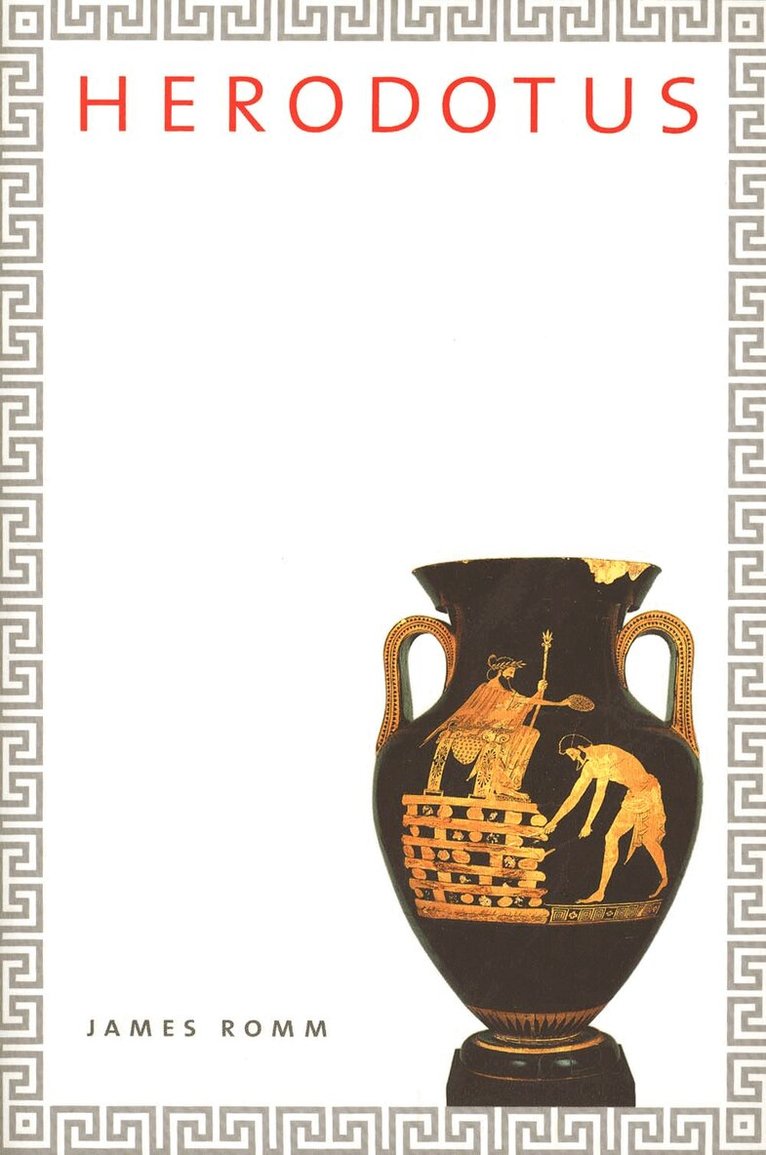
Herodotus, widely known as the father of history, was also described by Aristotle as a mythologos, or "tale-teller." In this stylish and insightful book, intended for both general readers and students, James Romm argues that the author of the Histories was both a historian—in the original sense of "one who inquires"—and a master storyteller.Although most ancient historians wrote only about events they themselves had lived through, Herodotus explored an era well before his own time—from the rise of the Persian Empire to the Persian invasions of Greece in 490 and 480 B.C., the heroic fight of the Greeks against the invaders, and the final Greek victory. Working without the aid of written sources, Herodotus traveled widely and wove into his chronology descriptions of people and countries he visited and anecdotes that shed light on their lives and customs. Romm discusses the historical background of Herodotus`s life and work, his moralistic approach to history, his insatiable fascination with people and places, his literary powers, and the question of the historical "truth" behind the stories he relates. He gives general readers a fresh appreciation of the Histories as a work encompassing fiction and nonfiction, myth and history, and poetry and prose. Herodotus becomes not simply a source of historical data but a masterful and artistic author who created a radically new literary genre.Hermes BooksJohn Herington, Founding Editor
478 kr
Skickas inom 5-8 vardagar
Written around the year 100, Plutarch’s Lives have shaped perceptions of the accomplishments of the ancient Greeks and Romans for nearly two thousand years. This engaging and stimulating book introduces both general readers and students to Plutarch’s own life and work.Robert Lamberton sketches the cultural context in which Plutarch worked—Greece under Roman rule—and discusses his family relationships, background, education, and political career. There are two sides to Plutarch: the most widely read source on Greek and Roman history and the educator whose philosophical and pedagogical concerns are preserved in the vast collection of essays and dialogues known as the Moralia. Lamberton analyzes these neglected writings, arguing that we must look here for Plutarch’s deepest commitment as a writer and for the heart of his accomplishment. Lamberton also explores the connection between biography and historiography and shows how Plutarch’s parallel biographies served the continuing process of cultural accommodation between Greeks and Romans in the Roman Empire. He concludes by discussing Plutarch’s influence and reputation through the ages.