History of Parliament – serie
Visar alla böcker i serien History of Parliament. Handla med fri frakt och snabb leverans.
5 produkter
5 produkter
555 kr
Skickas inom 7-10 vardagar
France, India and the revolt of the American colonies all had an impact on the business of the House during the second half of the eighteenth century, as detailed in these 3 volumes of the History of Parliament.The subject of the Namier/Brooke volumes concerns a period when politics were dominated in turn by the war with France, the accession of george III, the governance of India and the revolt of the American colonies. The repercussions of those problems upon the House provide the main themes of the Introductory Survey. Largely written by John Brooke, it draws heavily on Namier's views on mid to late eighteenth century politics. The three volumes contain 1,966biographical articles and 314 constituency articles.
920 kr
Skickas inom 7-10 vardagar
These 5 volumes cover the period of Britain's long wars with France, and a huge expansion of the business of the House of Commons: Charles Abbot, Speaker from 1802-1817 estimated that the amount of business carried on in the House had quintupled between 1761 and 1813. They include the period of the Union with Ireland and the introduction of 100 Irish MPs. They contain 2,142 biographical articles and 314 constituency articles. The biographical pieces include works on Henry Addington, Sir Frances Burdett, Edmund Burke, George Canning, Viscount Castlereagh, Henry Dundas, Charles James Fox, Spencer Perceval and William Pitt the Younger as well as all the other important, and not soimportant, political figures.
759 kr
Skickas inom 7-10 vardagar
This 4 volume set contains the biographies of 3,175 individuals who sat in the House of Commons in the late 14th and early 15th centuries, providing not only a picture of political affiliations, aim and motives in seeking Membership, but also a study of other preocupations: the contrast between the code of chivalrous conduct and the reality of military service; the competitive pursuit of wealthy heiresses; the sometimes ambivalent relations between thelaity and the Church; and their fluctuating success and failures in the scramble for patronage and preferment from the Crown and baronetage alike.Among those included are poets (Geoffrey Chaucer made an appearance in 1386), pirates (such as the notorious William Long and John Hawley), lollards (including Sir John Oldcastle, who met a traitor's death), henchmen of the king (most notably the infamous Bussy, Bagot and Green) and the most outstanding parliamentarians of the Middle Ages, among them Sir John Tiptoft, perhaps the youngest Speaker ever to be elected, the charismatic Thomas Chaucer (the poet's son), and the intrepid Sir Arnold Savage, whose verbal exchanges withHenry IV throw fresh light on the relationship between King and Commons in the 15th century.Surveys of each of the 135 constituencies represented in Parliament in this period supply a detailed explanation of local politics, while information about the economic and constitutional background of each city and borough provides the context in which the MPs' biographies are set. The Introductory Survey in Volume I, the culmination of a lifetime's dedication to the subject by the distinguished historian J. S. Roskell, provides the most thorough examination yet undertaken of the work of the medieval House of Commons. Appendices supply tables on specific topics discussed in theIntroductory Survey and touched on in the biographies.
8 337 kr
Skickas inom 7-10 vardagar
The most comprehensive and complete study ever compiled about the turbulent period of the English and British Civil Wars and their aftermath.The work of more than thirty years and multiple authors, the long-awaited nine volumes and more than 8,000 pages of The History of Parliament: The House of Commons 1640-1660 make up an enormous resource that historians will regard as the most comprehensive collection of information and analysis ever compiled of the politics of perhaps the most critical and dramatic period of English and British history. During it, a political crisis became a civil war in which the Westminster Parliament confronted, and ultimately defeated King Charles I, putting him on trial and executing him in 1649. Over the following eleven years, the struggle to establish a stable and legitimate government saw the young Republic displaced in 1653 by the army under Oliver Cromwell, Cromwell's assumption of the title of Lord Protector, and, after his death a contest for power that ended with the collapse of the revived Republic and the ultimate Restoration of the monarchy under Charles II. The work's main component is the 1,800 biographies of everyone was elected to the House of Commons between these years, including substantial reinterpretations of the lives of all of the major figures - Cromwell, Pym, Hampden and many others - as well as members of Oliver Cromwell's 'Other House', the second chamber of 1658-9. There are also accounts of the politics and elections of each constituency that returned members to the House of Commons - including the Scottish and Irish counties and towns that did so under the short-lived union constitution of 1653, the Instrument of Government. There are studies of the series of executive committees that were set up by Parliament to manage the enormous tasks of raising money for the war, directing its forces, maintaining its relationships with its allies (especially the Scots), and negotiating with foreign powers. And, finally, there is an introductory survey, summarising and analysing all this material as well as providing an essential political narrative of the period.These volumes contain huge amounts of previously unknown information about the personalities and backgrounds of those involved in politics, and fresh and authoritative interpretation of their manoeuvrings and motivations. They include the lives of the many lesser-known, lower-status figures who came to prominence and entered national politics through service in the military or administrative roles in the parliamentarian war effort, as well as the grander gentry figures who were more familiar at Westminster. They include the charismatic and powerful men who were the backbone of the parliamentary regime such as Henry Marten, or the younger Sir Henry Vane; front-rank soldier-politicians like John Lambert, Henry Ireton or George Monck; and key polemicists such as William Prynne or Edward Hyde. The committee articles for the first time expose the administrative machinery of Parliament's war effort, together with the factional struggles of those involved. Given the detail and comprehensiveness of the biographies, the work will be vital not only for political historians, but for military, literary, social and economic historians of the period; while the constituency histories make a major contribution to local histories across the British Isles.The History of Parliament: The House of Commons 1640-1660 constitutes an essential resource that will transform the way in which we study and think about the English and British Civil Wars.
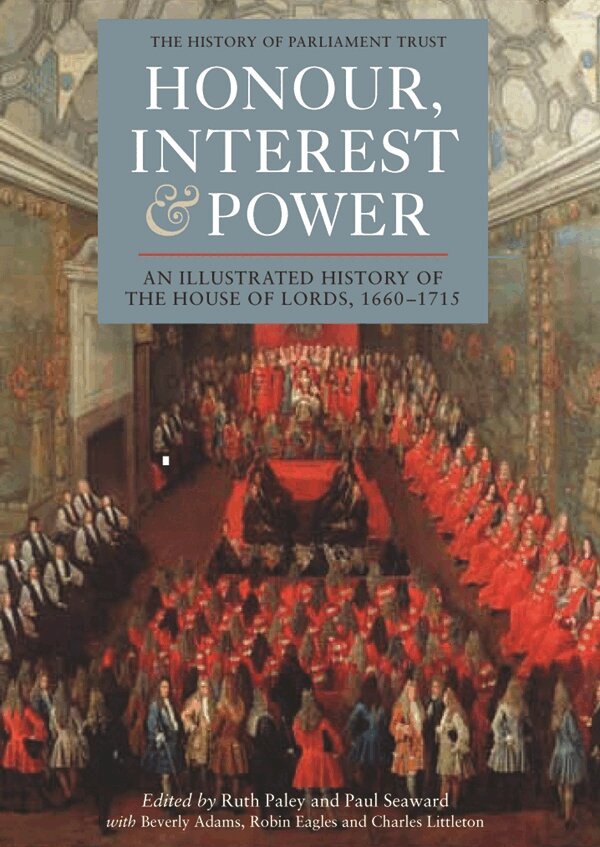
Honour, Interest and Power: an Illustrated History of the House of Lords, 1660-1715
Inbunden, Engelska, 2010
383 kr
Skickas inom 7-10 vardagar
The House of Lords presented the stage on which some of the critical confrontations in English and British constitutional and political history were played out in the late seventeenth and early eighteenth century. Published for the History of Parliament Trust.Condemned as 'useless and dangerous', the House of Lords was abolished in the revolution of 1649, shortly after the execution of King Charles I. Reinstated, along with the monarchy, at the Restoration of 1660, the House of Lords vigorously renewed its involvement in the political life of the nation. This highly illustrated book presents the first results from the research undertaken by the History of Parliament Trust on the peers and bishops between the Restoration and the accession of George I. It shows them as politicians at Westminster; as members of an elite intensely conscious of their honour and status; as a class apart, always devising new schemes - successful and unsuccessful - to increase their wealth and 'interest'; and as local grandees, to whom local society looked for leadership and protection. From the proud duke of Somerset to the beggarly Lord Mohun, from the devious earl of Oxford to the disgruntled Lord Lucas, the material here presents initial insights into the nature of the Restoration House of Lords and the men who formed it, showing them in their best moments, when they vigorously defended the law and the constitution, and in their worst, as they obsessively concerned themselves with honour and precedence and indefatigably pursued private interests. RUTH PALEY is editor, and BEVERLY ADAMS, ROBIN EAGLES and CHARLES LITTLETON are senior research fellows, for the House of Lords, 1660-1832 section of The History of Parliament. PAUL SEAWARD is director of The History of Parliament.