Independent Studies in Political Economy – serie
Visar alla böcker i serien Independent Studies in Political Economy. Handla med fri frakt och snabb leverans.
3 produkter
3 produkter
1 194 kr
Skickas inom 10-15 vardagar
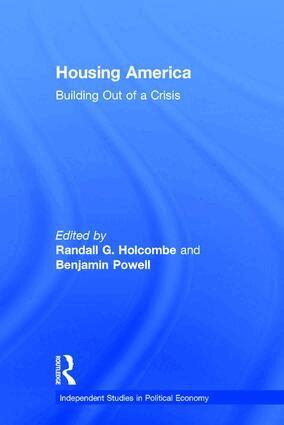
Housing policy not only aff ects all Americans' quality of life, but has a direct impact on their fi nancial well being. About 70 percent of American households own their own homes, and for most, their homes represent the majority of their net worth. Renters are aff ected by housing policy. Even the small minority of Americans who are homeless are aff ected by housing policies specifi cally targeted to low-income individuals.The government's increasing involvement in housing markets, fed by popular demand that government "do something" to address real problems of mortgage defaults and loans, provides good reason to take a new look at the public sector in housing markets. Crises in prime mortgage lending may lower the cost of housing, but the poor and homeless cannot benefi t because of increases in unemployment. Even the private market is heavily regulated. Government policies dictate whether people can build new housing on their land, what type of housing they can build, the terms allowed in rental contracts, and much more.This volume considers the eff ects of government housing policies and what can be done to make them work better. It shows that many problems are the result of government rules and regulations. Even in a time of foreclosures, the market can still do a crucial a job of allocating resources, just as it does in other markets. Consequently, the appropriate policy response may well be to signifi cantly reduce, not increase, government presence in housing markets. Housing America is a courageous and comprehensive eff ort to examine housing policies in the United States and to show how such policies aff ect the housing market.
2 176 kr
Skickas inom 10-15 vardagar
Water is becoming increasingly scarce. If recent usage trends continue, shortages are inevitable. Aquanomics discusses some of the instruments and policies that may be implemented to postpone, or even avoid, the onset of "water crises." These policies include establishing secure and transferable private water rights and extending these rights to uses that traditionally have not been allowed, including altering in-stream flows and ecosystem functions. The editors argue that such policies will help maximize water quantity and quality as water becomes scarcer and more valuable. Aquanomics contains many examples of how this is being accomplished, particularly in the formation of water markets and market-like exchanges of water rights.Many observers see calamity ahead unless water supplies are harnessed and effectively conserved, and unless water quality can be improved. It is also clear that declining water quality is a serious problem in much of the world, as increasing human activities induce high levels of water degradation. Those who voice these concerns, argue the contributors to this volume, fail to consider the forces for improvement inherent in market political-economic systems that can address water issues. The contributors see water quality in economically advanced countries as improving, and they believe this establishes the validity of market-based approaches.
693 kr
Skickas inom 10-15 vardagar
Water is becoming increasingly scarce. If recent usage trends continue, shortages are inevitable. Aquanomics discusses some of the instruments and policies that may be implemented to postpone, or even avoid, the onset of "water crises." These policies include establishing secure and transferable private water rights and extending these rights to uses that traditionally have not been allowed, including altering in-stream flows and ecosystem functions. The editors argue that such policies will help maximize water quantity and quality as water becomes scarcer and more valuable. Aquanomics contains many examples of how this is being accomplished, particularly in the formation of water markets and market-like exchanges of water rights.Many observers see calamity ahead unless water supplies are harnessed and effectively conserved, and unless water quality can be improved. It is also clear that declining water quality is a serious problem in much of the world, as increasing human activities induce high levels of water degradation. Those who voice these concerns, argue the contributors to this volume, fail to consider the forces for improvement inherent in market political-economic systems that can address water issues. The contributors see water quality in economically advanced countries as improving, and they believe this establishes the validity of market-based approaches.