International Association for the Study of Arabia Monographs – serie
Visar alla böcker i serien International Association for the Study of Arabia Monographs. Handla med fri frakt och snabb leverans.
7 produkter
7 produkter
Del 17 - International Association for the Study of Arabia Monographs
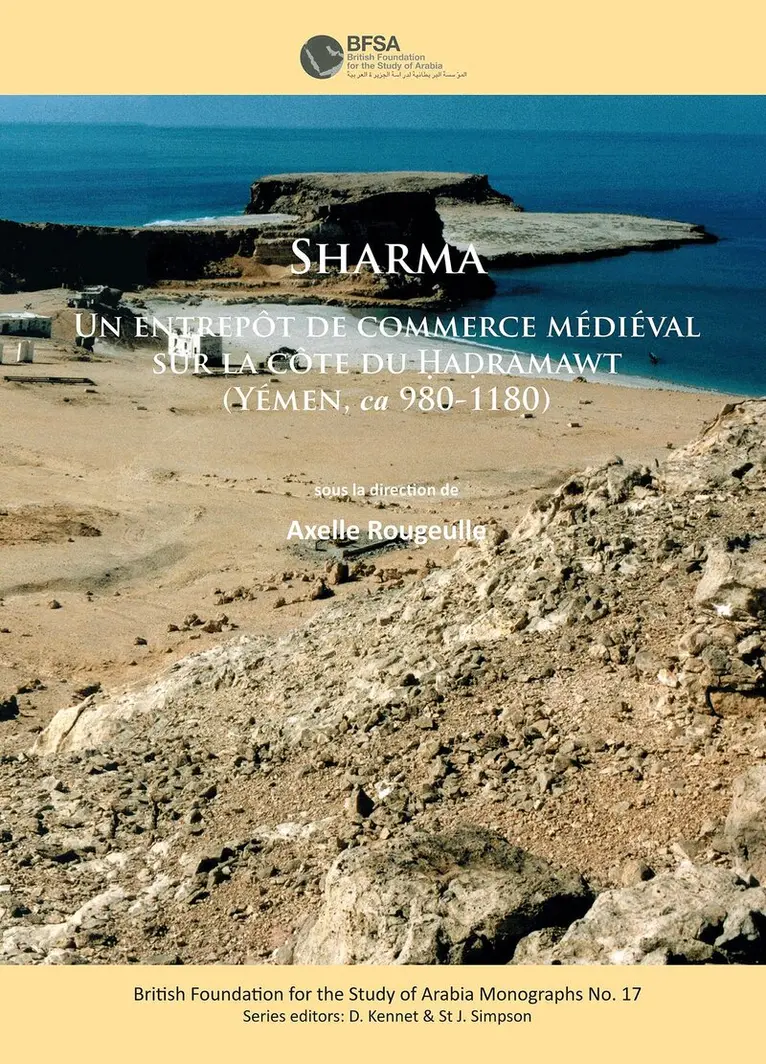
Sharma
Un entrepôt de commerce medieval sur la côte du Ḥaḍramawt (Yémen, ca 980-1180)
Häftad, Engelska, 2015
1 323 kr
Skickas
Cited by al-Muqaddasī in c.985 and then by al-Idrīsī in c.1150, the medieval port of Sharma was discovered in 1996 at the extremity of the Ra's Sharma, 50km east of al-Shiḥr on the Ḥaḍramawt coast of Yemen; it was excavated in 2001-2005. This unique site was actually a transit entrepôt, a cluster of warehouses probably founded by Iranian merchants and entirely devoted to the maritime trade. It knew a rather short period of activity, between around 980 and the second half of the 12th century, which may be acknowledged as the Sharma horizon. Excavations proved that this settlement experienced six occupation phases, which are closely related to the political and economic developments in the region at that time. The material is mainly transit merchandises, small objects, resins, glass and pottery; some of the ceramics were locally made, in the nearby kilns of Yaḍghaṭ, but most (70%) were imported, from all parts of the Indian Ocean from China to East Africa. The typo-chronological study of this closed assemblage brings very precise information on the dating and evolution of the various types recorded, and the historical analyse sheds new light on the history of the Islamic maritime trade in the 10th to 12th centuries. French text throughout.
Del 18 - International Association for the Study of Arabia Monographs
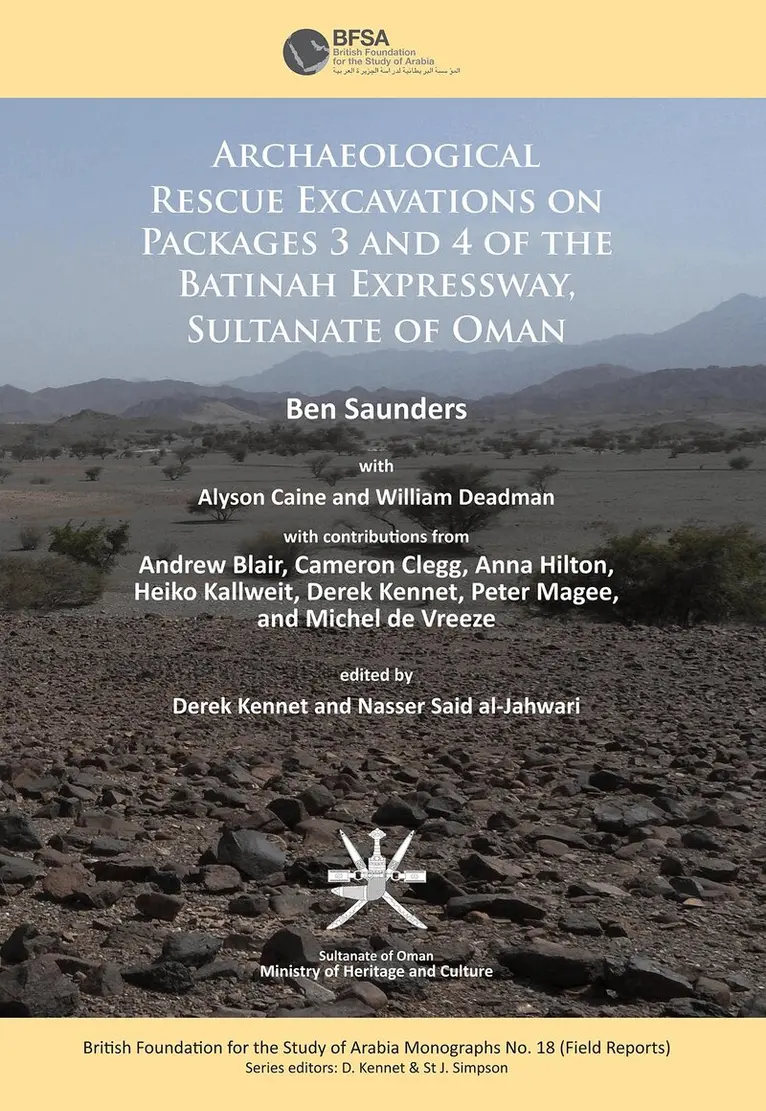
Archaeological rescue excavations on Packages 3 and 4 of the Batinah Expressway, Sultanate of Oman
Häftad, Engelska, 2016
680 kr
Skickas
The archaeological excavations along the route of packages 3 and 4 of the Batinah Expressway, Sultanate of Oman, conducted during the spring and summer of 2014, recorded over 60 archaeological sites over the 200km stretch of roadway cutting through the Batinah plain, north-west of Muscat. The majority of these sites were prehistoric tombs of varying ages. These excavations have allowed a re-thinking of the dating of some of these tombs, looking particularly at the structural styles of the tombs as well as their location in the landscape. It has also demonstrated techniques of rapid yet reliable excavation and recording techniques adapted from UK commercial archaeology for the Omani conditions. The report builds on the work of academic studies and adds a large dataset to the archaeology of the Batinah, Oman and the wider region. It is hoped that this will allow a wider scale reconsideration of the burial styles of the prehistoric Gulf.
Del 19 - International Association for the Study of Arabia Monographs
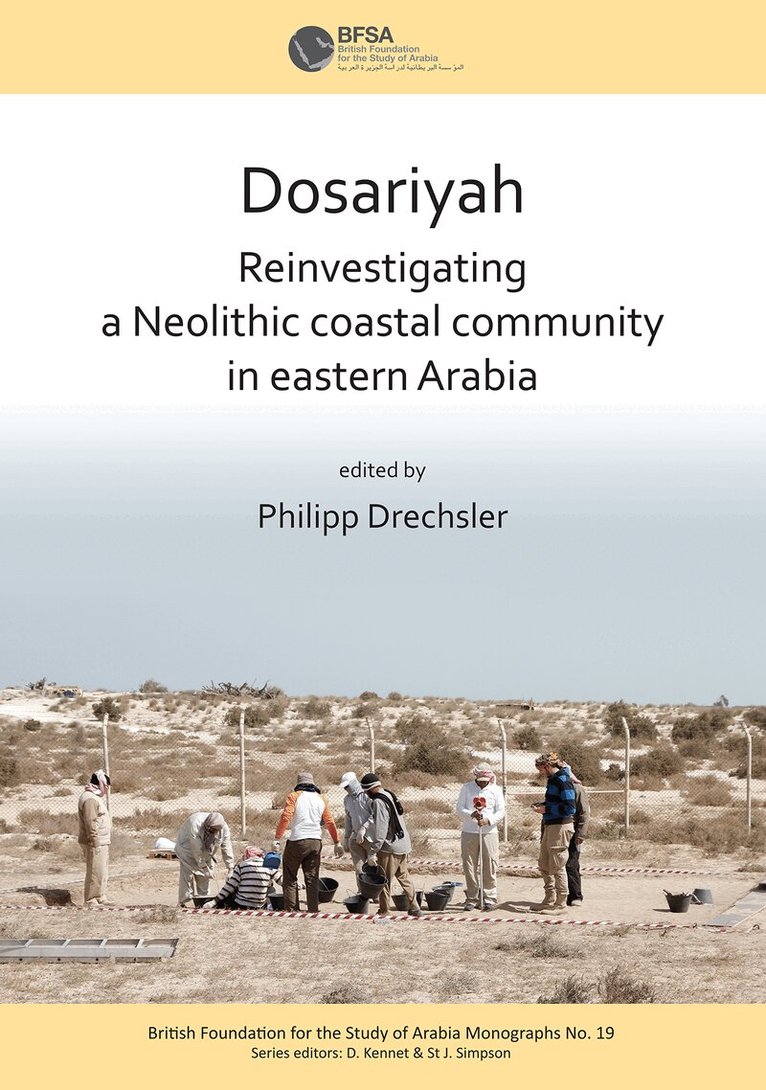
Dosariyah: An Arabian Neolithic Coastal Community in the Central Gulf
Häftad, Engelska, 2018
1 204 kr
Skickas
Dosariyah: Reinvestigating a Neolithic coastal community in eastern Arabia' describes the work carried out at Dosariyah, located in the Eastern Province of Saudi Arabia, which took place between 2010 and 2014. It was conducted by the joint German-Saudi Dosariyah Archaeological Research Project (DARP). A wealth of material remains was found during excavations within almost three metres of anthropogenic deposits. Radiocarbon dates and comparative studies of artefacts securely date the occupation of the site into the first centuries of the fifth millennium BC. The co-occurrence of locally produced artefacts that are technologically and typologically rooted in the local Arabian Middle Neolithic, and imports from southern Mesopotamia is characteristic of Dosariyah. However, the mechanisms behind this distribution of foreign materials along the Arabian Gulf coast, in particular, are still poorly understood. It is the central proposition of this book that the local societies living along the shores of the Arabian Gulf coast played an active role in the acquisition of Ubaid pottery and other objects originating in southern Mesopotamia. A predominance of imported objects, considered as ‘exotic items’, are understood as integral components of rituals that were part of temporary gatherings of larger groups of people at Dosariyah. Based on the material evidence from the site, such collective social events were embedded in everyday life during the fifth millennium BC.
Del 20 - International Association for the Study of Arabia Monographs
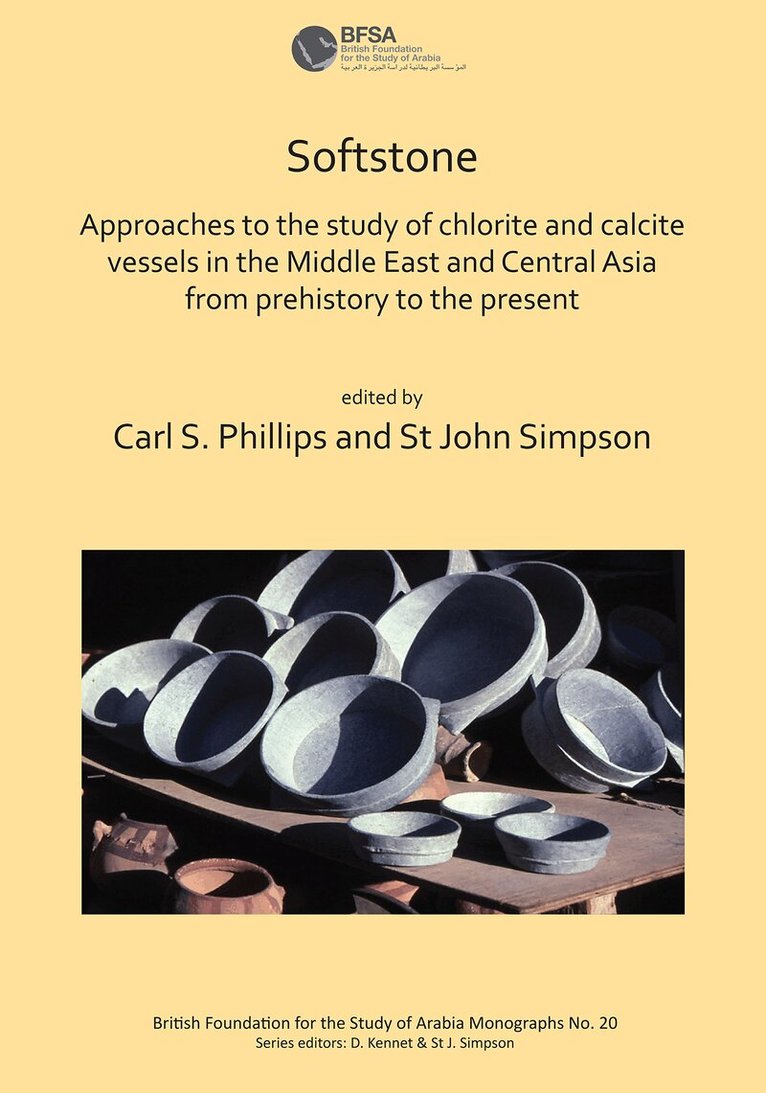
Softstone: Approaches to the study of chlorite and calcite vessels in the Middle East and Central Asia from prehistory to the present
Häftad, Engelska, 2018
680 kr
Skickas
Stone containers have been made and used in the Middle East for over eleven millennia where they pre-dated the invention of pottery and were widely traded. The appearance or properties of the stone helped govern how stone vessels were valued or used and many classes were strictly utilitarian, being used for storage, cooking or lighting. Others were decorated and at times they were considered valuable exotica, particularly in regions far removed from their source areas. The subject of stone vessels is attracting growing attention but this is the first attempt to bring together different approaches to the study of softstone vessels, particularly but not exclusively those carved from varieties of chlorite, and covering all periods from prehistory to the present.
531 kr
Skickas
Surveys by the French Archaeological Mission in Jawf-?a?ramawt (1992–1993) documented prehistoric and protohistoric sites along the palaeo-river. Despite informal data, findings offer insights into Yemen's archaeological map, including prehistoric, Bronze Age, and South Arabian sites, and inscriptions amid changes to the modern landscape.
Del 22 - International Association for the Study of Arabia Monographs
Umm al-Quwain 2
A Neolithic settlement and graveyard in the United Arab Emirates
Inbunden, Engelska, 2025
905 kr
Skickas
This volume examines the Neolithic period in Eastern Arabia, focusing on the coastal site of UAQ2 in Umm al-Quwain, United Arab Emirates. Based on years of excavations and surveys conducted by the French Archaeological Mission in the UAE, it explores how coastal communities lived and adapted between the 8th and 6th millennia before present. The book highlights the unique features of UAQ2, including its well-preserved stratigraphy, which provides insights into settlement patterns, subsistence strategies, and burial practices. These findings offer a detailed understanding of how these communities sustained themselves through fishing, hunting, and herding. The site contains one of the oldest known graveyards in the Arabian Gulf, revealing evidence of inter-group violence and symbolic practices linked to ancient pearling traditions. In addition to examining local practices, this monograph places UAQ2 within broader regional networks. It explores connections with Mesopotamia, demonstrated by Ubaid pottery, and links with the Sultanate of Oman, reflected in shared material culture and technologies. These interactions underline the UAE’s significant place in regional exchange during the Neolithic. The study also considers the impact of environmental changes on human mobility and settlement, including the effects of aridification and shifting coastal landscapes. By integrating archaeological and environmental analyses, this book enhances our understanding of the Neolithic period in Eastern Arabia and its place within the wider prehistoric world.
Del 23 - International Association for the Study of Arabia Monographs
Two Late Umm an-Nar Tombs at Mowaihat-Ajman, United Arab Emirates
Excavations and Human Bone Remains
Häftad, Engelska, 2025
531 kr
Skickas
Two Late Umm a-Nar Tombs at Mowaihat-Ajman, United Arab Emirates presents information resulting from rescue excavations at two collective tombs (A and B), belonging to the last quarter of the third millennium BC. The excavations at Tomb A, a disturbed above-ground, circular grave, and the diversity of the materials discovered in Tomb B, a rectangular subterranean pit-grave, in the mid-1980s, have confirmed that the sphere of the Umm an-Nar Culture in the United Arab Emirates is much wider than originally thought. Whilst Tomb A was fully excavated, Tomb B was only partially uncovered (Al Tikriti 1989). Excavation at the latter was completed by Late Ernie Haerinck (1991). The aim of this report is therefore to summarize the two preliminary published reports, and more importantly, to introduce an osteological study on the human bone remains from Tomb B. Since the discovery of the Umm an-Nar culture by the Danish Archaeological Expedition in the late 1950s, subterranean tombs of the period are still rare. Tomb N at Hili and Tomb B in Ajman are the only ones known so far. However, despite belonging to the same period and showing similarities in burial customs, the bone study of the Ajman remains demonstrated some differences between the dead of Tombs B and N.