Issues in Twenty-First Century Warfare - Böcker
Visar alla böcker i serien Issues in Twenty-First Century Warfare. Handla med fri frakt och snabb leverans.
4 produkter
4 produkter
259 kr
Skickas inom 10-15 vardagar
In this concise and penetrating study, Roger Barnett illuminates the effect of operational, organizational, legal, and moral constraints on the ability of the U.S. to use military force. As the tragic events of September 11 demonstrated, potential adversaries can take advantage of these limitations, thus spawning "asymmetrical warfare." Barnett defines asymmetrical warfare as not simply a case of pitting one's strength against another's weakness but rather of taking the calculated risk to exploit an adversary's inability or unwillingness to prevent, or defend against, certain actions. For instance, launching chemical, biological, or suicide attacks; taking indiscriminate actions against critical infrastructure; using hostages or human shields; deliberately destroying the environment; and targeting noncombatants all constitute possible asymmetrical warfare scenarios. Against these acts, the U.S. has not prepared any response in kind. Indeed it either cannot or will not undertake such responses, thus making these attacks especially difficult to counter. This refusal to retaliate in an "eye for an eye" fashion complicates the dilemma of American policymakers who seek to wield power and influence on the world stage while simultaneously projecting a peaceful and benign image. Barnett concludes that the U.S. must create a formal system of selectively eliminating the constraints that dictate our response to certain situations or scenarios. Failure to make such changes will only increase paralysis and, when the use of force is required, contribute to the already heightened risks.
517 kr
Skickas inom 7-10 vardagar
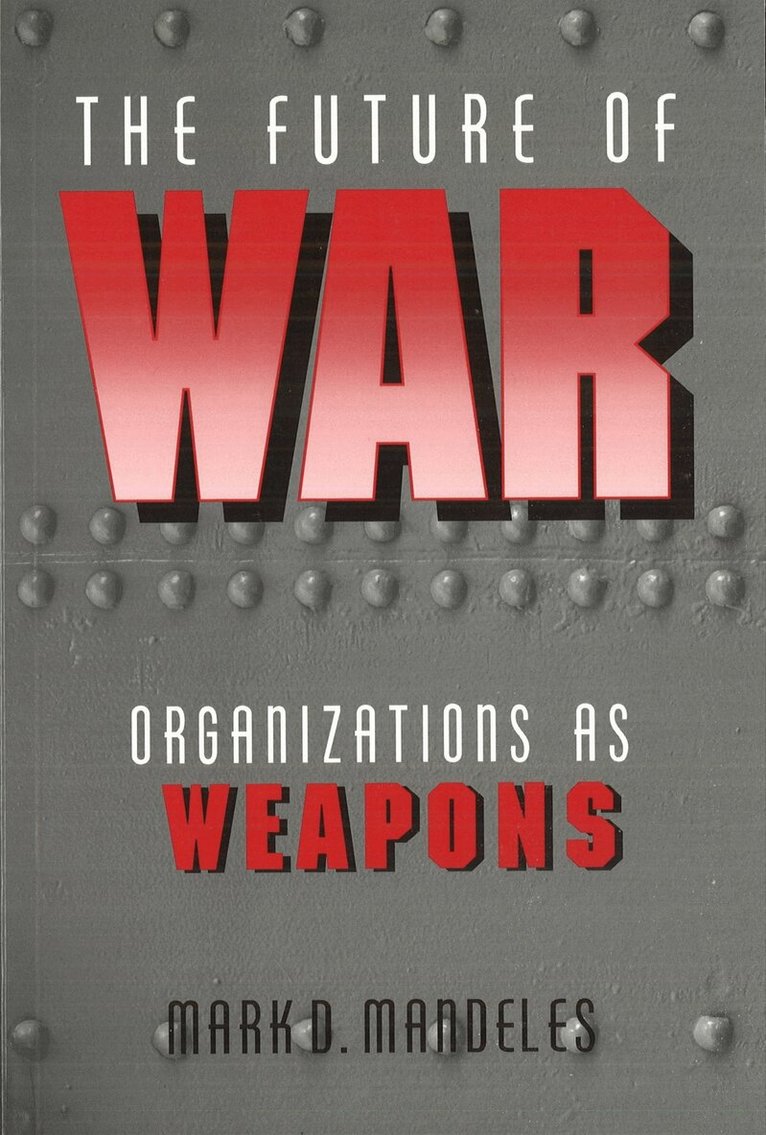
Many analysts have heralded the U.S. military's Revolution in Military Affairs (RMA), a qualitative improvement in operational concepts and weapons that transforms the nature and character of warfare. Focusing on military technology, most argue that the new sensor, surveillance, communications, and computational technologies will usher in a period in which U.S. military capabilities will far exceed those of potential competitors. Developments in such fields as nanotechnology, robotics, and genetic engineering will greatly influence new weapons designs of the twenty-first century. These discussions about military revolutions, however, too often ignore or only pay lip service to the role of military organization in improving combat capability. They downplay the relationship between organizational structure and outcomes, the difficulties of coordinating large organizations composed of many people and offices having specialized roles, and the challenges of calculation, attention, and memory that face individuals making decisions with inadequate or ambiguous information under short deadlines or stressful situations. Mark D. Mandeles argues that the key to future combat effectiveness is not in acquiring new technologies but rather in the Defense Department's institutional and organizational structure and its effect upon incentives to invent, to innovate, and to conduct operations effectively. Doing so requires the military establishment to resist incentives to substitute short-term technological gains for long-term operational advantages and to maintain incentives for effective long-term innovation.
272 kr
Skickas inom 10-15 vardagar
The modern means of communication have turned the world into an information fishbowl and, in terms of foreign policy and national security in post-Cold War power politics, helped transform international power politics. Information operations (IO), in which time zones are as important as national boundaries, is the use of modern technology to deliver critical information and influential content in an effort to shape perceptions, manage opinions, and control behavior. Contemporary IO differs from traditional psychological operations practiced by nation-states, because the availability of low-cost high technology permits nongovernmental organizations and rogue elements, such as terrorist groups, to deliver influential content of their own as well as facilitates damaging cyber-attacks ("hactivism") on computer networks and infrastructure. As current vice president Dick Cheney once said, such technology has turned third-class powers into first-class threats. Conceived as a textbook by instructors at the Joint Command, Control, and Information Warfare School of the U.S. Joint Forces Staff College and involving IO experts from several countries, this book fills an important gap in the literature by analyzing under one cover the military, technological, and psychological aspects of information operations. The general reader will appreciate the examples taken from recent history that reflect the impact of IO on U.S. foreign policy, military operations, and government organization.
259 kr
Skickas inom 10-15 vardagar
In Leigh Armistead's second edited volume on warfare in the Information Age, the authors explore the hype over possibilities versus actuality in their analysis of Information Operations (IO) today. First, leaders must better understand the informational element of national power, and second, their sole focus on technology must expand to include IO's physical interconnectivity, content, and cognitive dimensions. Finally the authors urge the United States to use its enormous IO advantage to deal with complex national security issues beyond the Department of Defense, for example, in swaying global opinion and influencing other populations. Armistead and his colleagues set aside the hype and conjecture concerning IO, because its real potential is more powerful and comprehensive than currently appreciated. In a straightforward format they take practitioners on the path toward a smart and effective way of waging IO. While the original claims of "bloodless" wars or of computer hackers plunging North America into a new "dark age" of constant electric grid collapses quickly raised awareness of new threats and capabilities in the Information Age, these scenarios strain credulity and hamper our understanding of those threats and capabilities. This volume corrects this situation, grounding IO in the real world, and concentrates on its actual challenges, capabilities, and accomplishments. Information Warfare will be an indispensable guide and reference work for professionals and students in the fields of national security.