Jefferson Memorial Lectures - Böcker
Visar alla böcker i serien Jefferson Memorial Lectures. Handla med fri frakt och snabb leverans.
8 produkter
8 produkter
684 kr
Skickas inom 3-6 vardagar
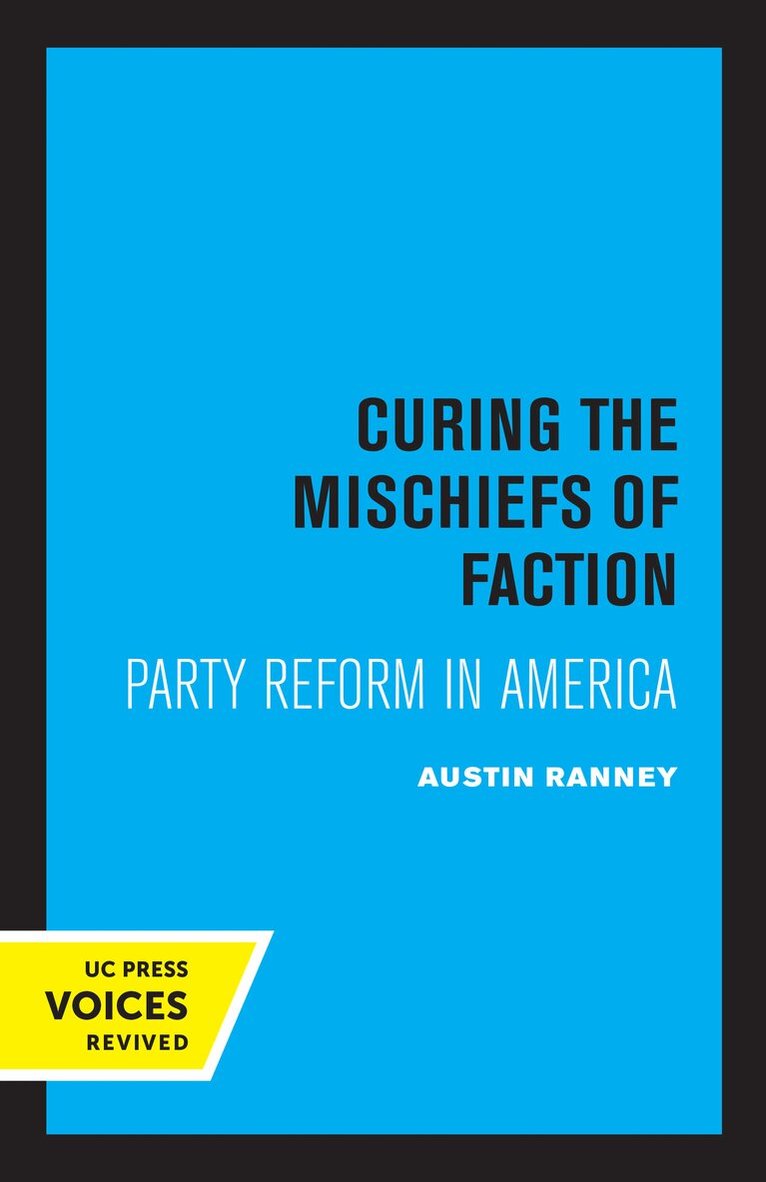
Curing the Mischiefs of Faction: Party Reform in America offers a profound exploration of the history and challenges of political party reform in the United States. Originating from the Jefferson Memorial Lectures at UC Berkeley, the book examines pivotal moments of transformation, from the end of congressional caucuses for presidential nominations in the 1820s to the groundbreaking McGovern-Fraser reforms of the 1970s. By intertwining historical narrative with insights from the author’s direct involvement in party reform efforts, the book illuminates how these changes have shaped—and been shaped by—the broader dynamics of American democracy.Rather than following a strict chronological approach, the book organizes its discussion around recurring themes and enduring debates in party reform. This structure highlights the persistent tensions between inclusivity, governance, and representation that have influenced reform efforts throughout history. By examining these recurring issues with both scholarly depth and practical perspective, the book provides a rich resource for understanding the complexities of reforming political institutions in a way that balances democratic ideals with functional governance.This title is part of UC Press's Voices Revived program, which commemorates University of California Press’s mission to seek out and cultivate the brightest minds and give them voice, reach, and impact. Drawing on a backlist dating to 1893, Voices Revived makes high-quality, peer-reviewed scholarship accessible once again using print-on-demand technology. This title was originally published in 1975.
705 kr
Skickas inom 3-6 vardagar
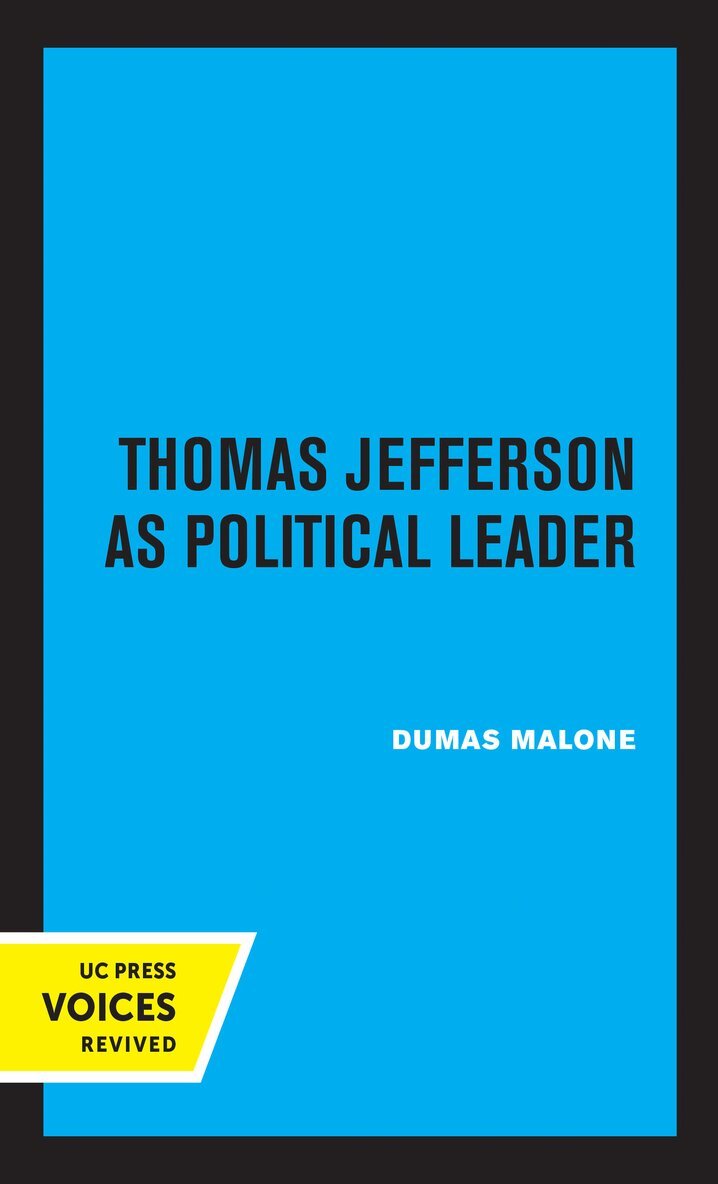
Thomas Jefferson as Political Leader by Dumas Malone distills three public lectures delivered at the University of California, Berkeley, in 1962. Written in a semipopular style for a general audience, the book focuses on Jefferson’s evolution into party leadership, a role often seen as incongruous with his broader reputation as statesman, diplomat, and intellectual. Malone highlights how Jefferson—initially reluctant to be characterized as a partisan—only fully acknowledged himself as a party leader after becoming Vice President in 1797, with decades of public service already behind him. The lectures chart his path from opposition figure to president, when the nature of his leadership and circumstances shifted significantly.Malone underscores Jefferson’s unusual approach to political leadership. Unlike most figures who achieve prominence through eloquent oratory, Jefferson rarely spoke publicly and never delivered campaign speeches, preferring the written word. Yet even his major documents—such as the Declaration of Independence—were drafted as institutional rather than personal statements. His greatest influence often came through private letters to individuals, which reveal both his guiding principles and his most extravagant views. Jefferson avoided direct appeals to crowds, valued privacy, and eschewed demagoguery, yet he maintained deep personal warmth, hospitality, and intellectual breadth. These qualities—paired with his aversion to mass politics—set him apart from contemporaries like Hamilton and Adams. Malone suggests that Jefferson’s effectiveness lay in his unique blend of intellect, personal relationships, and strategic communication, which enabled him to command loyalty and shape a political movement without conventional methods of mass leadership. The book offers an interpretive narrative of how Jefferson reconciled his intellectual, private temperament with the demands of party leadership in a period of fierce political conflict.This title is part of UC Press's Voices Revived program, which commemorates University of California Press’s mission to seek out and cultivate the brightest minds and give them voice, reach, and impact. Drawing on a backlist dating to 1893, Voices Revived makes high-quality, peer-reviewed scholarship accessible once again using print-on-demand technology. This title was originally published in 1963.
665 kr
Skickas inom 3-6 vardagar
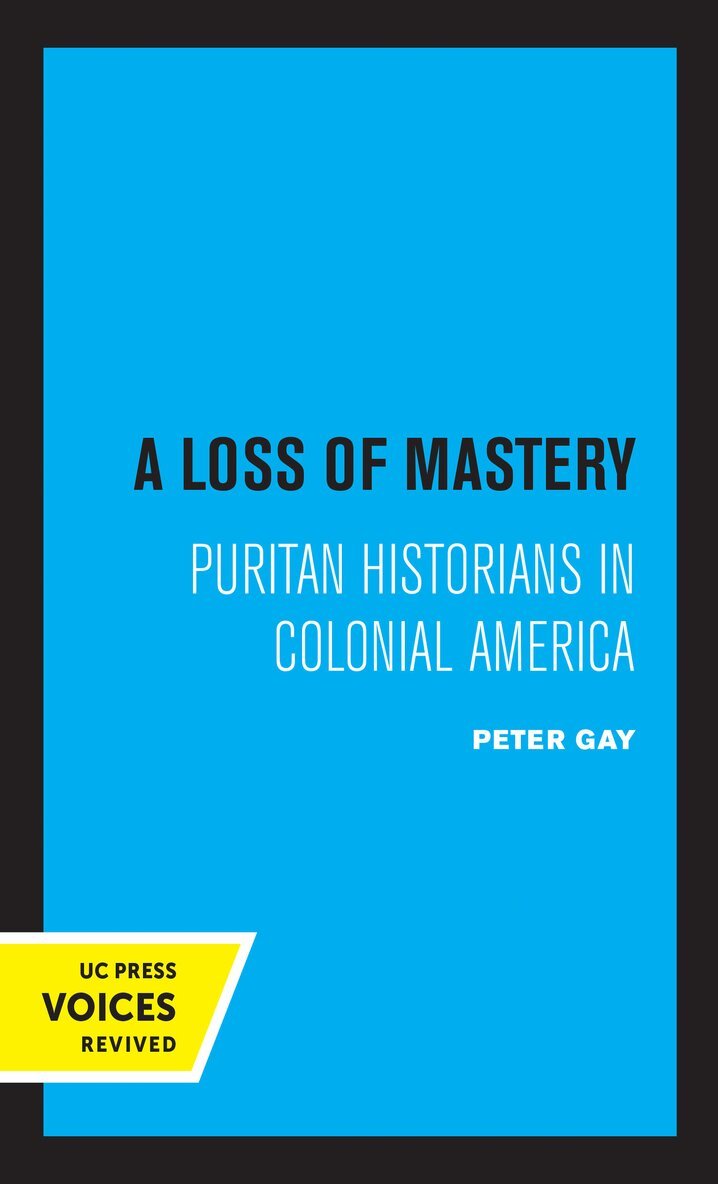
A Loss of Mastery: Puritan Historians in Colonial America by Peter Gay offers a brilliant exploration of how early New Englanders wrote their history and what that writing reveals about the Puritan mind. Drawing on figures from William Bradford and Cotton Mather to Jonathan Edwards, Gay shows how colonial historians sought to order the turbulence of settlement, theology, and politics into a providential narrative. At the heart of the book is the paradox that the Puritans, for all their obsession with recording God’s design in history, failed to develop the historical consciousness that was transforming Europe in the seventeenth and eighteenth centuries.Written originally as Jefferson Memorial Lectures, Gay’s study balances intellectual history with close readings of canonical Puritan texts. It traces the evolution of a historiography that began in heroic self-justification but descended into elegiac lamentations of decline. For Gay, this trajectory reveals both the grandeur and the limitations of the Puritan experiment: the effort to live within a providential frame of history that could not withstand the modernizing pressures of Enlightenment thought. A Loss of Mastery thus illuminates not only the Puritan worldview but also the larger problem of cultural adaptation in the New World.This title is part of UC Press's Voices Revived program, which commemorates University of California Press’s mission to seek out and cultivate the brightest minds and give them voice, reach, and impact. Drawing on a backlist dating to 1893, Voices Revived makes high-quality, peer-reviewed scholarship accessible once again using print-on-demand technology. This title was originally published in 1966.
646 kr
Skickas inom 3-6 vardagar
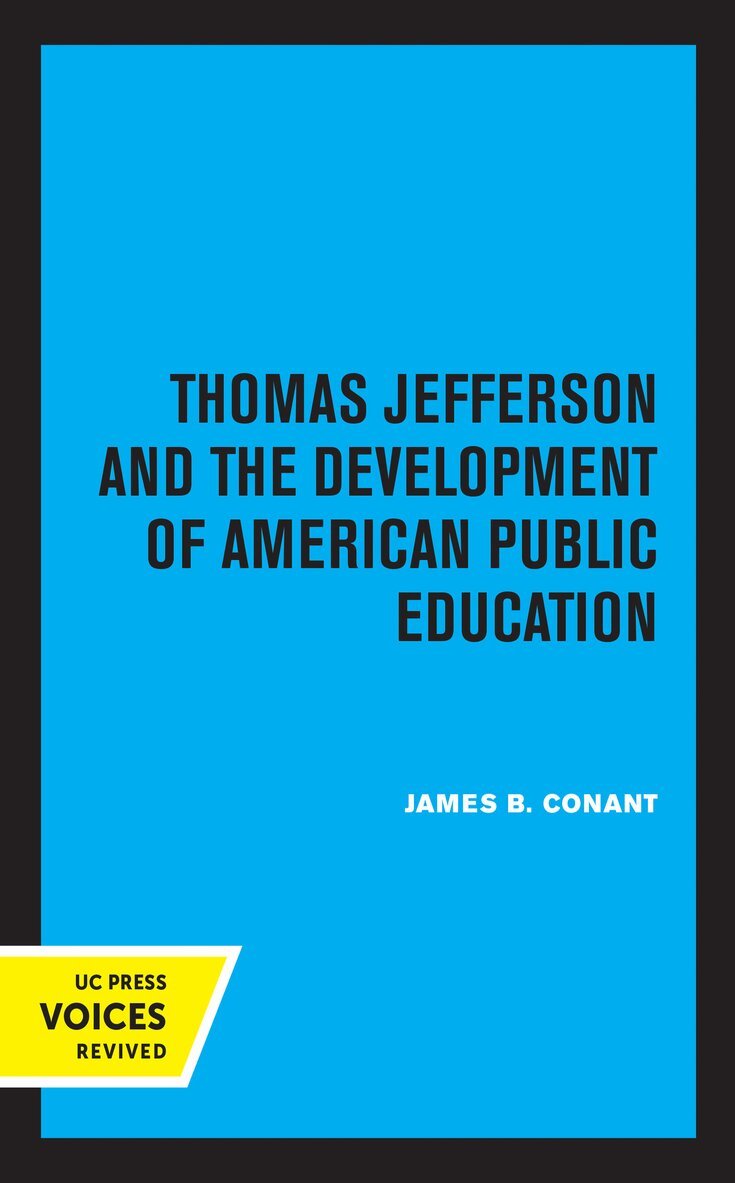
Thomas Jefferson and the Development of American Public Education by James B. Conant originates from the Jefferson Memorial Lectures delivered at the University of California in 1960. Conant uses this platform to revisit Jefferson’s role as both a visionary political leader and an educational innovator, situating his ideas within the broader trajectory of American schooling. Having earlier spoken on the Jeffersonian tradition in education while serving as President of Harvard, Conant now expands beyond selective scholarship schemes to address Jefferson’s entire philosophy of public education. He explores Jefferson’s proposals for free education at all levels for talented but impoverished youth, his advocacy for diffusion of knowledge as a safeguard for democracy, and his attempts to establish systematic schooling in Virginia. The first two chapters trace Jefferson’s wide-ranging contributions to educational thought, while the third returns to the enduring question of access and merit in American society.Conant’s study also places Jefferson’s educational vision in historical context, juxtaposing his unfulfilled proposals with the actual development of public education across the nineteenth century and beyond. By linking Jefferson’s democratic ideals to the eventual rise of America’s unique system of public schools, Conant underscores both the originality and the limitations of Jefferson’s initiatives. The volume includes a substantial appendix of Jefferson’s own writings—letters, legislative drafts, and reports—that reveal his commitment to education as a cornerstone of republican government. For Conant, understanding Jefferson’s educational philosophy is not merely an exercise in historical appreciation; it is a way of grasping how foundational ideals shaped, and continue to shape, the evolving structure of American schooling. The book thus bridges biography, intellectual history, and policy analysis, highlighting the lasting significance of Jefferson’s educational thought for modern debates about equity, opportunity, and the civic purposes of education.This title is part of UC Press's Voices Revived program, which commemorates University of California Press’s mission to seek out and cultivate the brightest minds and give them voice, reach, and impact. Drawing on a backlist dating to 1893, Voices Revived makes high-quality, peer-reviewed scholarship accessible once again using print-on-demand technology. This title was originally published in 1962.
1 513 kr
Skickas inom 3-6 vardagar
Curing the Mischiefs of Faction: Party Reform in America offers a profound exploration of the history and challenges of political party reform in the United States. Originating from the Jefferson Memorial Lectures at UC Berkeley, the book examines pivotal moments of transformation, from the end of congressional caucuses for presidential nominations in the 1820s to the groundbreaking McGovern-Fraser reforms of the 1970s. By intertwining historical narrative with insights from the author’s direct involvement in party reform efforts, the book illuminates how these changes have shaped—and been shaped by—the broader dynamics of American democracy.Rather than following a strict chronological approach, the book organizes its discussion around recurring themes and enduring debates in party reform. This structure highlights the persistent tensions between inclusivity, governance, and representation that have influenced reform efforts throughout history. By examining these recurring issues with both scholarly depth and practical perspective, the book provides a rich resource for understanding the complexities of reforming political institutions in a way that balances democratic ideals with functional governance.This title is part of UC Press's Voices Revived program, which commemorates University of California Press’s mission to seek out and cultivate the brightest minds and give them voice, reach, and impact. Drawing on a backlist dating to 1893, Voices Revived makes high-quality, peer-reviewed scholarship accessible once again using print-on-demand technology. This title was originally published in 1975.
737 kr
Skickas inom 7-10 vardagar
Thomas Jefferson and the Development of American Public Education by James B. Conant originates from the Jefferson Memorial Lectures delivered at the University of California in 1960. Conant uses this platform to revisit Jefferson’s role as both a visionary political leader and an educational innovator, situating his ideas within the broader trajectory of American schooling. Having earlier spoken on the Jeffersonian tradition in education while serving as President of Harvard, Conant now expands beyond selective scholarship schemes to address Jefferson’s entire philosophy of public education. He explores Jefferson’s proposals for free education at all levels for talented but impoverished youth, his advocacy for diffusion of knowledge as a safeguard for democracy, and his attempts to establish systematic schooling in Virginia. The first two chapters trace Jefferson’s wide-ranging contributions to educational thought, while the third returns to the enduring question of access and merit in American society.Conant’s study also places Jefferson’s educational vision in historical context, juxtaposing his unfulfilled proposals with the actual development of public education across the nineteenth century and beyond. By linking Jefferson’s democratic ideals to the eventual rise of America’s unique system of public schools, Conant underscores both the originality and the limitations of Jefferson’s initiatives. The volume includes a substantial appendix of Jefferson’s own writings—letters, legislative drafts, and reports—that reveal his commitment to education as a cornerstone of republican government. For Conant, understanding Jefferson’s educational philosophy is not merely an exercise in historical appreciation; it is a way of grasping how foundational ideals shaped, and continue to shape, the evolving structure of American schooling. The book thus bridges biography, intellectual history, and policy analysis, highlighting the lasting significance of Jefferson’s educational thought for modern debates about equity, opportunity, and the civic purposes of education.This title is part of UC Press's Voices Revived program, which commemorates University of California Press’s mission to seek out and cultivate the brightest minds and give them voice, reach, and impact. Drawing on a backlist dating to 1893, Voices Revived makes high-quality, peer-reviewed scholarship accessible once again using print-on-demand technology. This title was originally published in 1962.
1 469 kr
Skickas inom 3-6 vardagar
A Loss of Mastery: Puritan Historians in Colonial America by Peter Gay offers a brilliant exploration of how early New Englanders wrote their history and what that writing reveals about the Puritan mind. Drawing on figures from William Bradford and Cotton Mather to Jonathan Edwards, Gay shows how colonial historians sought to order the turbulence of settlement, theology, and politics into a providential narrative. At the heart of the book is the paradox that the Puritans, for all their obsession with recording God’s design in history, failed to develop the historical consciousness that was transforming Europe in the seventeenth and eighteenth centuries.Written originally as Jefferson Memorial Lectures, Gay’s study balances intellectual history with close readings of canonical Puritan texts. It traces the evolution of a historiography that began in heroic self-justification but descended into elegiac lamentations of decline. For Gay, this trajectory reveals both the grandeur and the limitations of the Puritan experiment: the effort to live within a providential frame of history that could not withstand the modernizing pressures of Enlightenment thought. A Loss of Mastery thus illuminates not only the Puritan worldview but also the larger problem of cultural adaptation in the New World.This title is part of UC Press's Voices Revived program, which commemorates University of California Press’s mission to seek out and cultivate the brightest minds and give them voice, reach, and impact. Drawing on a backlist dating to 1893, Voices Revived makes high-quality, peer-reviewed scholarship accessible once again using print-on-demand technology. This title was originally published in 1966.
805 kr
Skickas inom 7-10 vardagar
Thomas Jefferson as Political Leader by Dumas Malone distills three public lectures delivered at the University of California, Berkeley, in 1962. Written in a semipopular style for a general audience, the book focuses on Jefferson’s evolution into party leadership, a role often seen as incongruous with his broader reputation as statesman, diplomat, and intellectual. Malone highlights how Jefferson—initially reluctant to be characterized as a partisan—only fully acknowledged himself as a party leader after becoming Vice President in 1797, with decades of public service already behind him. The lectures chart his path from opposition figure to president, when the nature of his leadership and circumstances shifted significantly.Malone underscores Jefferson’s unusual approach to political leadership. Unlike most figures who achieve prominence through eloquent oratory, Jefferson rarely spoke publicly and never delivered campaign speeches, preferring the written word. Yet even his major documents—such as the Declaration of Independence—were drafted as institutional rather than personal statements. His greatest influence often came through private letters to individuals, which reveal both his guiding principles and his most extravagant views. Jefferson avoided direct appeals to crowds, valued privacy, and eschewed demagoguery, yet he maintained deep personal warmth, hospitality, and intellectual breadth. These qualities—paired with his aversion to mass politics—set him apart from contemporaries like Hamilton and Adams. Malone suggests that Jefferson’s effectiveness lay in his unique blend of intellect, personal relationships, and strategic communication, which enabled him to command loyalty and shape a political movement without conventional methods of mass leadership. The book offers an interpretive narrative of how Jefferson reconciled his intellectual, private temperament with the demands of party leadership in a period of fierce political conflict.This title is part of UC Press's Voices Revived program, which commemorates University of California Press’s mission to seek out and cultivate the brightest minds and give them voice, reach, and impact. Drawing on a backlist dating to 1893, Voices Revived makes high-quality, peer-reviewed scholarship accessible once again using print-on-demand technology. This title was originally published in 1963.