KADOC Artes – serie
Visar alla böcker i serien KADOC Artes. Handla med fri frakt och snabb leverans.
10 produkter
10 produkter
Del 17 - KADOC Artes
Missionary Spaces
Imagining, Building, Contesting Christianities in Africa and China, 1840-1960
Inbunden, Engelska, 2024
871 kr
Skickas inom 5-8 vardagar
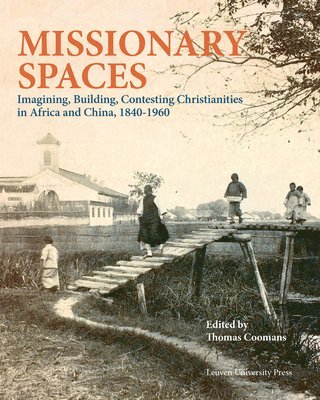
Situated at the crossroads of missionary history, imperial history, and colonial architecture, the contributions in this volume investigate the architectural staging and spatial implications of the worldwide expansion of Christianity in the nineteenth and twentieth centuries. By looking at specific architectural fragments, analysing the insertion of Christian edifices in colonial urban settings, or unravelling the social understanding of missionary places, each of the chapters contemplates an aspect of the agency of mission spaces.Bringing together scholars from different disciplines, this book approaches missionary places not as the mere d cor against which the missionary encounter was enacted, but as an integral part of it. In doing so, the contributors test the applicability of the spatial turn, an interpretative paradigm that has been dominant across the humanities since the late 1990s, to missionary historiography.Richly illustrated and with a global focus, the volume addresses case studies from, among other countries, China, Japan, Madagascar, Congo, Tanzania, Ghana, and Lebanon.
Del 19 - KADOC-Artes
Material Change
The Impact of Reform and Modernity on Material Religion in North-West Europe, 1780-1920
Inbunden, Engelska, 2021
579 kr
Skickas inom 5-8 vardagar
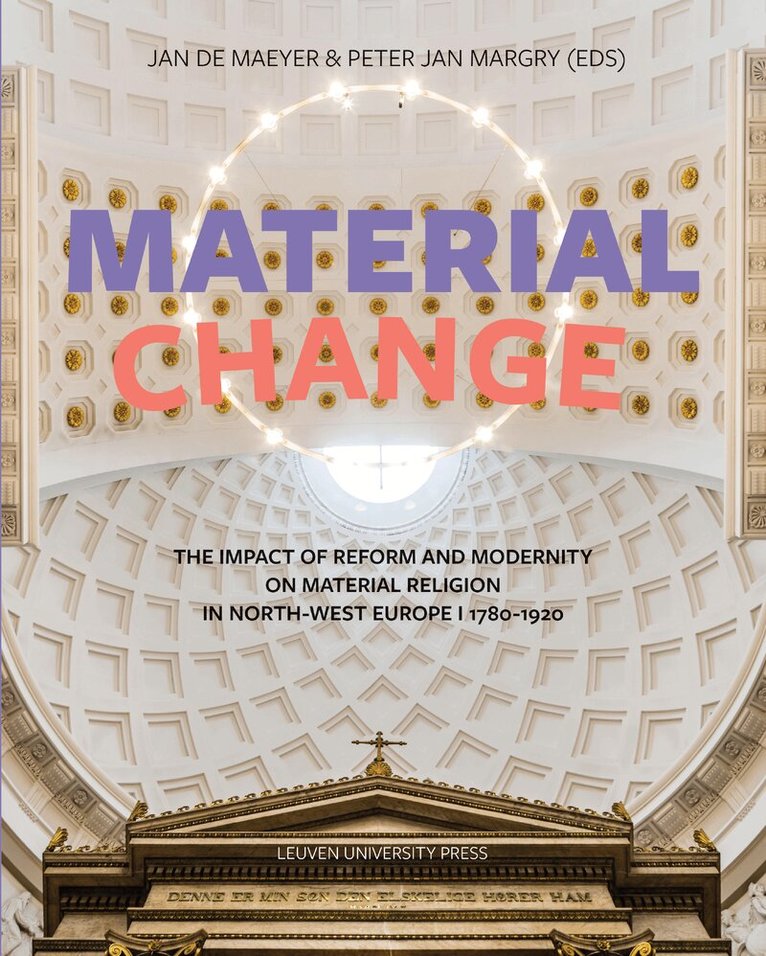
The long nineteenth century (c.1780-c.1920) in Western Europe saw an unprecedented rise in the production and possession of material goods. The material culture diversified and led to a rich variety of expressions. Dovetailing with a process of confessionalisation that manifested itself quite simultaneously, material religion witnessed its heyday in this period; from church buildings to small devotional objects.The present volume analyses how various types of reform (state, societal, and ecclesiastical) that were part of the process of modernisation affected the material devotional culture within Protestantism, Anglicanism, and Roman Catholicism. Although the contributions in this book start from a comparative European perspective, the case studies mostly focus on individual countries in North-West Europe, namely Germany, Belgium, the Netherlands, the United Kingdom, Ireland, Norway, Sweden, and Denmark.The concept of 'material religion' is approached in a very inclusive way. The volume discusses, amongst others, parish infrastructures and religious buildings that are part of land and cityscapes, but also looks into interior design and decorations of chapels, churches, monasteries, cemeteries, and educational, charitable, and health institutions. It comprises the fine arts of religious painting and sculpture, the applied arts, and iconographic designs. As far as private material culture is concerned, this volume examines and presents objects related to private devotion at home, including a great variety of popular devotional and everyday life objects, such as booklets, cards, photographs, and posters.Contributors: Carsten Bach-Nielsen (Aarhus University), Timothy Brittain-Catlin (University of Cambridge), Arne Bugge Amundsen (University of Oslo), Thomas Coomans (KU Leuven), Wolfgang Cortjaens (Deutsches Historisches Museum, Berlin), Jan De Maeyer (KU Leuven), Jens Christian Eldal (Norwegian Institute for Cultural Heritage Research, Oslo), Anders Gustavsson (University of Oslo), Dagmar Hanel (Institut fur Landeskunde und Regionalgeschichte, Bonn), Mary Heimann (Cardiff University), Antoine Jacobs (independent historian), Patricia Lysaght (University College Dublin), Peter Jan Margry (University of Amsterdam / Meertens Institute (KNAW)), Caroline McGee (Trinity College Dublin), Roderick O'Donnell (independent architecture historian), Wies van Leeuwen (architecture historian), Fred van Lieburg (Vrije Universiteit Amsterdam), Tine Van Osselaer (Ruusbroec Institute / University of Antwerp), William Whyte (University of Oxford)
Inbunden, Engelska, 2022
442 kr
Skickas inom 5-8 vardagar
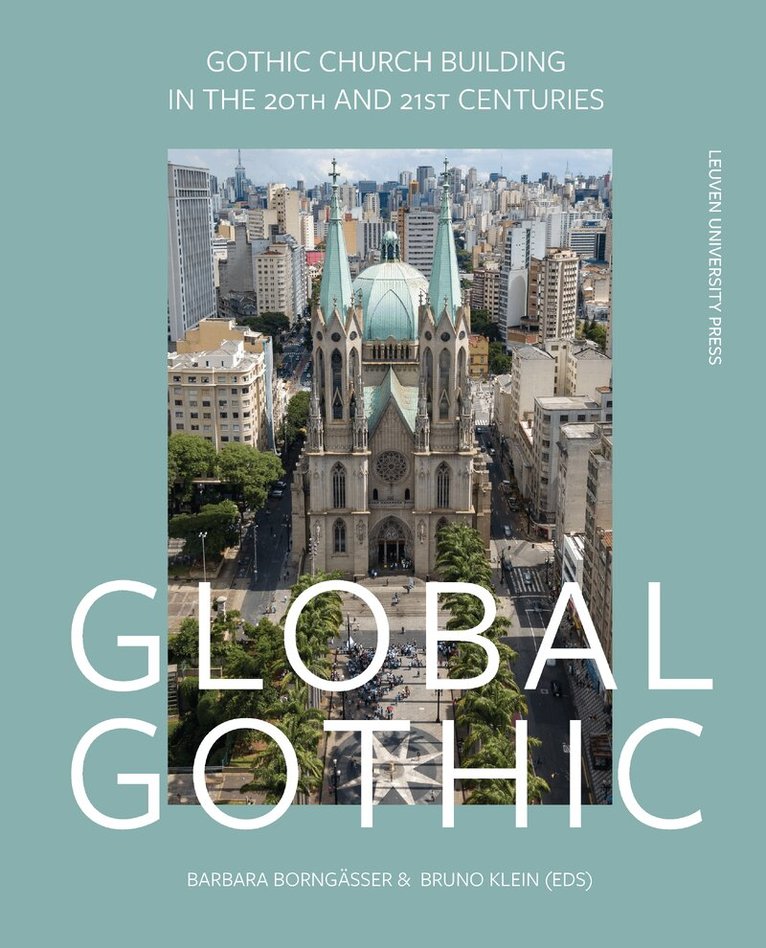
Although largely overlooked in studies of architectural history, church architecture in a Gothic idiom outlived its 19th century momentum to persist worldwide throughout the 20th century and into the new millennium.Global Gothic presents a first systematic worldwide understanding of Gothic in contemporary architecture, both as a distinct variation and as a competitor to recognized modern styles. The book's chapters critically discuss Gothic's various manifestations over the past century, describing and illustrating approaches from Gothic Revival living traditions in the former British Empire and original Gothic appropriation in Latin America to competitions of European builders in former Asian and African colonies. The focus is also on the special appropriations in North America, China and Japan, as well as contemporary solutions that tend to be transnational in style.With contributions from renowned architecture experts from around the world, Global Gothic provides an overview of this cultural phenomenon and presents a wealth of stunning material, much of it little known. Richly illustrated in full color, it offers an important contribution to colonial and postcolonial global art history and a seldom acknowledged perspective on art history in general.Contributors: Barbara Borngasser (Technische Universitat Dresden), Martin M. Checa-Artasu (Metropolitan Autonomous University, Mexico City), Thomas Coomans (KU Leuven), Pedro Guedes (University of Queensland), Bruno Klein (Technische Universitat Dresden), Bettina Marten (Technische Universitat Dresden), Olimpia Niglio (Hosei University Tokyo), Peter Scriver (University of Adelaide), Amit Srivastava (University of Adelaide)
Inbunden, Engelska, 2025
815 kr
Skickas inom 5-8 vardagar
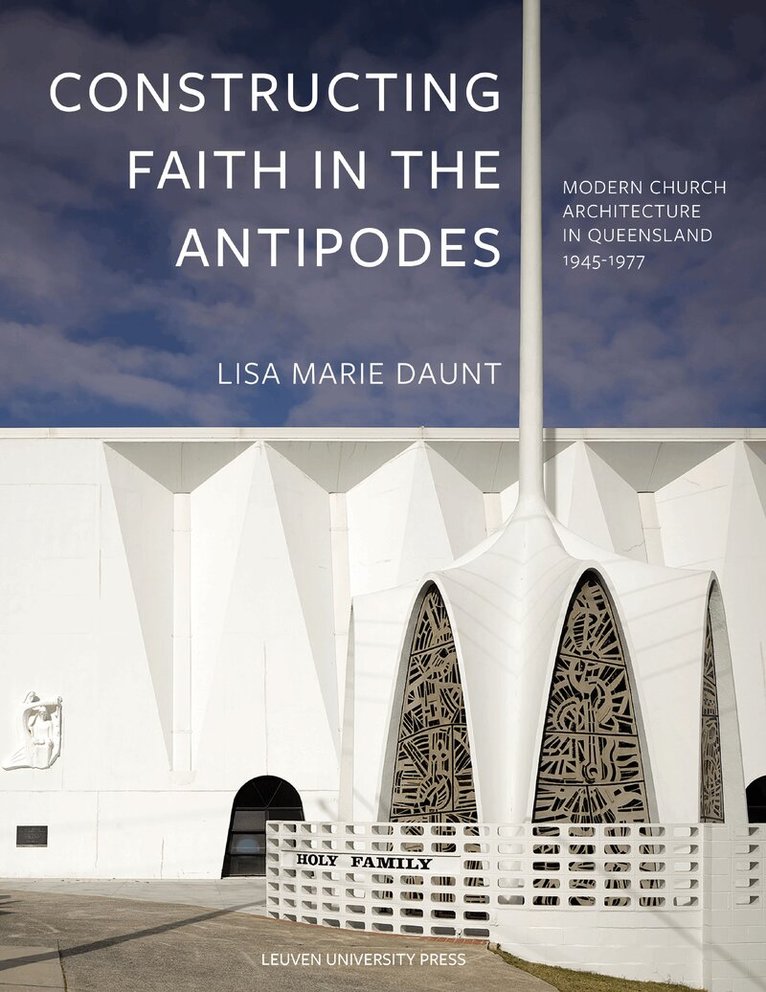
The overlooked history of modern church architecture in post-war AustraliaOver 1,650 churches were built in Queensland, Australia, between 1945 and 1977. They constitute some of the most notable modern architecture in the state and reveal tensions surrounding modernism’s role in cultural expression and regional identity. While much research has focused on post-war modern church architecture in the Global North, little has been done on the Global South.This book offers a particular perspective on modernist church architecture, differing from accounts of buildings in the northern hemisphere, as it highlights how church architecture in Queensland was shaped by its very specific time and place – a young and developing state covering a vast area of land, sparsely populated, highly multi-denominational and located in the antipodes.Modern architectural developments and emergent religious ideas did not simply transfer to Queensland. Rather, architectural ideas were circulated globally, allowing for a global narrative. This landmark study seeks to broaden views and methods for future research, both locally and internationally. Richly illustrated, Constructing Faith in the Antipodes combines both a chronological and a thematic approach to narrate modern church architectural history and offers a fascinating glimpse into a distinct collection of modern church buildings.
Inbunden, Engelska, 2007
549 kr
Tillfälligt slut
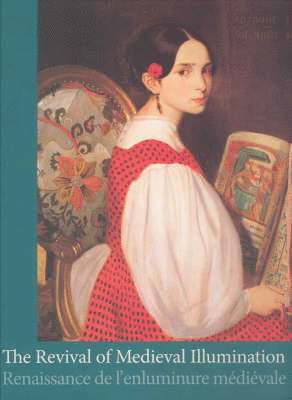
Reduced Price!Now only € 49,00 instead of € 75,00'Ce recueil, est un instrument de travail indispensable pour les chercheurs qui s'intéressent à' l'art néo-gothique, et surtout à l'art de l'enluminure'.Paul Valvekens in Revue D'Histoire Ecclésiastique, Volume 103, Issue 1, 2008The art of illumination, usually associated with the Middle Ages, experienced a spectacular revival in nineteenth-century Western Europe. This completely different context gave the illuminations another import. The output of the lay and religious workshops reveals a great artistic, stylistic, technical and typological diversity. The works illuminated go far beyond the world of exceptional and precious manuscripts and include many occasional documents, as well as golden books, devotional images, etc.Richly illustrated with unpublished masterworks, the present volume offers an overview of the important revival of medieval illumination. The fifteen authors do not limit their approach to the traditional questions of art history. Rather, they explore the historical, socio-cultural, ideological and religious components of the revival, which changed according to time and country, in order to understand the evolution and success of the art of illumination in the long nineteenth century.L’art de l’enluminure, bien connu pour le Moyen Âge, fit l’objet d’un regain d’intérêt spectaculaire au XIXe siècle. Le contexte résolument différent leur confère toutefois une autre signification. La production des ateliers civils et religieux présente une grande diversité artistique, stylistique, technique et typologique. Elle excède largement le monde des manuscrits exceptionnels et précieux et comprend nombre de documents de circonstance, de livres d’or, d’images de dévotion, etc.Abondamment illustré de chefs-d’œuvre inédits, le présent ouvrage présente pour la première fois une vue d’ensemble de l’important phénomène de la renaissance de l’enluminure médiévale. Les quinze auteurs n’ont pas voulu se limiter aux questions traditionnelles de l’histoire de l’art. Les composantes historiques, socioculturelles, idéologiques et religieuses de ce phénomène complexe, variant dans le temps et selon les pays, sont essentielles pour comprendre l’évolution et le succès de l’art de l’enluminure au XIXe siècle.
Inbunden, Engelska, 2008
612 kr
Tillfälligt slut
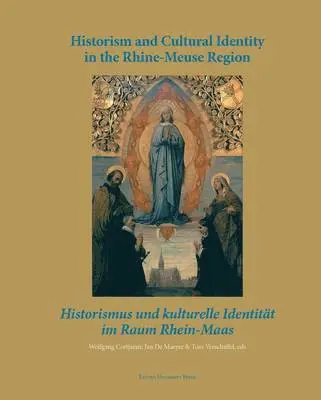
Based on the cultural insight that ‘historism’ – understood as the projection of the past into the present by artistic means, or the ‘invention of tradition’ – always occurs in close connection with the emergence of nation states, this volume describes for the first time the cultural and denominational character and development of the Maas-Rhine region during the period between the French Revolution and the First World War. Seventeen contributions shed new and revealing light on the cultural identity of this Catholic-dominated core region of Europe, using the defining term ‘historism’ as the historiographical element that unifies the book’s four sections (Social and Church Historical Context, The Organisational Structure of Ecclesiastical Art, Centres of Art, ‘Grenzgänger’: between Theory and Praxis).
Inbunden, Engelska, 2010
802 kr
Tillfälligt slut
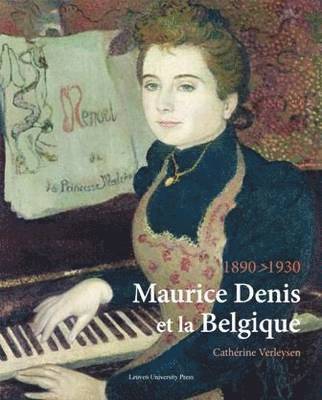
Cette ouvrage analyse les relations artistiques que Maurice Denis (1870-1943), peintre et théoricien français, noue avec la Belgique à la fin du 19e siècle et au cours des premières décennies du 20e siècle. La Belgique permet à Maurice Denis d'exprimer harmonieusement les deux valeurs centrales de son art, à savoir le goût moderne pour le formalisme allié à une réflexion spirituelle d'inspiration chrétienne. A lui seul, Denis illustre l'évolution historique de l'Eglise belge sur la manière dont la religion catholique envisage et appréhende la création artistique au sein de l'époque moderne ; une Eglise d'abord tentée par la modernité comme langage d'un nouvel art chrétien, puis, finalement, repliée sur ces valeurs en doute, voire en rejet de toute expression contemporaine.This richly illustrated book analyzes the artistic relationship of Maurice Denis (1870-1943), French painter and theoretician, with Belgium at the end of the nineteenth century and during the first decennia of the twentieth century. In Belgium Denis was able to harmonize the two central values of his art: a modern taste for formalism combined with Christian spirituality. In his works Denis illustrated the historical evolution of the Belgian Catholic Church and the way Catholicism embraced the modern artistic creation: first the Church was tempted to adopt modernism as a vehicle of a new Christian art, but then it started to doubt the modernist values and finally rejected all contemporary forms of expression.This publication is GPRC-labeled ( Guaranteed Peer-Reviewed Content)
Inbunden, Engelska, 2012
598 kr
Tillfälligt slut
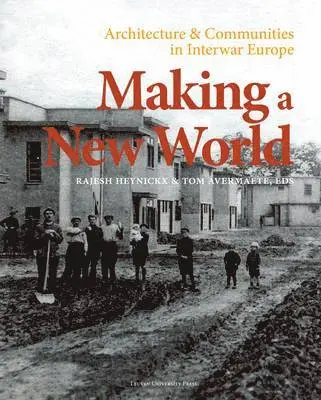
Study of the foundations and working mechanisms of modern communitiesIn the changing world of interwar Europe a longing for stability rose to the surface of social life. Newly developed neighbourhoods and buildings were designed to create the healing community that many people were dreaming of. Various social groups with nationalist, ideological, or religious agendas made this concept of community a cornerstone in their framework and appropriated it to prescribe the relations between architecture and modernity. Making a New World analyses the various ways in which these relations were determined.Most activists/entities encountered the potentialities of modernity, such as technology or mass media, in an accommodating way. In a broad spectrum of actions and proposals - from art exhibitions to séances, photo reports to roof tiles, landscapes to sanitation - these reformists were hoping to create a universe in which their communal dream could become a reality. The 17 contributions to this richly illustrated volume draw the contours of this new world by analysing its foundations and working mechanisms at its heart.This publication is GPRC-labeled (Guaranteed Peer-Reviewed Content).
Inbunden, Engelska, 2013
687 kr
Tillfälligt slut
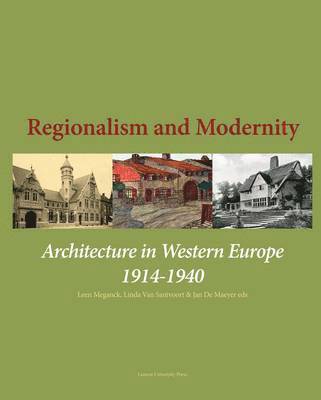
Previously published: Sources of Regionalism in the Nineteenth-Century. Architecture, Art and LiteratureThe complex and shifting relation between regionalism and modernity With its search for purity, honesty, modesty, and ‘fitness of purpose', the late 19th and early 20th century concept of architectural regionalism is seminal to the modern movement. In later historiography, however, regionalism in Europe was neglected and even labeled ‘backward'. The origins of this drastic change of perception can be traced to the 1930s, when regionalism as a positive form gradually turned into a ‘closed' form of regionalism, a folding back on one's own region as a defence mechanism in an economically and politically turbulent decade.In this book internationally renowned researchers investigate the complex and shifting relation between regionalism and modernity in the architecture of Western Europe between the two World Wars, with a focus on Belgium, France, Germany, Italy, and Great Britain. They demonstrate that regionalism cannot be separated from modernity, but is in fact a way of dealing with modernity and its contradictions. Applied to architecture, regionalism is a means to moderate modernism, to embed the design in its local surroundings. It is seen as a result of the search for identity in a modernizing and globalizing world where tensions arise between diversity and superiority and among science, aesthetics, and ideology. The employment of regional forms and concepts is then used as an adaptation strategy, a way to facilitate modernity. Rather than rejecting regionalism as an anti-modern phenomenon, this book's contributors show that we should interpret regionalism as a striving for continuity within modernity.This publication is GPRC-labeled (Guaranteed Peer-Reviewed Content)ContributorsHervé Doucet (University of Strasbourg); Kai Krauskopf (Technische Universität Dresden), Leen Meganck (Flanders Heritage Agency), Benoît Mihaïl (Police Museum Brussels), Lut Missinne (Westfälische Wilhelms-Universität Münster), Björn Rzoska (Groen), Michelangelo Sabatino (University of Houston), Vanessa Vanden Berghe (University of East London), Johan Van den Mooter (Kempens Landschap), Evert Vandeweghe (Ghent University), Jean-Claude Vigato (École nationale supérieure d'architecture de Nancy)
Inbunden, Engelska, 2014
612 kr
Tillfälligt slut
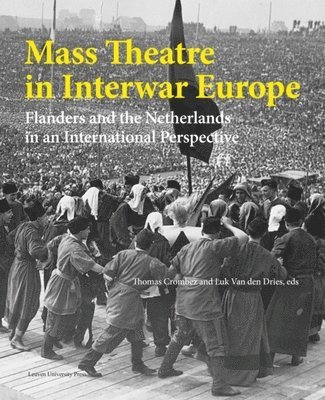
Ideological heterogeneity in mass plays in Flanders and the Netherlands In many European countries mass theatre was a widespread expression of ‘community art’ which became increasingly popular shortly before the First World War. From Max Reinhardt’s lavish open-air spectacles to socialist workers’ Laienspiel (lay theatre), theatre visionaries focused on ever larger groups for entertainment as well as political agitation.Despite wide research on the Soviet and German cases, examples from the Low Countries have hardly been examined. However, mass plays in Flanders and the Netherlands had a distinctive character, displaying an ideological heterogeneity not seen elsewhere. Mass Theatre in Interwar Europe studies this peculiar phenomenon of the Low Countries in its European context and sheds light on the broader framework of mass movements in the interwar period.This publication is GPRC-labeled (Guaranteed Peer-Reviewed Content).ContributorsStaf Vos (Het Firmament), Karel Vanhaesebrouck (Université Libre de Bruxelles/Rits), Evelien Jonckheere (Ghent University), Ad van der Logt (Leiden University), Frank Peeters (University of Antwerp)Blog Thomas Crombez - http://tcrombez.wordpress.com/