Kenneth J. Arrow Lecture Series - Böcker
Visar alla böcker i serien Kenneth J. Arrow Lecture Series. Handla med fri frakt och snabb leverans.
11 produkter
11 produkter
Creating a Learning Society
A New Approach to Growth, Development, and Social Progress
Inbunden, Engelska, 2014
350 kr
Skickas inom 7-10 vardagar
It has long been recognized that an improved standard of living results from advances in technology, not from the accumulation of capital. It has also become clear that what truly separates developed from less-developed countries is not just a gap in resources or output but a gap in knowledge. In fact, the pace at which developing countries grow is largely a function of the pace at which they close that gap. Thus, to understand how countries grow and develop, it is essential to know how they learn and become more productive and what government can do to promote learning. In Creating a Learning Society, Joseph E. Stiglitz and Bruce C. Greenwald cast light on the significance of this insight for economic theory and policy. Taking as a starting point Kenneth J. Arrow's 1962 paper "Learning by Doing," they explain why the production of knowledge differs from that of other goods and why market economies alone typically do not produce and transmit knowledge efficiently. Closing knowledge gaps and helping laggards learn are central to growth and development. But creating a learning society is equally crucial if we are to sustain improved living standards in advanced countries.Combining accessible prose with technical economic analysis, Stiglitz and Greenwald provide new models of "endogenous growth," up-ending thowhe thinking about both domestic and global policy and trade regimes. They show well-designed government trade and industrial policies can help create a learning society, and how poorly designed intellectual property regimes can retard learning. They also explain how virtually every government policy has effects, both positive and negative, on learning, a fact that policymakers must recognize. They demonstrate why many standard policy prescriptions, especially those associated with "neoliberal" doctrines focusing on static resource allocations, have impeded learning. Among the provocative implications are that free trade may lead to stagnation whereas broad-based industrial protection and exchange rate interventions may bring benefits-not just to the industrial sector, but to the entire economy. The volume concludes with brief commentaries from Philippe Aghion and Michael Woodford, as well as from Nobel Laureates Kenneth J. Arrow and Robert M. Solow.
209 kr
Skickas inom 7-10 vardagar
Kenneth J. Arrow's pathbreaking "impossibility theorem" was a watershed innovation in the history of welfare economics, voting theory, and collective choice, demonstrating that there is no voting rule that satisfies the four desirable axioms of decisiveness, consensus, nondictatorship, and independence. In this book Eric Maskin and Amartya Sen explore the implications of Arrow's theorem. Sen considers its ongoing utility, exploring the theorem's value and limitations in relation to recent research on social reasoning, and Maskin discusses how to design a voting rule that gets us closer to the ideal-given the impossibility of achieving the ideal. The volume also contains a contextual introduction by social choice scholar Prasanta K. Pattanaik and commentaries from Joseph E. Stiglitz and Kenneth J. Arrow himself, as well as essays by Maskin, Dasgupta, and Sen outlining the mathematical proof and framework behind their assertions.
169 kr
Skickas inom 7-10 vardagar
As long as there have been financial markets, there have been bubbles-those moments in which asset prices inflate far beyond their intrinsic value, often with ruinous results. Yet economists are slow to agree on the underlying forces behind these events. In this book Jose A. Scheinkman offers new insight into the mystery of bubbles. Noting some general characteristics of bubbles-such as the rise in trading volume and the coincidence between increases in supply and bubble implosions-Scheinkman offers a model, based on differences in beliefs among investors, that explains these observations. Other top economists also offer their own thoughts on the issue: Sanford J. Grossman and Patrick Bolton expand on Scheinkman's discussion by looking at factors that contribute to bubbles-such as excessive leverage, overconfidence, mania, and panic in speculative markets-and Kenneth J. Arrow and Joseph E. Stiglitz contextualize Scheinkman's findings.
271 kr
Tillfälligt slut
How should we evaluate the ethics of procreation, especially the environmental consequences of reproductive decisions on future generations, in a resource-constrained world? While demographers, moral philosophers, and environmental scientists have separately discussed the implications of population size for sustainability, no one has attempted to synthesize the concerns and values of these approaches. The culmination of a half century of engagement with population ethics, Partha Dasgupta’s masterful Time and the Generations blends economics, philosophy, and ecology to offer an original lens on the difficult topic of optimum global population.After offering careful attention to global inequality and the imbalance of power between men and women, Dasgupta provides tentative answers to two fundamental questions: What level of economic activity can our planet support over the long run, and what does the answer say about optimum population numbers? He develops a population ethics that can be used to evaluate our choices and guide our sense of a sustainable global population and living standards. Structured around a central essay from Dasgupta, the book also features a foreword from Robert Solow; correspondence with Kenneth Arrow; incisive commentaries from Joseph Stiglitz, Eric Maskin, and Scott Barrett; an extended response by the author to them; and a joint paper with Aisha Dasgupta on inequalities in reproductive decisions and the idea of reproductive rights. Taken together, Time and the Generations represents a fascinating dialogue between world-renowned economists on a central issue of our time.
210 kr
Skickas inom 7-10 vardagar
Moral hazard-the tendency to change behavior when the cost of that behavior will be borne by others-is a particularly tricky question when considering health care. Kenneth J. Arrow's seminal 1963 paper on this topic (included in this volume) was one of the first to explore the implication of moral hazard for health care, and Amy Finkelstein-recognized as one of the world's foremost experts on the topic-here examines this issue in the context of contemporary American health care policy. Drawing on research from both the original RAND Health Insurance Experiment and her own research, including a 2008 Health Insurance Experiment in Oregon, Finkelstein presents compelling evidence that health insurance does indeed affect medical spending and encourages policy solutions that acknowledge and account for this. The volume also features commentaries and insights from other renowned economists, including an introduction by Joseph P. Newhouse that provides context for the discussion, a commentary from Jonathan Gruber that considers provider-side moral hazard, and reflections from Joseph E. Stiglitz and Kenneth J. Arrow.
665 kr
Skickas inom 3-6 vardagar
For all of their focus on asset prices, financial economists rarely ask if assets are priced ethically-that is, if their prices are compatible with the public good. Yet in a world facing major, possibly catastrophic problems-global warming, for instance, and growing inequality-it is now more important than ever that we allocate capital to projects that will benefit society as a whole, not just today but far into the future. In this book, Christian Gollier develops a powerful method for transforming our societal goals of collective prosperity into the cornerstone of our financial decision making. Ethical Asset Valuation and the Good Society starts by stating transparent moral principles and, from these, derives simple rules that can be used to evaluate saving and investment decisions in terms of the public good. Rather than trying to explain observed asset prices, Gollier derives what these prices ought to be in order to direct capital toward socially desirable investments. He focuses especially on the two prices that drive most financial decisions-the price of time as reflected in the interest rate and the price of risk-and explores the role these play in our long-term planning.If investment projects in renewable energy could be financed at a lower interest rate than those linked to fossil fuels, for instance, the energy transition would be easier to accomplish. Building on criticism of the short-term thinking of financial markets, Gollier suggests ways to shift investment toward the future through the discounting of the valuation of assets and investments with long-term benefits. In this sophisticated but accessible work, Gollier builds a bridge between welfare economics and finance theory to provide a framework for ethical valuation capable of establishing what asset prices should be on the basis of our shared moral values.
Creating a Learning Society
A New Approach to Growth, Development, and Social Progress, Reader's Edition
Häftad, Engelska, 2015
227 kr
Skickas inom 7-10 vardagar
Since its publication Creating a Learning Society has served as an effective tool for those who advocate government policies to advance science and technology. It shows persuasively how enormous increases in our standard of living have been the result of learning how to learn, and it explains how advanced and developing countries alike can model a new learning economy on this example. Creating a Learning Society: Reader's Edition uses accessible language to focus on the work's central message and policy prescriptions. As the book makes clear, creating a learning society requires good governmental policy in trade, industry, intellectual property, and other important areas. The text's central thesis-that every policy affects learning-is critical for governments unaware of the innovative ways they can propel their economies forward.
816 kr
Skickas inom 7-10 vardagar
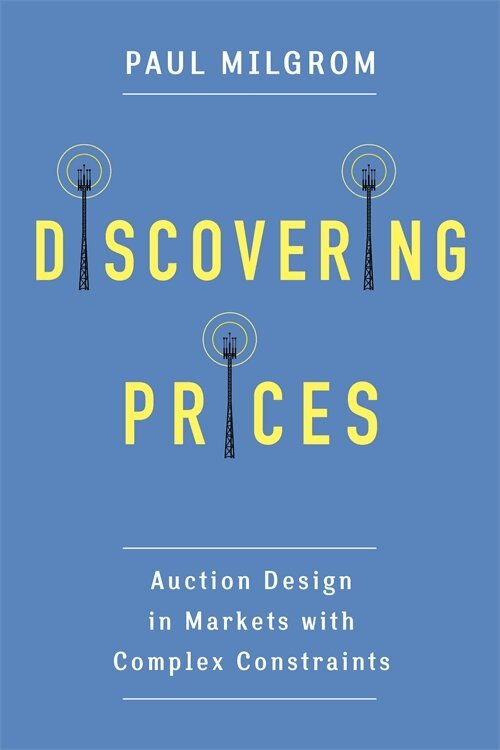
Traditional economic theory studies idealized markets in which prices alone can guide efficient allocation, with no need for central organization. Such models build from Adam Smith's famous concept of an invisible hand, which guides markets and renders regulation or interference largely unnecessary. Yet for many markets, prices alone are not enough to guide feasible and efficient outcomes, and regulation alone is not enough, either. Consider air traffic control at major airports. While prices could encourage airlines to take off and land at less congested times, prices alone do just part of the job; an air traffic control system is still indispensable to avoid disastrous consequences. With just an air traffic controller, however, limited resources can be wasted or poorly used. What's needed in this and many other real-world cases is an auction system that can effectively reveal prices while still maintaining enough direct control to ensure that complex constraints are satisfied.In Discovering Prices, Paul Milgrom-the world's most frequently cited academic expert on auction design-describes how auctions can be used to discover prices and guide efficient resource allocations, even when resources are diverse, constraints are critical, and market-clearing prices may not even exist. Economists have long understood that externalities and market power both necessitate market organization. In this book, Milgrom introduces complex constraints as another reason for market design. Both lively and technical, Milgrom roots his new theories in real-world examples (including the ambitious U.S. incentive auction of radio frequencies, whose design he led) and provides economists with crucial new tools for dealing with the world's growing complex resource allocation problems.
210 kr
Skickas inom 7-10 vardagar
Traditional economic theory studies idealized markets in which prices alone can guide efficient allocation, with no need for central organization. Such models build from Adam Smith’s famous concept of an invisible hand, which guides markets and renders regulation or interference largely unnecessary. Yet for many markets, prices alone are not enough to guide feasible and efficient outcomes, and regulation alone is not enough, either. Consider air traffic control at major airports. While prices could encourage airlines to take off and land at less congested times, prices alone do just part of the job; an air traffic control system is still indispensable to avoid disastrous consequences. With just an air traffic controller, however, limited resources can be wasted or poorly used. What’s needed in this and many other real-world cases is an auction system that can effectively reveal prices while still maintaining enough direct control to ensure that complex constraints are satisfied.In Discovering Prices, Paul Milgrom—the world’s most frequently cited academic expert on auction design—describes how auctions can be used to discover prices and guide efficient resource allocations, even when resources are diverse, constraints are critical, and market-clearing prices may not even exist. Economists have long understood that externalities and market power both necessitate market organization. In this book, Milgrom introduces complex constraints as another reason for market design. Both lively and technical, Milgrom roots his new theories in real-world examples (including the ambitious U.S. incentive auction of radio frequencies, whose design he led) and provides economists with crucial new tools for dealing with the world’s growing complex resource-allocation problems.
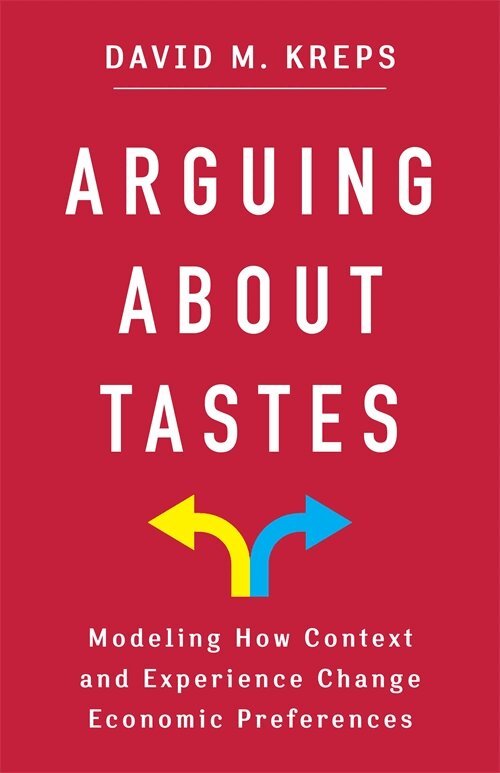
Arguing About Tastes
Modeling How Context and Experience Change Economic Preferences
Inbunden, Engelska, 2023
862 kr
Skickas
Mainstream economics considers individual preferences to be fixed and unchanging. Although psychologists and other social scientists explore how tastes are formed, influenced, and evolve, it is not considered “proper” in orthodox economics to do so. Arguing About Tastes makes the case that economists should abandon the principle that preferences are fixed and instead incorporate into their work how context and experience shape individual tastes.David M. Kreps argues that the discipline must account for dynamic personal tastes when it comes to understanding social exchange, emphasizing human resource management and on-the-job behavior. He develops formal models that illustrate the power of intrinsic motivation and show why applying extrinsic incentives can be counterproductive. Kreps weighs the advantages and disadvantages of the principle de gustibus non est disputandum: there is no arguing about tastes. He calls for a new era of economics in which preferences are taken into account—and not for granted.Arguing About Tastes concludes with responses by the distinguished economists Alessandra Casella and Joseph E. Stiglitz and a final reply by Kreps.
Arguing About Tastes
Modeling How Context and Experience Change Economic Preferences
Häftad, Engelska, 2023
233 kr
Skickas
Mainstream economics considers individual preferences to be fixed and unchanging. Although psychologists and other social scientists explore how tastes are formed, influenced, and evolve, it is not considered “proper” in orthodox economics to do so. Arguing About Tastes makes the case that economists should abandon the principle that preferences are fixed and instead incorporate into their work how context and experience shape individual tastes.David M. Kreps argues that the discipline must account for dynamic personal tastes when it comes to understanding social exchange, emphasizing human resource management and on-the-job behavior. He develops formal models that illustrate the power of intrinsic motivation and show why applying extrinsic incentives can be counterproductive. Kreps weighs the advantages and disadvantages of the principle de gustibus non est disputandum: there is no arguing about tastes. He calls for a new era of economics in which preferences are taken into account—and not for granted.Arguing About Tastes concludes with responses by the distinguished economists Alessandra Casella and Joseph E. Stiglitz and a final reply by Kreps.