SUNY series, Literature... in Theory - Böcker
Visar alla böcker i serien SUNY series, Literature... in Theory. Handla med fri frakt och snabb leverans.
2 produkter
2 produkter
1 818 kr
Kommande
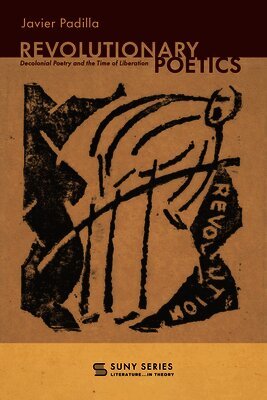
Demonstrates the centrality of thinking about time to decolonial poetry and poetics.Revolutionary Poetics considers the role of politically engaged poetry during social revolutions and processes of decolonization. Javier Padilla argues that writers in Ireland, Central America, Africa, and the Caribbean sought to capture in their poetry the time of liberation—a moment conjoining the end of colonialism and imperialism and the dawn of a decolonized historical consciousness. The book thus analyzes key moments in the history of twentieth-century liberation movements through poetry and poetics, examining the work of W. B. Yeats, Ernesto Cardenal, Pedro Mir, René Depestre, and Roque Dalton alongside the decolonial theories of thinkers such as Frantz Fanon and Enrique Dussel. These poets reimagined and adapted modernist poetics of instantaneity in order to advance collective aims and bolster the prospects of liberation. While the poetics of temporal rupture can be traced back to earlier Anglo-European traditions, it is in peripheral regions that the revolutionary moment acquired not just aesthetic but also historical and political meaning.

1 818 kr
Kommande
Argues that Freud and a host of twentieth-century writers after him conceptualize mourning as a matter of "hypertranslation," an essentially linguistic endeavor.Mourning After Freud offers new insight into a much-discussed but not yet exhausted topic of twentieth-century discourse. Whereas contemporary trauma theorists have identified interiorization as the central feature of Freud's theory of loss, Birger Vanwesenbeeck argues that Freud above all conceptualizes mourning as a form of translation and, more precisely, of "hypertranslation"—a translation of an unavailable original. Foregrounding the role of language in Freud's thought, the book reveals, provocatively, that the true heirs of his model are to be found not in psychoanalysis or trauma theory but rather in contiguous fields such as deconstruction, African American writing, and second-generation US immigrant literature more broadly. Through a series of close readings of twentieth-century theorists, poets, and novelists—from W. E. B. Du Bois to Sylvia Plath, from Henry Roth to Jacques Derrida—Mourning After Freud reveals time and again that the question of mourning cannot be separated from that of language.