Medicine and Society - Böcker
Visar alla böcker i serien Medicine and Society. Handla med fri frakt och snabb leverans.
8 produkter
8 produkter
Del 4 - Medicine and Society
Inheriting Madness
Professionalization and Psychiatric Knowledge in Nineteenth-Century France
Inbunden, Engelska, 1991
519 kr
Skickas inom 7-10 vardagar
Historically, one of the recurring arguments in psychiatry has been that heredity is the root cause of mental illness. In Inheriting Madness, Ian Dowbiggin traces the rise in popularity of hereditarianism in France during the second half of the nineteenth century to illuminate the nature and evolution of psychiatry during this period. In Dowbiggin's mind, this fondness for hereditarianism stemmed from the need to reconcile two counteracting factors. On the one hand, psychiatrists were attempting to expand their power and privileges by excluding other groups from the treatment of the mentally ill. On the other hand, medicine's failure to effectively diagnose, cure, and understand the causes of madness made it extremely difficult for psychiatrists to justify such an expansion. These two factors, Dowbiggin argues, shaped the way psychiatrists thought about insanity, encouraging them to adopt hereditarian ideas, such as the degeneracy theory, to explain why psychiatry had failed to meet expectations. Hereditarian theories, in turn, provided evidence of the need for psychiatrists to assume more authority, resources, and cultural influence.Inheriting Madness is a forceful reminder that psychiatric notions are deeply rooted in the social, political, and cultural history of the profession itself. At a time when genetic interpretations of mental disease are again in vogue, Dowbiggin demonstrates that these views are far from unprecedented, and that in fact they share remarkable similarities with earlier theories. A familiarity with the history of the psychiatric profession compels the author to ask whether or not public faith in it is warranted.
Del 8 - Medicine and Society
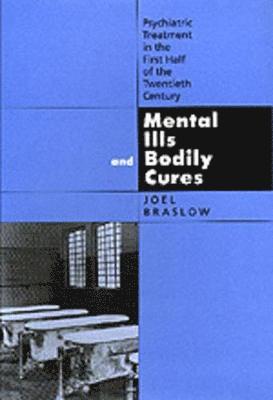
Mental Ills and Bodily Cures
Psychiatric Treatment in the First Half of the Twentieth Century
Inbunden, Engelska, 1997
567 kr
Skickas inom 7-10 vardagar
"Mental Ills and Bodily Cures" depicts a time when psychiatric medicine went to lengths we now find extreme and perhaps even brutal ways to heal the mind by treating the body. From a treasure trove of California psychiatric hospital records, including many verbatim transcripts of patient interviews, Joel Braslow masterfully reconstructs the world of mental patients and their doctors in the first half of the twentieth century. Hydrotherapy, sterilization, electroshock, lobotomy, and clitoridectomy - these were among the drastic somatic treatments used in these hospitals. By allowing the would-be healers and those in psychological and physical distress to speak for themselves, Braslow captures the intense and emotional interplay surrounding these therapies. His investigation combines revealing clinical detail with the immediacy of 'being there' in the institutional setting while decisions are made, procedures undertaken, and results observed by all those involved.We learn how well-intentioned physicians could rationalize and regard as therapeutic treatments that often had dreadful consequences, and how much the social and cultural world is inscribed within the practice of biological psychiatry. The book will interest historians of medicine, practicing psychiatrists, and everyone who knows or has seen what it's like to be in mental distress.
Del 7 - Medicine and Society
Impure Science
AIDS, Activism, and the Politics of Knowledge
Häftad, Engelska, 1998
283 kr
Skickas inom 7-10 vardagar
In the short, turbulent history of AIDS research and treatment, the boundaries between scientist insiders and lay outsiders have been crisscrossed to a degree never before seen in medical history. Steven Epstein's astute and readable investigation focuses on the critical question of "how certainty is constructed or deconstructed," leading us through the views of medical researchers, activists, policy makers, and others to discover how knowledge about AIDS emerges out of what he calls "credibility struggles." Epstein shows the extent to which AIDS research has been a social and political phenomenon and how the AIDS movement has transformed biomedical research practices through its capacity to garner credibility by novel strategies. Epstein finds that nonscientist AIDS activists have gained enough of a voice in the scientific world to shape NIH--sponsored research to a remarkable extent. Because of the blurring of roles and responsibilities, the production of biomedical knowledge about AIDS does not, he says, follow the pathways common to science; indeed, AIDS research can only be understood as a field that is unusually broad, public, and contested.He concludes by analyzing recent moves to democratize biomedicine, arguing that although AIDS activists have set the stage for new challenges to scientific authority, all social movements that seek to democratize expertise face unusual difficulties. Avoiding polemics and accusations, Epstein provides a benchmark account of the AIDS epidemic to date, one that will be as useful to activists, policy makers, and general readers as to sociologists, physicians, and scientists.
Del 10 - Medicine and Society
Imperial Bedlam
Institutions of Madness in Colonial Southwest Nigeria
Häftad, Engelska, 1999
564 kr
Skickas inom 3-6 vardagar
The colonial government of southern Nigeria began to use asylums to confine the allegedly insane in 1906. These asylums were administered by the British but confined Africans. Yet, as even many in the government recognized, insanity is a condition that shows cultural variation. Who decided the inmates were insane and how? This sophisticated historical study pursues these questions as it examines fascinating source material - writings by African patients in these institutions and the reports of officials, doctors, and others - to discuss the meaning of madness in Nigeria, the development of colonial psychiatry, and the connections between them. Jonathan Sadowsky's well-argued, concise study provides important new insights into the designation of madness across cultural and political frontiers. "Imperial Bedlam" follows the development of insane asylums from their origins in the nineteenth century to innovative treatment programs developed by Nigerian physicians during the transition to independence.Special attention is given to the writings of those considered 'lunatics,' a perspective relatively neglected in previous studies of psychiatric institutions in Africa and most other parts of the world. "Imperial Bedlam" shows how contradictions inherent in colonialism were articulated in both asylum policy and psychiatric theory. It argues that the processes of confinement, the labeling of insanity, and the symptoms of those so labeled reflected not only cultural difference but also political divides embedded in the colonial situation. "Imperial Bedlam" thus emphasizes not only the cultural background to madness but also its political and experiential dimensions.
Del 12 - Medicine and Society
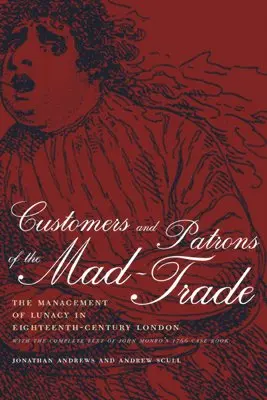
Customers and Patrons of the Mad-Trade
The Management of Lunacy in Eighteenth-Century London
Inbunden, Engelska, 2003
1 031 kr
Skickas inom 3-6 vardagar
This book is a lively commentary on the eighteenth-century mad-business, its practitioners, its patients (or "customers"), and its patrons, viewed through the unique lens of the private case book kept by the most famous mad-doctor in Augustan England, Dr. John Monro (1715-1791). Monro's case book, comprising the doctor's jottings on patients he saw in the course of his private practice--patients drawn from a great variety of social strata--offers an extraordinary window into the subterranean world of the mad-trade in eighteenth-century London. The volume concludes with a complete edition of the case book itself, transcribed in full with editorial annotations by the authors. In the fragmented stories Monro's case book provides, Andrews and Scull find a poignant underworld of human psychological distress, some of it strange and some quite familiar. They place these "cases" in a real world where John Monro and othersuccessful doctors were practicing, not to say inventing, the diagnosis and treatment of madness.
Del 11 - Medicine and Society
Undertaker of the Mind
John Monro and Mad-Doctoring in Eighteenth-Century England
Inbunden, Engelska, 2001
985 kr
Skickas inom 3-6 vardagar
As visiting physician to Bethlem Hospital, the archetypal 'Bedlam' and Britain's first and (for hundreds of years) only public institution for the insane, Dr. John Monro (1715-1791) was a celebrity in his own day. Jonathan Andrews and Andrew Scull call him a 'connoisseur of insanity, this high priest of the trade in lunacy'. Although the basics of his life and career are well known, this study is the first to explore in depth Monro's colorful and contentious milieu. Mad-doctoring grew into a recognized, if not entirely respectable, profession during the eighteenth century, and besides being affiliated with public hospitals, Monro and other mad-doctors became entrepreneurs and owners of private madhouses and were consulted by the rich and famous. Monro's close social connections with members of the aristocracy and gentry, as well as with medical professionals, politicians, and divines, guaranteed him a significant place in the social, political, cultural, and intellectual worlds of his time.Andrews and Scull draw on an astonishing array of visual materials and verbal sources that include the diaries, family papers, and correspondence of some of England's wealthiest and best-connected citizens. The book is also distinctive in the coverage it affords to individual case histories of Monro's patients, including such prominent contemporary figures as the Earls Ferrers and Orford, the religious 'enthusiast' Alexander Cruden, and the 'mad' King George III, as well as his crazy would-be assassin, Margaret Nicholson. What the authors make clear is that Monro, a serious physician neither reactionary nor enlightened in his methods, was the outright epitome of the mad-trade as it existed then, esteemed in some quarters and ridiculed in others. The fifty illustrations, expertly annotated and integrated with the text, will be a revelation to many readers.
Del 13 - Medicine and Society
Madness at Home
The Psychiatrist, the Patient, and the Family in England, 1820-1860
Inbunden, Engelska, 2006
1 363 kr
Skickas inom 3-6 vardagar
The history of psychiatric institutions and the psychiatric profession is by now familiar: asylums multiplied in nineteenth-century England and psychiatry established itself as a medical specialty around the same time. We are, however, largely ignorant about madness at home in this key period: what were the family's attitudes toward its insane member, what were patient's lives like when they remained at home? Until now, most accounts have suggested that the family and community gradually abdicated responsibility for taking care of mentally ill members to the doctors who ran the asylums. However, this provocatively argued study, painting a fascinating picture of how families viewed and managed madness, suggests that the family actually played a critical role in caring for the insane and in the development of psychiatry itself.Akihito Suzuki's richly detailed social history includes several fascinating case histories, looks closely at little studied source material including press reports of formal legal declarations of insanity, or Commissions of Lunacy, and also provides an illuminating historical perspective on our own day and age, when the mentally ill are mainly treated in home and community.
972 kr
Skickas inom 5-8 vardagar
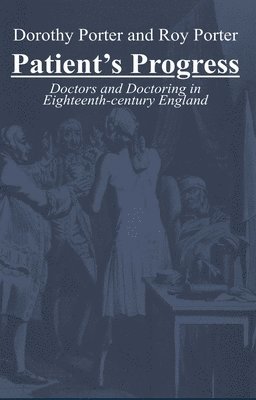
Pre-modern society was overshadowed by illness and the threat of death. This outstanding new book examines what people did when they fell sick in Britain between 1650 - 1850. The authors investigate the well-established and flourishing tradition of self-medication, as practised by individuals, within the family and in the wider community. They look at what kinds of medical services could be obtained, both from the regular profession and among quacks and other healers. Above all they explore the personal and sociological bonds developed between patients and their doctors, examining in particular the economic and ethical dimensions of this privileged but precarious relationship. What precisely did doctors have to offer the sick in an age before scientific medicine could promise near-certain cures? This fundamental question is analysed against the background of the cultural and religious attitudes of Enlightenment England and in the context of the development of the medical profession. Drawing on the letters, journals and autobiographies of individual sufferers and from the papers of doctors, this remarkable investigation opens up new issues and offers interpretations which will certainly stimulate controversy among historians, anthropologists and sociologists and lead the way to further research in this area.