Medieval Texts in Translation – serie
Visar alla böcker i serien Medieval Texts in Translation. Handla med fri frakt och snabb leverans.
5 produkter
5 produkter
362 kr
Skickas inom 10-15 vardagar
The Romantic Tale of Peter Abelard and Heloise has been widely known for centuries. The legend relates in part to the letters exchanged between the two, years after Abelard had been castrated at the behest of Heloise's vindictive uncle, Fulbert. These ""personal"" letters form the basis for bestselling compilations of works by Abelard and Heloise in translation, such as the recently revised Penguin ""The Letters of Abelard and Heloise"" or the new Hackett Abelard and Heloise, ""The Letters and Other Writings"". They hold fascination for the light they shed on the relationship between the man and woman, as teacher and student, lovers, husband and wife, monk and nun, abbot and mother superior, and much more. The popularity of the ""personal"" letters has generated considerable fanfare for the publication of another set of correspondence printed under the title ""The Lost Love Letters of Heloise and Abelard"". The authorship of all these letters has been contested repeatedly, with the last-mentioned collection being the center of a present firestorm. Generally ignored have been nearly a dozen other letters or letter-like texts, unassailably the work of Peter Abelard. Jan M. Ziolkowski's comprehensive and learned translation of these texts affords insight into Abelard's thinking over a much longer sweep of time and offers snapshots of the great twelfth-century philosopher and theologian in a variety of contexts. Broadening our panorama of the twelfth-century Renaissance, the picture presented by these texts complements, complicates, and enriches Abelard's autobiographical letter of consolation and his personal letters to Heloise.
Anchoress and Abbess in Ninth-century Saxony
The Lives of Liutbirga of Wendhausen and Hathumoda of Gandersheim
Häftad, Engelska, 2009
314 kr
Skickas inom 10-15 vardagar
Around the year 840, Liutbirga, the adopted daughter of a noble Saxon widow, asked to be walled into a cell in a church at one of the family's cloisters for religious women. She spent the last thirty years of her life in her cell, doing penance for her sins, fending off attacks by the devil, and instructing women in religion and handiwork through its one small window. Hathumoda, the daughter of a noble Saxon couple whose progeny would establish the first German empire, became abbess of a similar community of women when she was twelve years old. She too spent the rest of her life there, dying at the age of thirty-four in the course of an epidemic that swept across northwestern Europe. In spite of their confinement, both women made so great an impression on those who knew them that substantial biographies appeared within a few years of their deaths. In the growing field of early medieval texts in translation, this book presents the first full English translations of the ""Lives of Liutbirga of Wendhausen"", the first anchoress in Saxony, and Hathumoda, the first abbess of Gandersheim. The introduction and notes tell the story of the remarkable survival and transmission of the Lives and describe the ninth-century Saxon world that produced them and their authors. Although praised by their biographers for their holiness, Liutbirga and Hathumoda are not presented primarily as wonder-working saints, but as real flesh-and-blood women, pursuing sanctity in a world driven by family and ecclesiastical politics as much as spirituality. Histories of the women's families as well as memorials to their heroines, the ""Lives of Liutbirga and Hathumoda"" shed new light on a vibrant corner of Christian Europe in the century after Charlemagne.
379 kr
Skickas inom 10-15 vardagar
The Chronicle of the Czechs by Cosmas of Prague (d. 1125) is a masterwork of medieval historical writing, deeply erudite, consciously researched, and narrated in high rhetorical style. Regarded as the foundational narrative of Czech history, it is the source of the oldest stories about the land, people, and rulers of Bohemia and Moravia. Lisa Wolverton provides the first annotated English translation of this eminently enjoyable and teachable work. The first of the three books of the Chronicle describes the earliest people to arrive in Bohemia, the first rulers and the origins of the Premyslid dynasty, the founding of Prague, and the early phases of Christianization. Book Two covers the period from 1037 to 1092, the age of Duke Bretislav I and his five contentious sons. Book III treats events contemporary with the author's writing, a time of great political upheaval, both internally and in relation to neighboring Germans, Poles, and Hungarians. Preeminently concerned with rulers and political life, the chronicle is striking for its narrative brilliance, vivid characters and scenes, dramatic dialogues, evocative soliloquies, and deep classical and Biblical erudition. In composing it, Cosmas sought to define the Czechs as a nation through history, compel them to think about their political culture, and urge reform, justice, and responsibility. The oldest history of a Slavic people written by a Slav, the work rivals any medieval chronicle in its verve, accessibility, and insight into the very nature of political power. ""The Chronicle of the Czechs"" will be indispensable for medieval specialists wanting to extend their reach into Eastern Europe, as well as for college instructors in search of a lively and insightful text on medieval political life generally.
368 kr
Skickas inom 10-15 vardagar
Guido of Monte Rochen’s Handbook for Curates became the most popular pastoral manual at the close of the Middle Ages as thousands of copies were printed in Europe. Composed of a mixture of practical “how to” and theological instruction, the Handbook taught pastoral basics to everyday priests. As such, it is an essential and vibrant source on late medieval religion and parish practice, which this full-length translation makes available in English for the first time.The Handbook is divided into three parts: sacraments and their administration, the sacrament of penance, and basic catechesis. Together they reflect Guido’s mission to facilitate the fundamental duties priests were expected to fulfill for souls under their charge. Guido explains constituent parts of each sacrament, how each is done, who receives it, and what problems might arise in its practice. In step with broader religious currents of his day, Guido treats penance extensively, addressing topics from instances of the deadly sins to how to question penitents in confession. His Handbook concludes with explanations of the Creed, Lord’s Prayer, and Ten Commandments for the benefit of his readers and their flocks.To help contemporary students and scholars understand fully the Handbook’s richness as a historical source, the introduction situates it within the intellectual milieu of late medieval Christianity. Guido is well acquainted with the vagaries of real life in a parish and a sense of compassion underlies his directives. Evidence of readers’ hands-on engagement abounds in the annotations that were written in the book’s margins. Examination of both the content of such comments and their location within the text suggests how Guido’s readers sought to translate his advice into practice.
338 kr
Skickas inom 10-15 vardagar
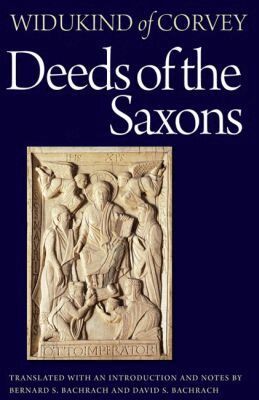
Widukind, a monk at the prominent monastery of Corvey in Saxony during the middle third of the tenth century, is known to posterity through his Res gestae Saxonicae, an exceptionally rich account of the Saxon people and the reigns of the first two rulers of the Ottonian dynasty, Henry I (919–936) and Otto I (936–973). Widukind, likely of noble birth, received a thorough education in both biblical and classical texts. When writing the Gestae, Widukind also had available the extensive library at Corvey, with its large collection of ancient texts as well as numerous works from the eighth and ninth centuries. Widukind drew on these, and even more contemporary written sources to complement and inform orally transmitted information that he received from many sources including people closely associated with the Ottonian royal court. Widukind wrote the Res gestae from the 950s to the 970s, incorporating additional material as he obtained further information and as major new events took place in the German kingdom and beyond. After providing a historical background for the Saxon people Widukind devotes most of his attention to the political and military affairs of the German kingdom, concentrating heavily on affairs of the royal court. Widukind provides information that can be found in no other source. His close relationship with the royal court enabled him to provide an “insider’s” view of the people and events that shaped the political and military history of the most powerful kingdom in Europe. As a consequence, the Res gestae is an indispensable account for the history of the German kingdom during the tenth century.Bernard S. Bachrach and David Bachrach provide an introduction to the text that contextualizes the author, his historical methods, and the information that he provides. They draw on a large number of other written sources of information, including both narrative works and the political, economic, social, and military affairs of the day, and provide an extensive apparatus of notes.