Microeconomic Studies - Böcker
Visar alla böcker i serien Microeconomic Studies. Handla med fri frakt och snabb leverans.
11 produkter
11 produkter
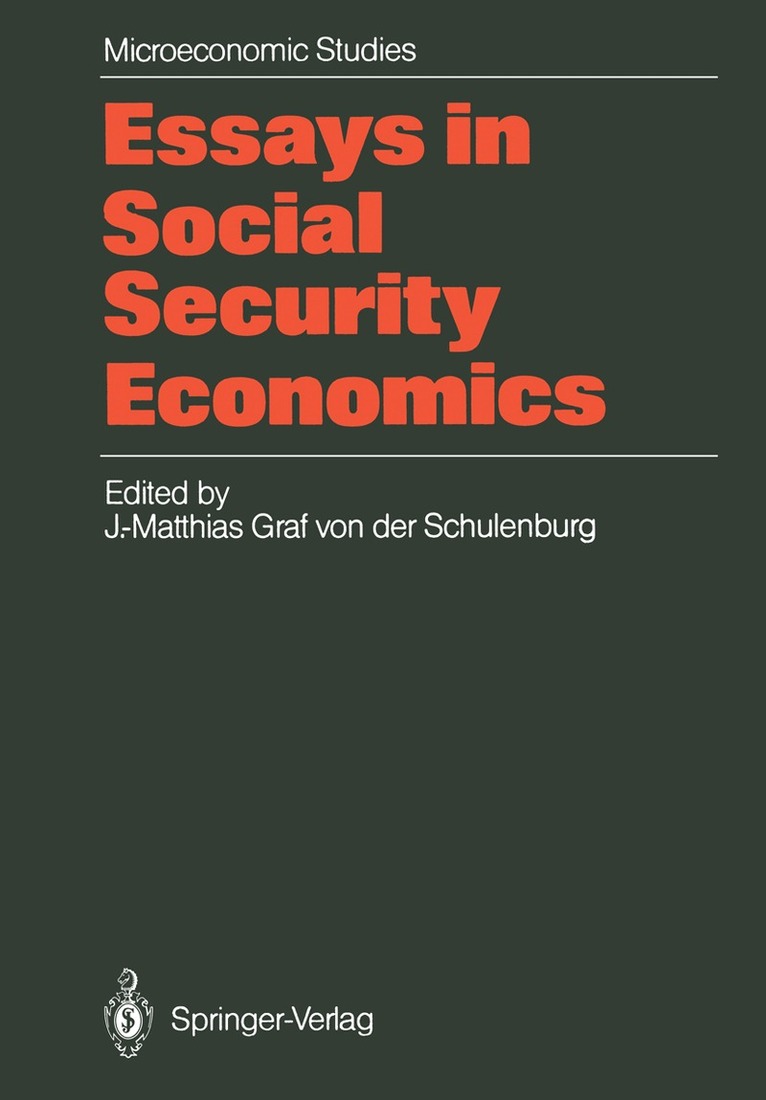
Essays in Social Security Economics
Selected Papers of a Conference of the International Institute of Management, Wissenschaftszentrum Berlin
Häftad, Engelska, 1986
1 059 kr
Skickas inom 10-15 vardagar
Presented at the Workshop on the Origin and Furure of Social Security Schemes, Berlin, December 13 - 14, 1984
549 kr
Skickas inom 10-15 vardagar
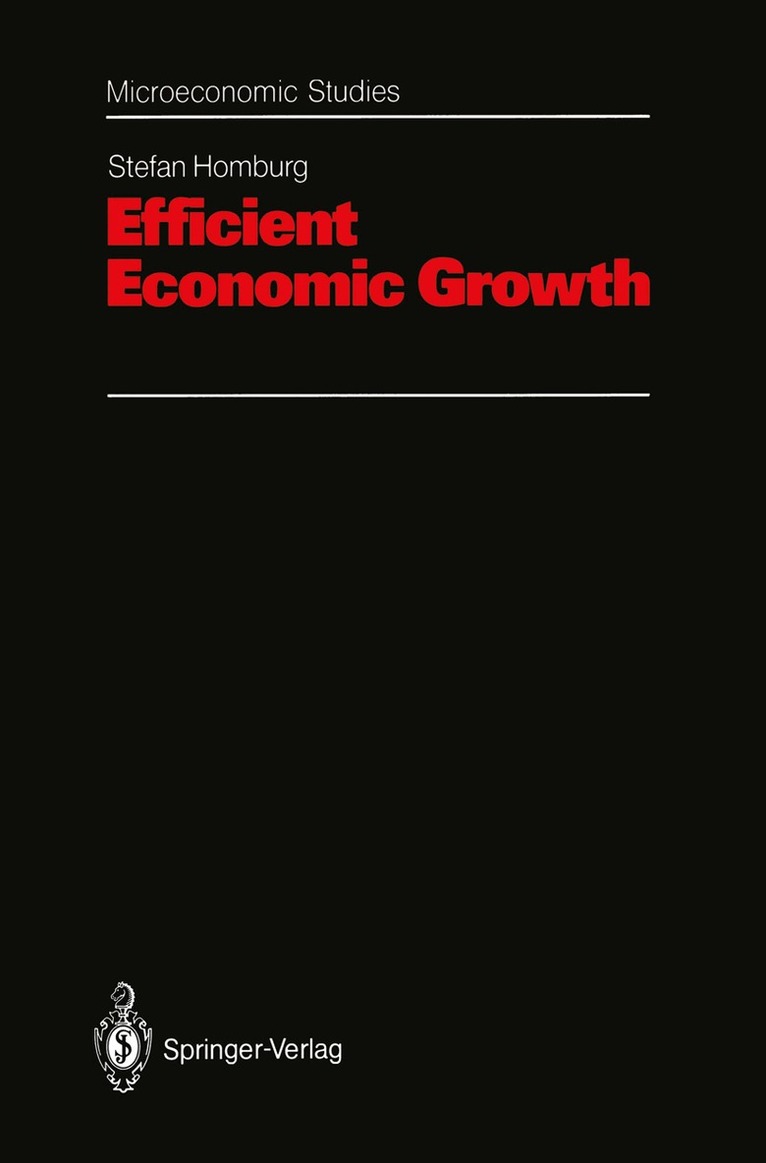
This book contains a revised version of my Habilitationsschrift which has been accepted by the economic department of Dortmund University in 1991. It consists mostly of unpublished material which has been presented during the last years at the universities of Cologne, Dortmund, Hagen, Mannheim, and Munich and at a meeting in Wiesbaden. I am indebted to very many collegues for fruitful discussions. In par- ticular, I want to thank Friedrich Breyer, Johannes Hoffmann, Heinz Hollander, Wolfgang Leininger, Bruno Schonfelder, Gerhard Schwodi- auer, Hans-Werner Sinn, Klaus Spremann, and lochen Weimann, but this list is surely incomplete. I am especially grateful, however, to Wolfram F. Richter and Niko Wolik who have continually accompanied the evolution of this work and to whom lowe many suggestions as well as corrections. The remaining errors, needless to say, are mine. Cologne, September 1991 Stefan Homburg Contents Chapter 1. Introduction 1 Chapter 2. Dynamic Efficiency 3 2. 1 The Basic Model...3 2. 2 A General Theorem on Dynamic Efficiency . 9 2. 3 Some Further Results ...12 2. 4 Storable Consumer Goods...14 2. 5 The Failure of the First Basic Welfare Theorem 17 2.6 A Stronger Condition ...20 2. 7 A Remark on Necessary Conditions. 21 2. 8 Conclusion...22 Chapter 3. Interest and Growth 25 3. 1 Commodity Own Rates of Interest 26 3. 2 The Asset-augmented Economy . . 28 3. 3 Interest, Growth, and Dynamic Efficiency . 31 3. 4 Conclusion...33 Appendix: The Cash Flow Criterion.
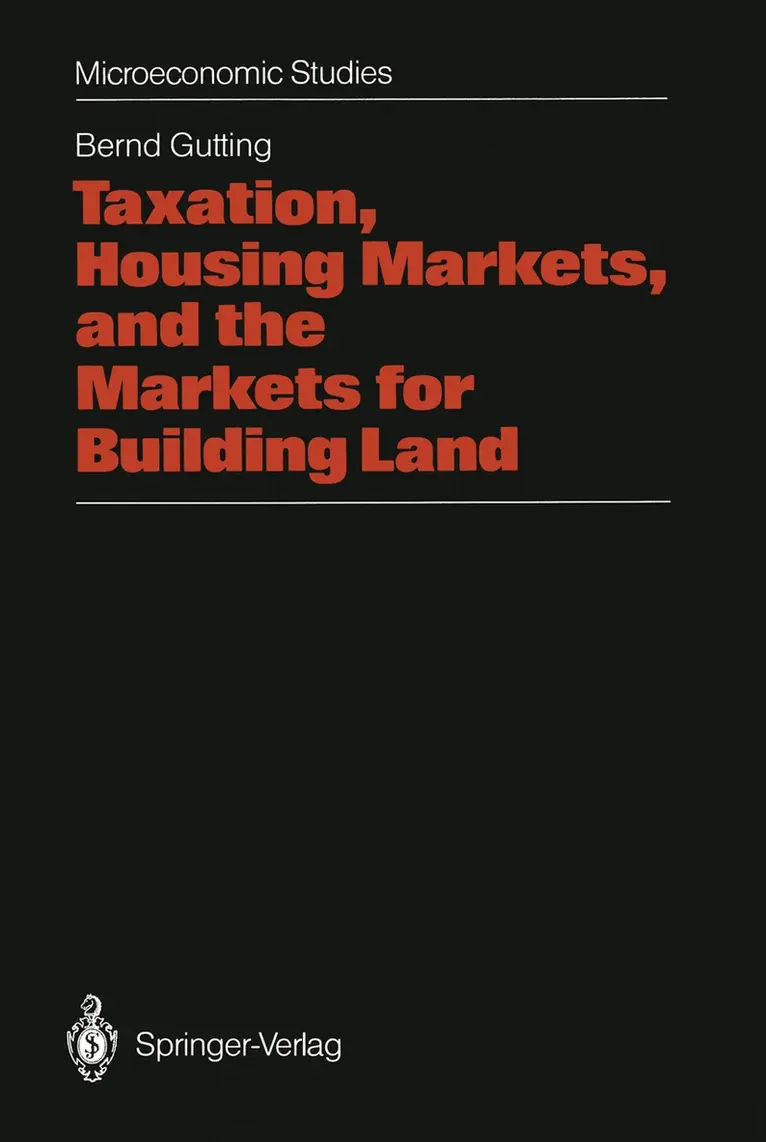
Taxation, Housing Markets, and the Markets for Building Land
An Intertemporal Analysis
Häftad, Engelska, 2012
549 kr
Skickas inom 10-15 vardagar
Almost everywhere in the world housing policies play an important role in government programs. Especially in the industrialized Western economies housing policy issues are triggered mainly by two developments: growing population density and increasing environmental pollution enforce a systematic planning of regional and urban development; all social groups want to participate in the increasing welfare of the domestic economies; until today housing policy is considered an appropriate tool for redistribution and social policy. Taxation serves as an important instrument for the realization of the political objectives mentioned above. Surprisingly, there exists wide-spread consent (even on the academic side) on the effectivity of this instrument. However, strictly speaking this consent concerns only the short run. Long-term effects are usually ignored. Therefore, there is always the inherent risk in these policies that (supposed) market inefficiencies will not be cured, but merely carried forward, and possibly amplified. Moreover, it is characteristic for the political discussion that there is no consistent notion of what efficient housing and land markets ought to look like. Generally accepted for example, is the position that land speculation should be fought whereever possible. Hardly anyone asks the question whether the holding of building land will be beneficial to the economy as a whole, and not only to the speculant.
1 091 kr
Skickas inom 10-15 vardagar
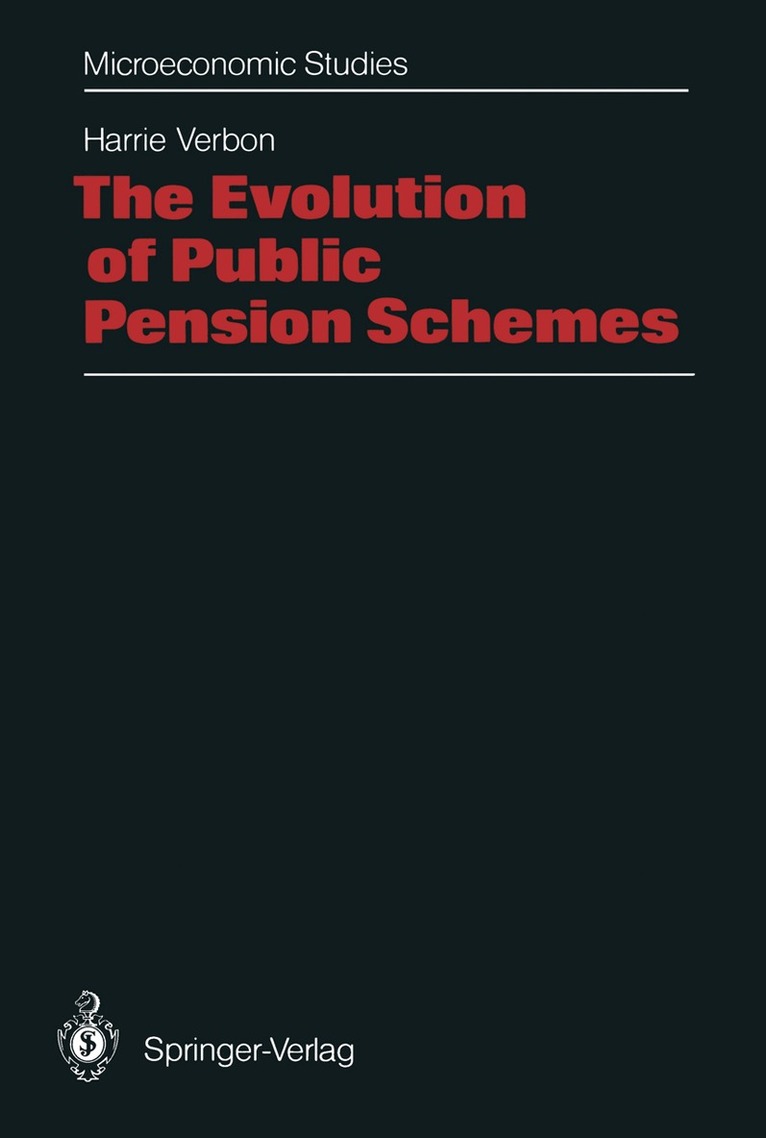
1. 1 An introduction to the problem This book deals with the development of public pension schemes. The operation of public pension schemes has drawn a great deal of attention recently due to ageing of the population which has become apparent since the 19 70s. This would probably have been less of a problem if these schemes had been financed by a Capital Reserve (abbreviated from now on as CR) system. As is well-known, in a pure CR-system individuals (or generations) save for their own retirement. The (average) rate of return on the premiums paid in this system equals the real rate of interest and, in principle, changes in the rate of population growth do not affect the premium rate or the benefit rate of the system. Most public pension schemes, however, are financed by a Pay-As-You-Go (abbreviated from now on as PAYG) system. In this system current pension payments are financed by current premium payments. In contrast to the CR-system intergenerational transfers occur in this system. If the number of retired people increases relative to the number of workers the premium rate will increase under PAYG. In itself this increase does not have to imply any concern for the premium paying population. What counts is whether the rate of return under a PAYG-system will fall (too far) below the rate of return the CR-system is offering.
1 059 kr
Skickas inom 10-15 vardagar
A model of household decisions based on a bargainingapproach is developed providing a comprehensive frameworkfor the analysis of family behavior. Treating the family asan economic organization, household behavior is explained bythe cooperation of utility maximizing individuals. Thedifference to traditional microeconomic household models isthat theassumption of a joint household utility functionis abandoned. Instead of this, a game theoretic approach isused to model family decisions as a result of intrafamilybargaining. Considering the development of the spouses`human capital in a dynamic approach, the long-term effectsof intrafamily specialization in market work and work athome are analyzed. Onemajor finding is that in a dynamicsetting non-Pareto efficient allocations may result.Empirical tests demonstrate the relevanace of the bargainingapproach.
1 091 kr
Skickas inom 10-15 vardagar
The list of those to whom I am indebted is a long one. Prof. Neil Wallace (University of Minnesota) stimulated my interest in the kind of models with which the book deals. I am grateful for a large number of conversations with him. I learned a lot from him and will always be proud that I have been one of his student. I hope that he is not dissappointed with the outcome. I am deeply indebted to Prof. Dr. Hans-Werner Sinn (University of Munich). His observations and critical remarks were instrumental for a great number of changes and improvements which I was able to introduce while revising the manuscript again and again, and rethinking the basic arguments. I also want to thank Prof. Dr. Utta Gruber (University of Munich) for her helpful comments and for her support. I am very much obliged to Prof. Dr. Dr. h. c. Hans Moller (University of Munich). For many years I have had the honour of a nearly continuous dialogue with him. I am also grateful to Prof. Dr. Werner Gumpel (University). The stimulating atmosphere and the research opportunities which were provided by his seminar contributed a lot to my work. Finally I want to thank my wife Sigrid for looking through the English draft of this book and correcting numerous linguistic flaws. The remaining errors are of course mine. CONTENTS Page v Preface 1. INTRODUCTION 1. 1.
1 059 kr
Skickas inom 10-15 vardagar
This volume contains the proceedings of a conference at Freudenberg, Germany, that brought together some forty (environmental) economists from seven European countries and the U.S. in November 1990 to analy:se "Conflicts and Cooperation in Managing Environmental Resources". I should like to thank the Volkswagen-Stiftung whose finan- cial support made this conference possible. Additional funding by the Forschungsinstitut fur Geistes-und Sozialwissenschaften at the Universitiit - Gesamthochschule Siegen is also gratefully acknowledged. The papers and formal comments published in this volume emerged from those presented at Freudenberg. Thorough and competent discussions during and after the conference as well as an anonymous reviewing process led to major revisions which im- proved the quality of all contributions. I am grateful to the authors for their construc- tive collaboration before and during the conference as well as during the editing process.The authors demonstrated convincingly that they are not only able to scrutinise the inefficiencies of non-eooperation in their research work, but that they also succeeded to learn this lesson by avoiding delays of the editing process at the expense of the remain- ing players.
Factors in Business Investment
Papers of a Conference Held at the Science Centre, Berlin, Research Area “Labour Market and Employment”, September 1987
Häftad, Engelska, 2012
1 091 kr
Skickas inom 10-15 vardagar
State of the art modeling of investment behavior and analysis of incentive and allocative effects of taxation on investment behavior are reported in these proceedings. Leading researchers from seven OECD countries treat problems ranging from modeling investment behavior and estimating investment equations with various data sets to detailed studies of tax influences on investment behavior. Particular attention is paid to tax reform plans, especially in West Germany and the UK. The role of financial variables and uncertainty is analysed. A major topic in the volume is recent work within Tobin's Q-theoretic framework. Papers report developments and applications of Q-type investment functions, and for the first time estimated Q-theoretic investment equations are presented for West German industries taking into account the complex tax structure.
1 690 kr
Skickas inom 10-15 vardagar
We are used to calling most developing countries overpopulated and consi- dering some industrialized countries (like West Germany) "threatened by underpopulation". Analogous population policies with different objecti- ves are discussed. However, none of the measures suggested can be justi- fied or evaluated without an implicit concept of optimum population, a notion which has attracted attention ever since economics was made a science. The relevance of the subject and the recent rise in interest by popula- tion economists has motivated the organization of a conference on "Opti- mal Population" in Bielefeld, where most of this book originates. Finan- cial support for the conference and the publication of this book by the Thyssen Foundation and the editorial help provided by John De New and Contents Optimum Population: An Introduction K. F. Zimmermann ...I. Optimal Size and Growth Rate of Population Socially Optimal Population Size and Individual Choice M. Nerlove, A. Razin, and E. Sadka ...19 Endogenous Population With Discrete Family Size and a Capital Market D. Leonard ...
549 kr
Skickas inom 10-15 vardagar
This book contains a revised version of my Habilitationsschrift which has been accepted by the economic department of Dortmund University in 1991. It consists mostly of unpublished material which has been presented during the last years at the universities of Cologne, Dortmund, Hagen, Mannheim, and Munich and at a meeting in Wiesbaden. I am indebted to very many collegues for fruitful discussions. In par- ticular, I want to thank Friedrich Breyer, Johannes Hoffmann, Heinz Hollander, Wolfgang Leininger, Bruno Schonfelder, Gerhard Schwodi- auer, Hans-Werner Sinn, Klaus Spremann, and lochen Weimann, but this list is surely incomplete. I am especially grateful, however, to Wolfram F. Richter and Niko Wolik who have continually accompanied the evolution of this work and to whom lowe many suggestions as well as corrections. The remaining errors, needless to say, are mine. Cologne, September 1991 Stefan Homburg Contents Chapter 1. Introduction 1 Chapter 2. Dynamic Efficiency 3 2. 1 The Basic Model...3 2. 2 A General Theorem on Dynamic Efficiency . 9 2. 3 Some Further Results ...12 2. 4 Storable Consumer Goods...14 2. 5 The Failure of the First Basic Welfare Theorem 17 2.6 A Stronger Condition ...20 2. 7 A Remark on Necessary Conditions. 21 2. 8 Conclusion...22 Chapter 3. Interest and Growth 25 3. 1 Commodity Own Rates of Interest 26 3. 2 The Asset-augmented Economy . . 28 3. 3 Interest, Growth, and Dynamic Efficiency . 31 3. 4 Conclusion...33 Appendix: The Cash Flow Criterion.
1 059 kr
Skickas inom 10-15 vardagar
This text is concerned with the economics of potentially fatal industrial hazards, namely the prospect of very unlikely, yet catastrophic, incidents. The first part of the analysis is devoted to the microeconomic representation of the relevant risk-preference patterns displayed by both endangered individuals as well as insurers exposed to risk on the basis of the von Neumann-Morgenstern framework. The second part is concerned with a standard microeconomic assessment of the welfare-impact of industrial facilities constituting a severe industrial hazard. Particular attention is paid to the economic investigation into insurance regulatory policy-instruments aimed at correcting risk-externalities created by the risk-emiting sector. Thus, the book serves two primary objectives: to provide a better theoretical understanding and modelling of the economic nature of the problem constituted by severe industrial hazards; and to develop regulatory concepts by means of adroitly instrumentalizing the incentives provided by the insurance sector and the law of tort.