• Fri frakt över 249 kr
  • •
  • Snabba leveranser
  • •
  • Billiga böcker
Kundservice

Du är på sajten för privatpersoner.

Företag, bibliotek eller offentlig verksamhet?

Du handlar på classic.bokus.com, där alla dina funktioner finns intakta.
Till classic.bokus.com
Bokus logotyp. Gå till startsidan.
  • Erbjudanden
  • Nyheter
  • Student
  • Topplistor
  • Barn & ungdom
  • Bokus Play
  • E-böcker
  • Pocketböcker
  • Spel & pussel

10% rabatt på allt med kod: NYSTART10 →

Sidfot

Mina sidor

    Hjälp

    • Kundservice
    • Vanliga frågor och svar
    • Frakt och leverans
    • Retur vid ångerrätt
    • Reklamera vara
    • Betalning
    • Köpvillkor
    • Allmänna villkor
    • Information om webbplatsens tillgänglighet

    Om Bokus

    • Om oss
    • Pressrum
    • För studenter
    • För företag
    • För bibliotek och offentlig verksamhet
    • För leverantörer
    • Hållbarhet

    Populärt

    • Aktuella erbjudanden
    • Presentkort
    • Studentlitteratur
    • Nya böcker
    • Topplistor
    • Signerade böcker
    • Engelska böcker

    Inspiration

    • Boktips
    • BookTok
    • Populära bokserier
    • Barnbokskaraktärer
    • Populära författare
    Logotyp för Bokus
    Följ oss på Facebook (extern länk)Följ oss på Instagram (extern länk)Följ oss på YouTube (extern länk)Följ oss på TikTok (extern länk)
    bokus @ CookiesAnpassa cookiesIntegritetspolicyKöpvillkor
    Till Citymail hemsida (extern länk)Till Budbee hemsida (extern länk)Till Postnord hemsida (extern länk)Till Schenker hemsida (extern länk)Till Early Bird hemsida (extern länk)Till Walleys hemsida (extern länk)
    1. Samhälle och politik
    2. Sociologi och antropologi
    3. Sociologi

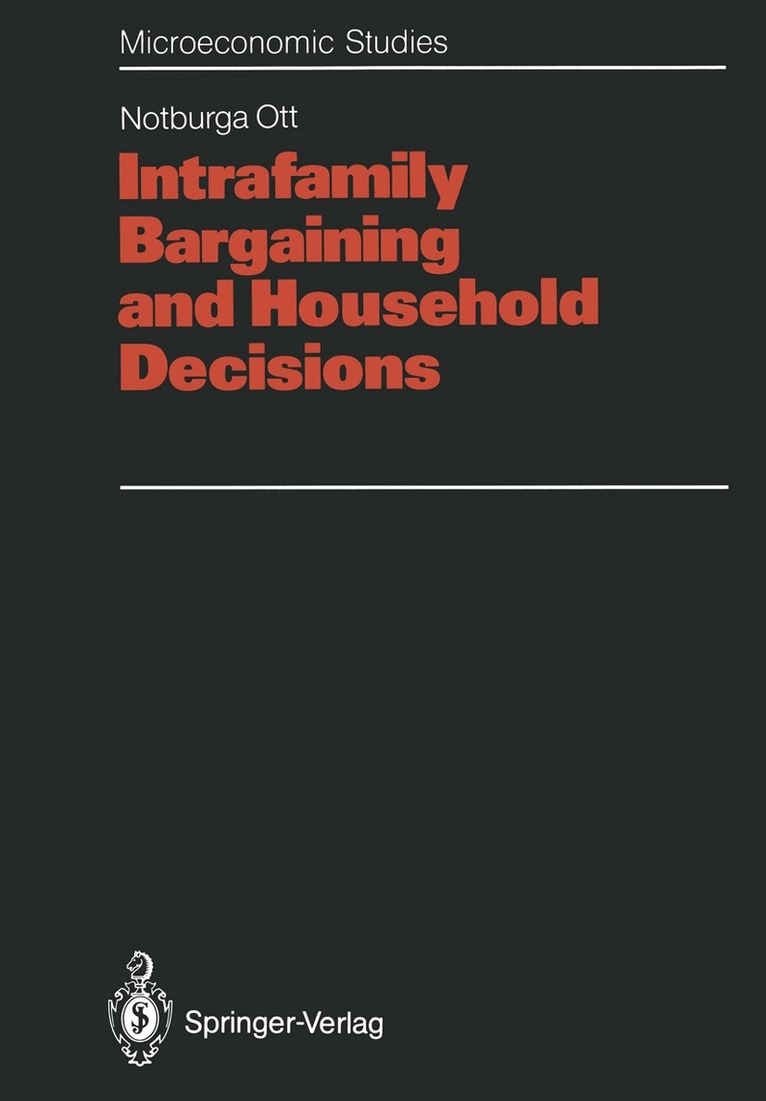
    Intrafamily Bargaining and Household Decisions

    AvNotburga Ott

    Häftad, Engelska, 2012

    Del i serien Microeconomic Studies

    1 086 kr

    Beställningsvara. Skickas inom 10-15 vardagar. Fri frakt över 249 kr.

    Fler format och utgåvor

    E-bok

    1 413 kr

    Beskrivning

    A model of household decisions based on a bargainingapproach is developed providing a comprehensive frameworkfor the analysis of family behavior. Treating the family asan economic organization, household behavior is explained bythe cooperation of utility maximizing individuals. Thedifference to traditional microeconomic household models isthat theassumption of a joint household utility functionis abandoned. Instead of this, a game theoretic approach isused to model family decisions as a result of intrafamilybargaining. Considering the development of the spouses`human capital in a dynamic approach, the long-term effectsof intrafamily specialization in market work and work athome are analyzed. Onemajor finding is that in a dynamicsetting non-Pareto efficient allocations may result.Empirical tests demonstrate the relevanace of the bargainingapproach.

    Produktinformation

    • Utgivningsdatum:2012-02-17
    • Mått:170 x 244 x 14 mm
    • Vikt:442 g
    • Format:Häftad
    • Språk:Engelska
    • Serie:Microeconomic Studies
    • Antal sidor:242
    • Förlag:Springer-Verlag Berlin and Heidelberg GmbH & Co. KG
    • ISBN:9783642457104

    Utforska kategorier

    • Sociologi inom Samhälle och politik

    Innehållsförteckning

    • 1 Introduction.- 2 Models of the ‘new home economics’.- 2.1 Decisions in an existing family.- 2.2 Family formation and marital stability.- 2.3 Problems and further questions.- 3 Family decisions as a bargaining problem.- 3.1 The family as an organization of exchange.- 3.2 Household decisions as a non-cooperative game.- 3.3 Household decisions as a cooperative game.- 4 A Nash bargaining model for household decisions.- 4.1 Comparison with traditional approaches.- 4.2 Comparative statics.- 5 Time allocation in a static bargaining model with household production.- 5.1 The model.- 5.2 Division of work within the household.- 5.3 Effects of an exogenous change in wages.- 6 A dynamic model with accumulation of human capital.- 6.1 Intrafamily division of work and accumulation of human capital.- 6.2 The dynamic approach.- 6.3 Time allocation depending on individual bargaining power.- 7 Pareto efficiency of family decisions.- 7.1 Binding force of contracts and efficiency.- 7.2 Discrete choices.- 7.3 Fertility as a prisoner’s dilemma.- 8 The binding force of intrafamily contracts.- 8.1 Self-enforcing contracts.- 8.2 Enforcement by institutions.- 8.3 Remarks on policy options.- 9 Introducing uncertainty: the possibility of conflict.- 9.1 Exogenous probability of conflict.- 9.2 Causes of conflict and negotiation strategies.- 9.3 Endogenous probability of conflict.- 10 Empirical tests of the bargaining approach.- 10.1 Tests based on the Slutsky restrictions.- 10.2 Test of Pareto efficiency.- 11 Survey of empirical bargaining models.- 11.1 Household labor supply: a model with fixed bargaining power.- 11.2 Household labor supply: a game theoretic model in a discrete choice setting.- 11.3 The distribution of welfare in the household: measuring the bargaining power.- 11.4 Marriageand divorce: estimates with explicit threat point.- 12 Empirical evidence of the bargaining approach - first findings with German data.- 12.1 Balance of power within marriages.- 12.2 Fertility decision.- 12.3 Divorce behavior.- 13 Concluding remarks.