Modern Theoretical Chemistry - Böcker
Visar alla böcker i serien Modern Theoretical Chemistry. Handla med fri frakt och snabb leverans.
8 produkter
8 produkter
536 kr
Skickas inom 10-15 vardagar
The last decade has been marked by a rapid growth in statistical mechanics, especially in connection with the physics and chemistry of the fluid state. Our understanding in these areas has been considerably advanced and enriched by the discovery of new techniques and the sharpening of old techniques, ranging all the way from computer simulations to mode-mode coupling theories. Statistical mechanics brings together under one roof a broad spectrum of mathematical methods. The aim of these volumes is to provide a didactic treatment of those topics that are most useful for the study of problems of current interest to theoretical chemists. The emphasis throughout is on the techniques themselves and not on reviewing the enormous literature in statistical mechanics. Each author was charged with the following task. Given N pages, (a) pose the problem, (b) present those aspects of the particular technique that cJearly illustrate its internal workings, (c) apply the technique to the solUlion of several illustrative examples, and (d) write the chapter so that it will enable the reader to approach key citations to the literature intelligently. These volumes are designed for graduate students and research workers in statistical mechanics. Nevertheless, they should be useful in other areas as weIl.
536 kr
Skickas inom 10-15 vardagar
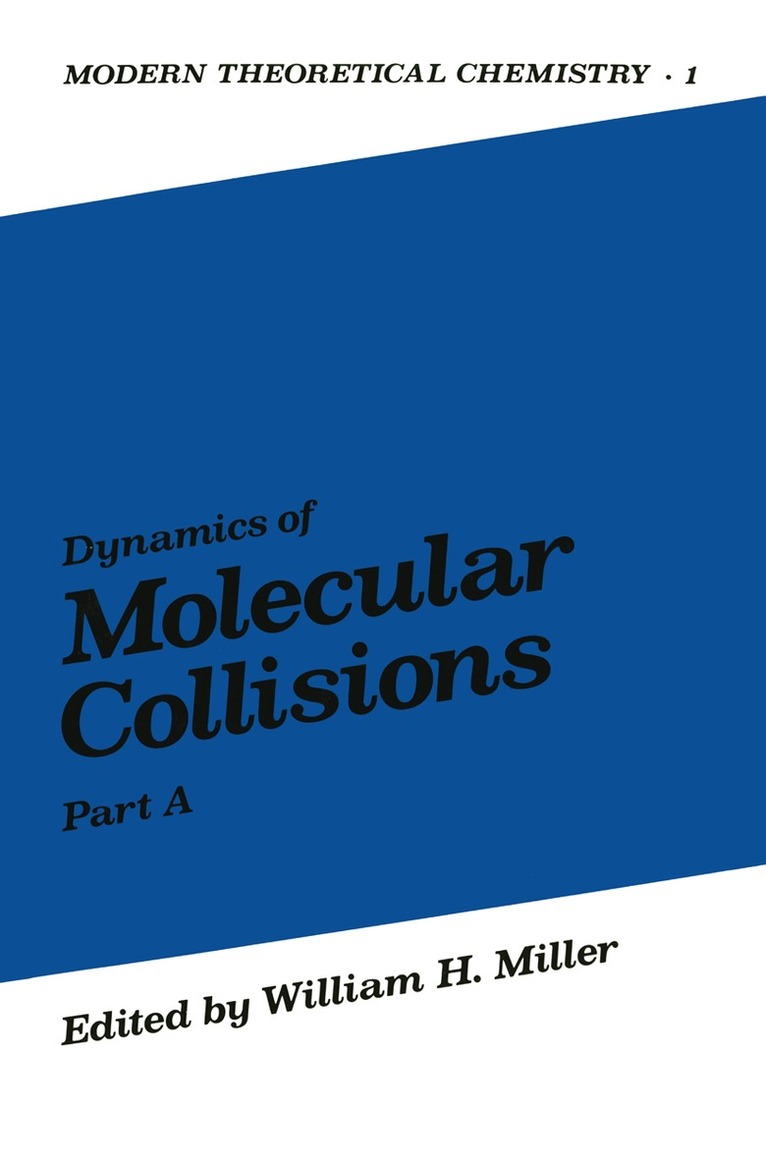
Activity in any theoretical area is usually stimulated by new experimental techniques and the resulting opportunity of measuring phenomena that were previously inaccessible. Such has been the case in the area under consideration here beginning about fifteen years ago when the possibility of studying chemical reactions in crossed molecular beams captured the imagination of physical chemists, for one could imagine investigating chemical kinetics at the same level of molecular detail that had previously been possible only in spectroscopic investigations of molecular stucture. This created an interest among chemists in scattering theory, the molecular level description of a bimolecular collision process. Many other new and also powerful experimental techniques have evolved to supplement the molecular beam method, and the resulting wealth of new information about chemical dynamics has generated the present intense activity in molecular collision theory. During the early years when chemists were first becoming acquainted with scattering theory, it was mainly a matter of reading the physics literature because scattering experiments have long been the staple of that field. It was natural to apply the approximations and models that had been developed for nuclear and elementary particle physics, and although some of them were useful in describing molecular collision phenomena, many were not. The most relevant treatise then available to students was Mott and Massey's classic The Theory of Atomic Collisions, * but, as the title implies, it dealt only sparingly with the special features that arise when at least one of the collision partners is a molecule.
Del 5 - Modern Theoretical Chemistry
Statistical Mechanics
Part A: Equilibrium Techniques
Häftad, Engelska, 2012
536 kr
Skickas inom 10-15 vardagar
The last decade has been marked by a rapid growth in statistical mechanics, especially in connection with the physics and chemistry of the fluid state. Our understanding in these areas has been considerably advanced and enriched by the discovery of new techniques and the sharpening of old techniques, ranging all the way from computer simulation to mode-mode coupling theories. Statistical mechanics brings together under one roof a broad spectrum of mathematical techniques. The aim of these volumes is to provide a didactic treatment of those techniques that are most useful for the study of problems of current interest to theoretical chemists. The emphasis throughout is on the techniques themselves and not on reviewing the enormous literature in statistical mechanics. Each author was charged with the following task. Given N pages, (a) pose the problem, (b) present those aspects of the particular technique that clearly illustrate its internal workings, (c) apply the technique to the solution of several illustrative examples, and (d) write the chapter so that it will enable the reader to approach key citations to the literature intelligently. These volumes are designed for graduate students and research workers in statistical mechanics. Nevertheless, because of the range of techniques and their general utility, they should be useful in other areas as well.
Del 7 - Modern Theoretical Chemistry
Semiempirical Methods of Electronic Structure Calculation
Part A: Techniques
Häftad, Engelska, 2012
536 kr
Skickas inom 10-15 vardagar
If one reflects upon the range of chemical problems accessible to the current quantum theoretical methods for calculations on the electronic structure of molecules, one is immediately struck by the rather narrow limits imposed by economic and numerical feasibility. Most of the systems with which experimental photochemists actually work are beyond the grasp of ab initio methods due to the presence of a few reasonably large aromatic ring systems. Potential energy surfaces for all but the smallest molecules are extremely expensive to produce, even over a restricted group of the possible degrees of freedom, and molecules containing the higher elements of the periodic table remain virtually untouched due to the large numbers of electrons involved. Almost the entire class of molecules of real biological interest is simply out of the question. In general, the theoretician is reduced to model systems of variable appositeness in most of these fields. The fundamental problem, from a basic computational point of view, is that large molecules require large numbers of basis functions, whether Slater type orbitals or Gaussian functions suitably contracted, to provide even a modestly accurate description of the molecular electronic environment. This leads to the necessity of dealing with very large matrices and numbers of integrals within the Hartree-Fock approximation and quickly becomes both numerically difficult and uneconomic.
Del 8 - Modern Theoretical Chemistry
Semiempirical Methods of Electronic Structure Calculation
Part B: Applications
Häftad, Engelska, 2012
536 kr
Skickas inom 10-15 vardagar
If one reflects upon the range of chemical problems accessible to the current quantum theoretical methods for calculations on the electronic structure of molecules, one is immediately struck by the rather narrow limits imposed by economic and numerical feasibility. Most of the systems with which experimental photochemists actually work are beyond the grasp of ab initio methods due to the presence of a few reasonably large aromatic ring systems. Potential energy surfaces for all but the smallest molecules are extremely expensive to produce, even over a restricted group of the possible degrees of freedom, and molecules containing the higher elements of the periodic table remain virtually untouched due to the large numbers of electrons involved. Almost the entire class of molecules of real biological interest is simply out of the question. In general, the theoretician is reduced to model systems of variable appositeness in most of these fields. The fundamental problem, from a basic computational point of view, is that large molecules require large numbers of basis functions, whether Slater type orbitals or Gaussian functions suitably contracted, to provide even a modestly accurate description of the molecular electronic environment. This leads to the necessity of dealing with very large matrices and numbers of integrals within the Hartree-Fock approximation and quickly becomes both numerically difficult and uneconomic.
536 kr
Skickas inom 10-15 vardagar
These two volumes deal with the quantum theory of the electronic structure of ab initio is the notion that approximate solutions molecules. Implicit in the term of Schrodinger's equation are sought "from the beginning," i. e. , without recourse to experimental data. From a more pragmatic viewpoint, the distin guishing feature of ab initio theory is usually the fact that no approximations are involved in the evaluation of the required molecular integrals. Consistent with current activity in the field, the first of these two volumes contains chapters dealing with methods per se, while the second concerns the application of these methods to problems of chemical interest. In a sense, the motivation for these volumes has been the spectacular recent success of ab initio theory in resolving important chemical questions. However, these applications have only become possible through the less visible but equally important efforts of those developing new theoretical and computational methods and models. Henry F. Schaefer vii Contents Contents of Volume 3 xv Chapter 1. A Priori Geometry Predictions 1. A. Pople 1. Introduction . . . . . . . . . . . . . . . . . . . 1 2. Equilibrium Geometries by Hartree-Fock Theory 2 2. 1. Restricted and Unrestricted Hartree-Fock Theories 2 2. 2. Basis Sets for Hartree-Fock Studies . . . . . 4 2. 3. Hartree-Fock Structures for Small Molecules . 6 2. 4. Hartree-Fock Structures for Larger Molecules 12 3. Equilibrium Geometries with Correlation . . 18 4. Predictive Structures for Radicals and Cations 20 5. Conclusions 23 References 24 Chapter 2. Barriers to Rotation and Inversion Philip W. Payne and Leland C.
536 kr
Skickas inom 10-15 vardagar
Activity in any theoretical area is usually stimulated by new experimental techniques and the resulting opportunity of measuring phenomena that were previously inaccessible. Such has been the case in the area under consideration he re beginning about fifteen years aga when the possibility of studying chemical reactions in crossed molecular beams captured the imagination of physical chemists, for one could imagine investigating chemical kinetics at the same level of molecular detail that had previously been possible only in spectroscopic investigations of molecular stucture. This created an interest among chemists in scattering theory, the molecular level description of a bimolecular collision process. Many other new and also powerful experimental techniques have evolved to supplement the molecular be am method, and the resulting wealth of new information about chemical dynamics has generated the present intense activity in molecular collision theory. During the early years when chemists were first becoming acquainted with scattering theory, it was mainly a matter of reading the physics literature because scattering experiments have long been the staple of that field. It was natural to apply the approximations and models that had been developed for nuclear and elementary particle physics, and although some of them were useful in describing molecular collision phenomena, many were not.
1 064 kr
Skickas inom 10-15 vardagar
These two volumes deal with the quantum theory of the electronic structure of molecules. Implicit in the term ab initio is the notion that approximate solutions of Schrödinger's equation are sought "from the beginning," i. e. , without recourse to experimental data. From a more pragmatic viewpoint, the distin guishing feature of ab initio theory is usually the fact that no approximations are involved in the evaluation of the required molecular integrals. Consistent with current activity in the field, the first of these two volumes contains chapters dealing with methods per se, while the second concerns the application of these methods to problems of chemical interest. In asense, the motivation for these volumes has been the spectacular recent success of ab initio theory in resolving important chemical questions. However, these applications have only become possible through the less visible but equally important efforts of those develop ing new theoretical and computational methods and models. Henry F Schaefer Vll Contents Contents of Volume 4 XIX Chapter 1. Gaussian Basis Sets for Molecular Calculations Thom. H. Dunning, Ir. and P. Ieffrey Hay 1. Introduction . . . . . . . . . . . . . . . . 1 1. 1. Slater Functions and the Hydrogen Moleeule 1 1. 2. Gaussian Functions and the Hydrogen Atom 3 2. Hartree-Fock Calculations on the First Row Atoms 5 2. 1. Valence States of the First Row Atoms 6 7 2. 2. Rydberg States of the First Row Atoms 9 2. 3.