• Fri frakt över 249 kr
  • •
  • Snabba leveranser
  • •
  • Billiga böcker
Kundservice

Du är på sajten för privatpersoner.

Företag, bibliotek eller offentlig verksamhet?

Du handlar på classic.bokus.com, där alla dina funktioner finns intakta.
Till classic.bokus.com
Bokus logotyp. Gå till startsidan.
  • Erbjudanden
  • Nyheter
  • Student
  • Topplistor
  • Barn & ungdom
  • Bokus Play
  • E-böcker
  • Pocketböcker
  • Spel & pussel

10% rabatt på allt med kod: NYSTART10 →

Sidfot

Mina sidor

    Hjälp

    • Kundservice
    • Vanliga frågor och svar
    • Frakt och leverans
    • Retur vid ångerrätt
    • Reklamera vara
    • Betalning
    • Köpvillkor
    • Allmänna villkor
    • Information om webbplatsens tillgänglighet

    Om Bokus

    • Om oss
    • Pressrum
    • För studenter
    • För företag
    • För bibliotek och offentlig verksamhet
    • För leverantörer
    • Hållbarhet

    Populärt

    • Aktuella erbjudanden
    • Presentkort
    • Studentlitteratur
    • Nya böcker
    • Topplistor
    • Signerade böcker
    • Engelska böcker

    Inspiration

    • Boktips
    • BookTok
    • Populära bokserier
    • Barnbokskaraktärer
    • Populära författare
    Logotyp för Bokus
    Följ oss på Facebook (extern länk)Följ oss på Instagram (extern länk)Följ oss på YouTube (extern länk)Följ oss på TikTok (extern länk)
    bokus @ CookiesAnpassa cookiesIntegritetspolicyKöpvillkor
    Till Citymail hemsida (extern länk)Till Budbee hemsida (extern länk)Till Postnord hemsida (extern länk)Till Schenker hemsida (extern länk)Till Early Bird hemsida (extern länk)Till Walleys hemsida (extern länk)
    1. Naturvetenskap och teknik
    2. Matematik och naturvetenskap
    3. Kemi
    4. Fysikalisk kemi

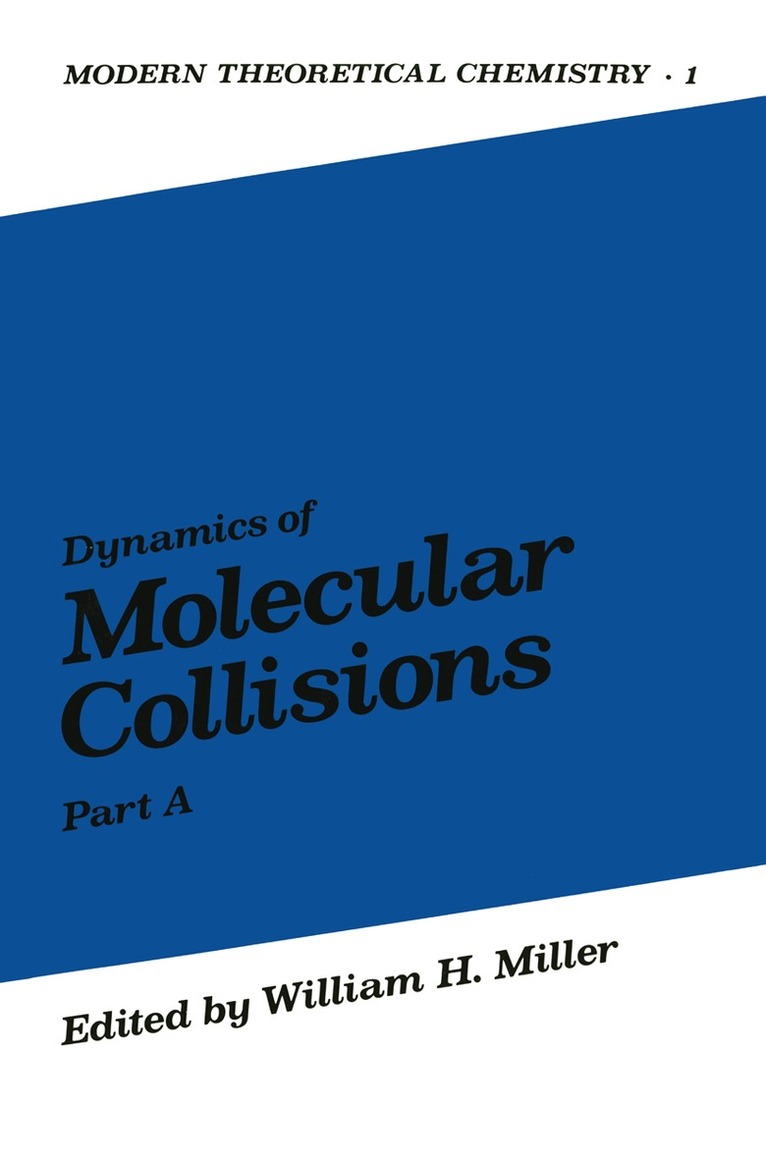
    Dynamics of Molecular Collisions

    Part A

    AvW. Miller

    Häftad, Engelska, 2013

    Del 1 i serien Modern Theoretical Chemistry

    547 kr

    Beställningsvara. Skickas inom 10-15 vardagar. Fri frakt över 249 kr.

    Beskrivning

    Activity in any theoretical area is usually stimulated by new experimental techniques and the resulting opportunity of measuring phenomena that were previously inaccessible. Such has been the case in the area under consideration here beginning about fifteen years ago when the possibility of studying chemical reactions in crossed molecular beams captured the imagination of physical chemists, for one could imagine investigating chemical kinetics at the same level of molecular detail that had previously been possible only in spectroscopic investigations of molecular stucture. This created an interest among chemists in scattering theory, the molecular level description of a bimolecular collision process. Many other new and also powerful experimental techniques have evolved to supplement the molecular beam method, and the resulting wealth of new information about chemical dynamics has generated the present intense activity in molecular collision theory. During the early years when chemists were first becoming acquainted with scattering theory, it was mainly a matter of reading the physics literature because scattering experiments have long been the staple of that field. It was natural to apply the approximations and models that had been developed for nuclear and elementary particle physics, and although some of them were useful in describing molecular collision phenomena, many were not. The most relevant treatise then available to students was Mott and Massey's classic The Theory of Atomic Collisions, * but, as the title implies, it dealt only sparingly with the special features that arise when at least one of the collision partners is a molecule.

    Produktinformation

    • Utgivningsdatum:2013-05-22
    • Mått:178 x 254 x 19 mm
    • Vikt:634 g
    • Format:Häftad
    • Språk:Engelska
    • Serie:Modern Theoretical Chemistry
    • Antal sidor:318
    • Förlag:Springer-Verlag New York Inc.
    • ISBN:9781461588696

    Utforska kategorier

    • Fysikalisk kemi inom Naturvetenskap och teknik

    Innehållsförteckning

    • 1. The N Coupled-Channel Problem.- 1. Introduction.- 2. Coupled-Channel Equations.- 3. Coupled-Equation Approaches.- 4. Uncoupled-Equation Approaches.- References.- 2. Effective Hamiltonians in Molecular Collisions.- 1. Introduction.- 2. Conventional Treatment of Two Vibrating-Rotating Molecules.- 3. Effective Potential Method.- 4. Centrifugal Decoupling Hamiltonians.- 5. Partitioning Theory.- 6. Related Techniques with Effective Hamiltonians.- 7. Applications and Conclusions.- References.- 3. Optical Models in Molecular Collision Theory.- 1. Introduction.- 2. Physical Models of Optical Potentials.- 3. Formal Theory of Optical Potentials.- References.- 4. Vibrational Energy Transfer.- 1. Introduction.- 2. Basic Theory.- 3. WKB Method.- 4. Operator Solution of the Schrödinger Equation.- 5. Effects of Molecular Orientations on Vibrational Energy Transfer.- 6. Vibration-Rotation Energy Transfer.- 7. Vibration-Vibration Energy Transfer.- 8. Effects of the Multiplicity of Impacts on Vibration-Translation Energy Transfer.- 9. Concluding Remarks.- References.- 5. The Scattering of Atoms and Molecules from Solid Surfaces.- 1. Introduction.- 2. Elastic Scattering.- 3. Gas-Solid Energy Transfer.- 4. Reactive Scattering, Embedding.- References.- 6. Nonradiative Processes in Molecular Systems.- 1. Introduction.- 2. Radiationless Phenomena.- 3. Theoretical Methods and Models.- 4. Physical Interpretation.- References.- Author Index.