MoLAS Monograph - Böcker
Visar alla böcker i serien MoLAS Monograph. Handla med fri frakt och snabb leverans.
2 produkter
2 produkter
413 kr
Tillfälligt slut
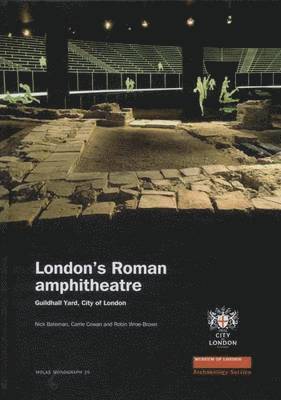
The discovery of one of Roman Londons most significant buildings - its amphitheatre - underneath the medieval Guildhall resulted from major archaeological excavations which took place between 1985 and 1999 as part of the City of London Corporations ambitious programme of redevelopment at the Guildhall. The history of the Guildhall and its precinct from the 12th to the 20th centuries is the subject of a companion volume. This book describes the construction, development and disuse of the amphitheatre, from the 1st to 4th centuries AD. Constructed on relatively low ground in the north-west part of Londinium, the first amphitheatre was built in c AD 74 of timber. Evidence was recovered for the eastern entrance, arena palisade, bank for seating and associated drains. The amphitheatre was rebuilt shortly after AD 120, with masonry foundations and walls, associated with new timber stands. The evidence allows conjectural reconstruction and comparison with other British amphitheatres. Abandoned by the mid 4th century, the amphitheatre was largely demolished and sealed by dark earth. The arena may have survived as an oval depression until the area was reoccupied in the 11th century. Significant finds assemblages include an early 2nd-century dump of glass cullet, lead curses from the arena surface and samian pottery with gladiatorial motifs. The amphitheatres remains are preserved and displayed in the basement of the new Guildhall Art Gallery.
In the Northern Cemetery of Roman London
Excavations at Spitalfields Market, London E1, 1991-2007
Inbunden, Engelska, 2020
414 kr
Tillfälligt slut
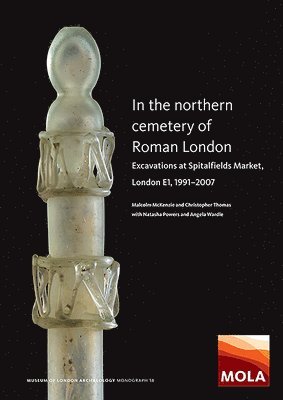
London’s Spitalfields Market was the location of one of the city’s largest archaeological excavations, carried out by MOLA between 1991 and 2007. This book presents the archaeological and bioarchaeological evidence for Roman activity here, to the north-east of the urban settlement and the site of a series of burial grounds on the east side of Ermine Street. Burial began here c AD 120 and continued into the 4th century AD. Excavation revealed a number of ditched enclosures, some used for the interment of 169 inhumations and five cremation burials, some for other purposes. Among the early burials men outnumbered women by five to one, but by the later 3rd and 4th centuries AD a more even sex ratio prevailed. Subadults were well represented, with one area apparently set aside for the burial of neonates and children. The cemetery attracted some particularly wealthy 4th-century AD burials, including at least two in stone sarcophagi, one of which contained an inner, decorated, lead coffin enclosing a young woman. She had been anointed with imported resins and buried in fine clothing, with unusual glassware and jet items. Some burial rites and grave goods are more familiar from Continental cemeteries, emphasising the cosmopolitan and mobile nature of London’s population.