Monographs in Evolutionary Biology - Böcker
Visar alla böcker i serien Monographs in Evolutionary Biology. Handla med fri frakt och snabb leverans.
5 produkter
5 produkter
536 kr
Skickas inom 10-15 vardagar
George H. F. Nuttall pioneered the study of phylogeny through the ge- netically encoded sequence structures of proteins. His classic monograph, Blood Immllnity and Blood Relationship, was published in 1904. The findings described in this monograph testified that immunologic compar- isons of serum proteins could help reveal the phyletic relationships of primates and other animals. Although Nuttall had no way of knowing that a correspondence between the nucleotide sequences of genes and the amino acid sequences of proteins was the genetic basis for the immuno- logic specificities of animal sera, he clearly saw the implications of his findings. Thus he wrote in the introduction of his monograph, "The per- sistence of the chemical blood-relationship between the various groups of animals serves to carry us back into geological times, and I believe we have but begun the work along these lines, and that it will lead to valuable results in the study of various problems of evolution. " Nuttall's prophecy is being fulfilled. Through the first two-thirds of the 20th century immu- nology led the way in the molecular analysis of the phyletic relationships of animal taxa above the species level.Amino acid sequencing of proteins began in earnest during the 1960s. It overtook immunology during the 1970s and provided more exact molecular data for investigating the history of life and the forces of chance and selection which drive evolution.
1 593 kr
Skickas inom 10-15 vardagar
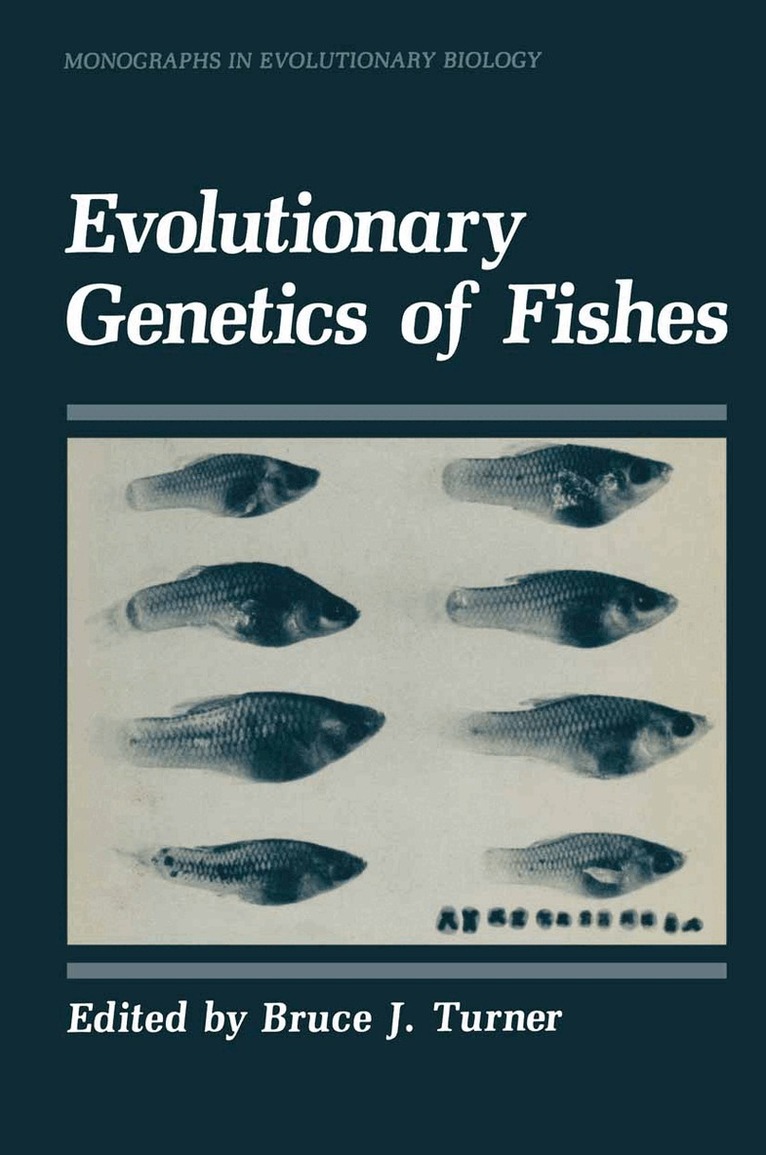
It is my hope that this collection of reviews can be profitably read by all who are interested in evolutionary biology. However, I would like to specifically target it for two disparate groups of biologists seldom men tioned in the same sentence, classical ichthyologists and molecular biologists. Since classical times, and perhaps even before, ichthyologists have stood in awe at the tremendous diversity of fishes. The bulk of effort in the field has always been directed toward understanding this diversity, i. e. , extracting from it a coherent picture of evolutionary processes and lineages. This effort has, in turn, always been overwhelmingly based upon morphological comparisons. The practical advantages of such compari sons, especially the ease with which morphological data can be had from preserved museum specimens, are manifold. But considered objectively (outside its context of "tradition"), morphological analysis alone is a poor tool for probing evolutionary processes or elucidating relationships. The concepts of "relationship" and of "evolution" are inherently genetic ones, and the genetic bases of morphological traits are seldom known in detail and frequently unknown entirely. Earlier in this century, several workers, notably Gordon, Kosswig, Schmidt, and, in his salad years, Carl Hubbs, pioneered the application of genetic techniques and modes of reasoning to ichthyology. While certain that most contemporary ichth yologists are familiar with this body of work, I am almost equally certain that few of them regard it as pertinent to their own efforts.
1 064 kr
Skickas inom 10-15 vardagar
The microorganisms present on the earth today possess a vast range of metabolic activities and are often able to demonstrate their surprising versatility by gaining both new enzyme activities and new metabolic path ways through mutations. It is generally assumed that the earliest micro organisms were very limited in their metabolic abilities, but as time passed they gradually expanded their range of enzymatic activities and increased both their biosynthetic and catabolic capacity. It is also believed that these primitive microorganisms increased the amount of genetic material they possessed by duplicating their existing genes and possibly by ac quiring genetic material from other organisms. A small group of scientists has been exploring the means by which existing microorganisms are capable of mutating to expand their bio chemical abilities. In recent years, more attention has been focused on this type of research, sometimes called "evolution in a test tube." The recent advances in biotechnology and modern techniques of genetic trans fer have generated new interest in the methods by which a microorgan ism's metabolic activities can be improved or deliberately changed in some specific manner.
1 096 kr
Skickas inom 10-15 vardagar
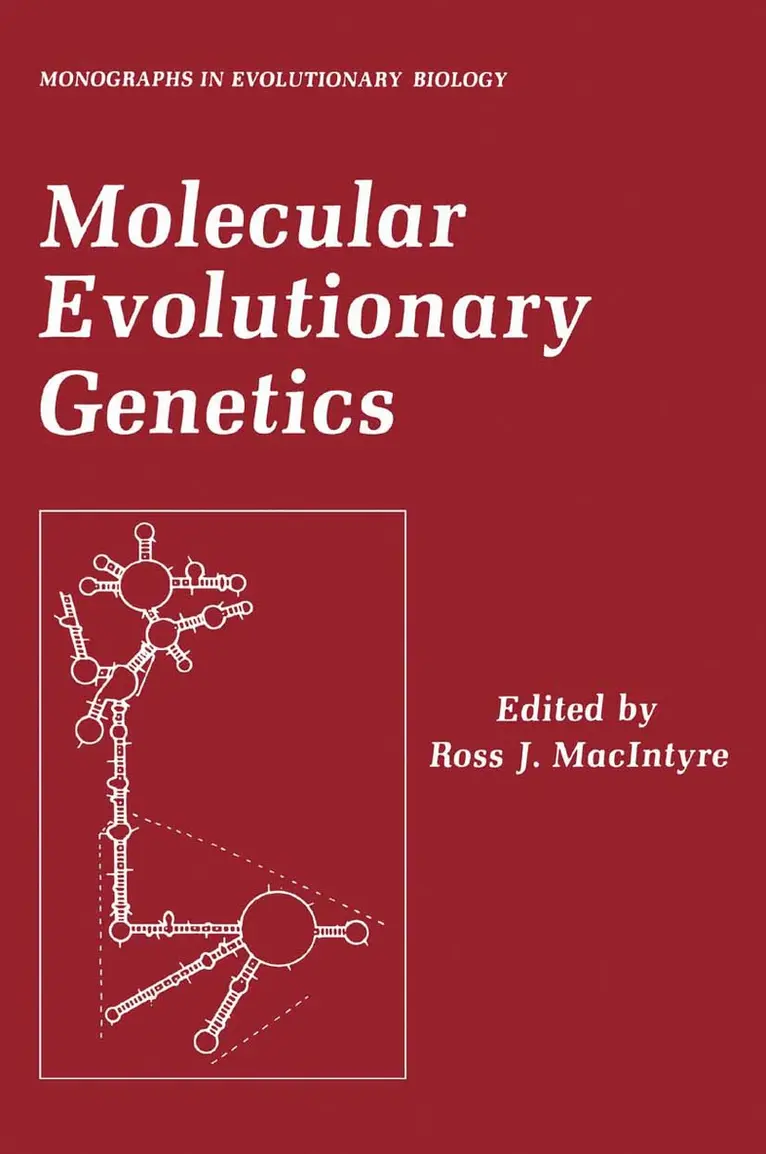
This volume in the Monographs in Evolutionary Biology series addresses issues that are part of an emerging area of research loosely called "mo lecular evolution. " Its practitioners include both molecular biologists cu rious about the evolutionary implications of their data and evolutionary biologists pushing their analyses to the molecular level. The union of these fields of molecular and organismal biology has been turbulent at times, and, as shall be seen, this dialectic has led to some very serious challenges to long-held notions about the role of natural selection in evolution and the economy of genome organization in eukaryotes. As an inevitable outgrowth of molecular biology, molecular evolution is necessarily a young discipline, but it can already point proudly to two major discoveries. The first, is the molecular clock, a concept that has emerged from the analysis of at least four data sets-amino acid sequences, immunologic data, DNA renaturation studies, and, recently, analyses of DNA sequences. The reality of a strong stochastic component in the evolution of nucleotide sequences can no longer be doubted, although the accuracy of the clock with regard to particular sequences and within particular groups of or ganisms should be independently measured each time it is used. Never theless, molecular clocks will assume increasingly important roles in phy logenetic reconstructions, especially since the fossil record is so fragmentary. The second major discovery of molecular evolution has been the incredible complexity of the eukaryotic genome.
1 096 kr
Skickas inom 10-15 vardagar
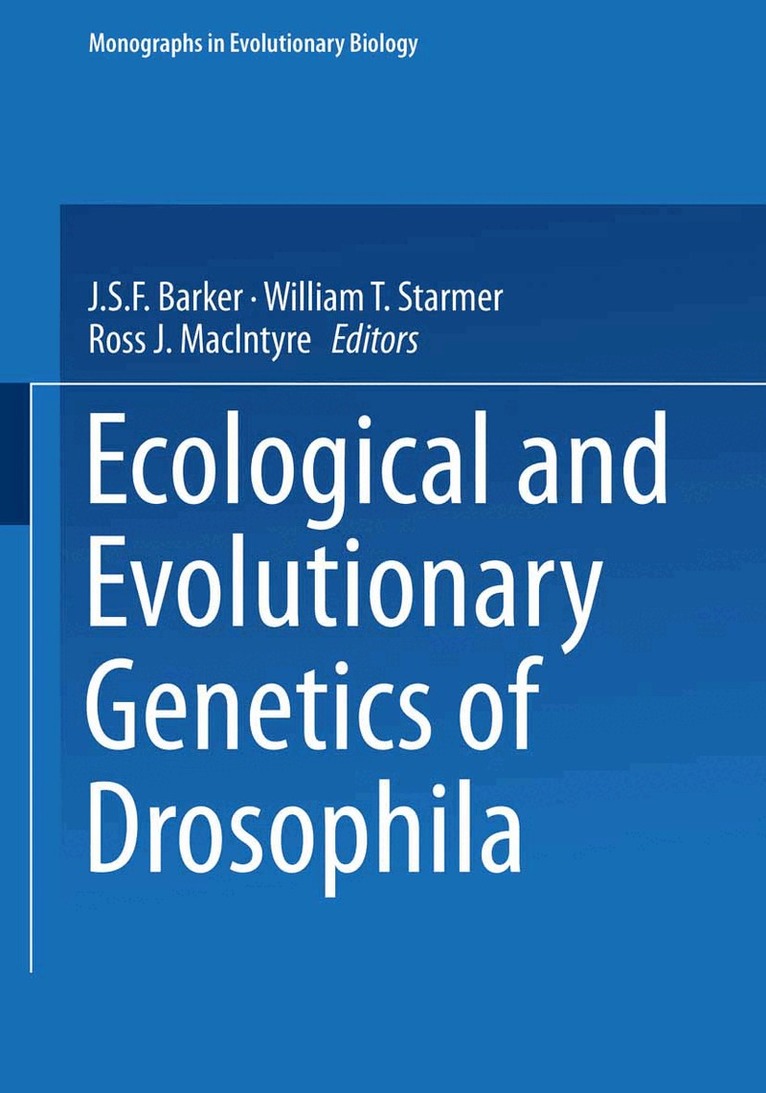
Ecological and evolutionary genetics span many disciplines and virtually all levels of biological investigation, from the genetic information itself to the principles governing the complex organization of living things. The ideas and informa tion generated by ecological and evolutionary genetics provide the substance for strong inferences on the origins, changes and patterns of structural and functional organization in bio logical communi ties. It is the coordination of these ideas and thoughts that will provide the answers to many fundamental questions in biology. There is no doubt that Drosophilids provide strong model systems amenable to experimental manipulation and useful for testing pertinent hypotheses in ecological and evolutionary genetics. The chapters in this volume represent efforts to use Drosophila species for such a purpose. The volume consists of a dedication to William B. Heed, followed by four major sections: Ecological Genetics, Habitat Selection, Biochemical Genetics and Molecular Evolution. Each section is introduced by a short statement, and each chapter has an independent summary. The chapters contain the sub stance of talks given at a joint Australia-US workshop held January 5-10, 1989 at the University of New England, New South Wales, Australia. We are indebted to the Division of International Programs of the National Science Foundation (USA) and to the Science and Technology Collaboration Section of the Department of Industry, Technology and Commerce (Australia) for the provi sion of financial support under the US/Australia Science and Technology Agreement. Many people contributed to the preparation of this volume.