Native Peoples of the Americas - Böcker
Visar alla böcker i serien Native Peoples of the Americas. Handla med fri frakt och snabb leverans.
7 produkter
7 produkter
Archaeology at El Perú-Waka'
Ancient Maya Performances of Ritual, Memory, and Power
Inbunden, Engelska, 2014
740 kr
Skickas inom 7-10 vardagar
Archaeology at El Perú-Waka' is the first book to summarize long-term research at this major Maya site. The results of fieldwork and subsequent analyses conducted by members of the El Perú-Waka' Regional Archaeological Project are coupled with theoretical approaches treating the topics of ritual, memory, and power as deciphered through material remains discovered at Waka'. The book is site-centered, yet the fifteen wide-ranging contributions offer readers greater insight to the richness and complexity of Classic-period Maya culture, as well as to the ways in which archaeologists believe ancient peoples negotiated their ritual lives and comprehended their own pasts.El Perú-Waka' is an ancient Maya city located in present-day northwestern Petén, Guatemala. Rediscovered by petroleum exploration workers in the mid-1960s, it is the largest known archaeological site in the Laguna del Tigre National Park in Guatemala's Maya Biosphere Reserve. The El Perú-Waka' Regional Archaeological Project initiated scientific investigations in 2003, and through excavation and survey, researchers established that Waka' was a key political and economic center well-integrated into Classic-period lowland Maya civilization, and reconstructed many aspects of Maya life and ritual activity in this ancient community. The research detailed in this volume provides a wealth of new, substantive, and scientifically excavated data, which contributors approach with fresh theoretical insights. In the process, they lay out sound strategies for understanding the ritual manipulation of monuments, landscapes, buildings, objects, and memories, as well as related topics encompassing the performance and negotiation of power throughout the city's extensive sociopolitical history
From Tribute to Communal Sovereignty
The Tarascan and Caxcan Territories in Transition
Inbunden, Engelska, 2015
649 kr
Skickas inom 11-20 vardagar
From Tribute to Communal Sovereignty examines both continuity and change over the last five centuries for the indigenous peoples of Central Western Mexico, providing the first sweeping and comprehensive regional history of this important region in Mesoamerica.The continuities elucidated concern ancestral territorial claims that date back centuries and reflect the stable geographic locations occupied by core populations of indigenous language–speakers in or near their pre-Columbian territories since the Postclassical period, from the thirteenth to late fifteenth centuries. A common theme of this volume is the strong cohesive forces present, not only in the colonial construction of Christian village communities in Purhépecha and Nahuatl groups in Michoacán but also in the demographically less inclusive Huichol (Wixarika) and Cora and Tepehuan groups, whose territories were more extensive.The authors review a cluster of related themes: settlement patterns of the last five centuries in Central Western Mexico, language distribution, ritual representation of territoriality, processes of collective identity, and the forms of participation and resistance during different phases of Mexican state formation. From such research, the question arises: does the village community constitute a unique level of organization of the experience of the original peoples of Central Western Mexico? The chapters address this question in rich and complex ways by first focusing on the past configurations and changes in lifeways during the transition from pre-Columbian to Spanish rule in tributary empires, then examining the long-term postcolonial process of Mexican Independence that introduced the emerging theme of the communal sovereignty.
399 kr
Skickas inom 7-10 vardagar
In this provocative new book, Margaret M. Bruchac, an Indigenous anthropologist, turns the word savage on its head. Savage Kin explores the nature of the relationships between Indigenous informants, such as Gladys Tantaquidgeon (Mohegan), Jesse Cornplanter (Seneca), and George Hunt (Tlingit), and early twentieth-century anthropological collectors, such as Frank Speck, Arthur C. Parker, William N. Fenton, and Franz Boas.This book reconceptualizes the intimate details of encounters with Native interlocutors who by turns inspired, facilitated, and resisted the anthropological enterprise. Like other texts focused on this era, Savage Kin features some of the elite white men credited with salvaging material that might otherwise have been lost. Unlike other texts, this book highlights the intellectual contributions and cultural strategies of unsung Indigenous informants without whom this research could never have taken place.These bicultural partnerships transgressed social divides and blurred the roles of anthropologist/informant, relative/stranger, and collector/collected. Yet these stories were obscured by collecting practices that separated people from objects, objects from communities, and communities from stories. Bruchac’s decolonizing efforts include “reverse ethnography”—painstakingly tracking seemingly unidentifiable objects, misconstrued social relations, unpublished correspondence, and unattributed field notes—to recover this evidence. Those early encounters generated foundational knowledges that still affect Indigenous communities today.Savage Kin also contains unexpected narratives of human and other-than-human encounters—brilliant discoveries, lessons from ancestral spirits, prophetic warnings, powerful gifts, and personal tragedies—that will move Native and non-Native readers alike.
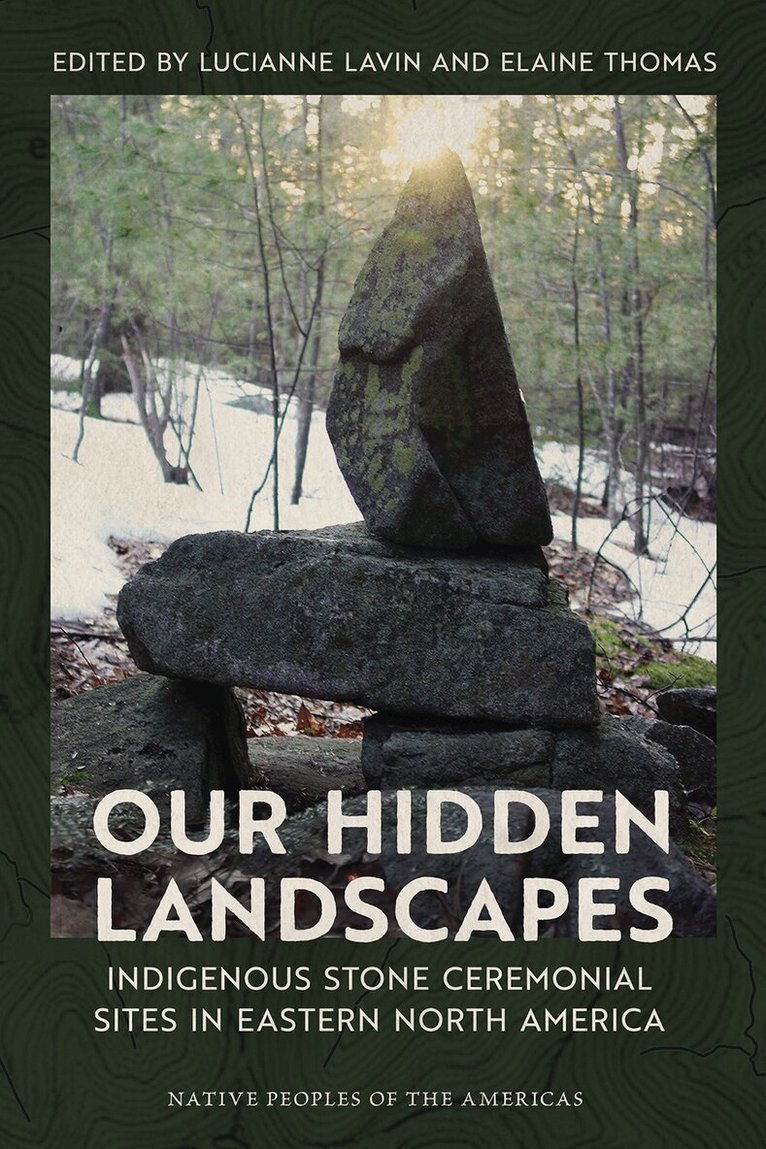
Our Hidden Landscapes
Indigenous Stone Ceremonial Sites in Eastern North America
Inbunden, Engelska, 2023
822 kr
Skickas inom 7-10 vardagar
Challenging traditional and long-standing understandings, this volume provides an important new lens for interpreting stone structures that had previously been attributed to settler colonialism. Instead, the contributors to this volume argue that these locations are sacred Indigenous sites.This volume introduces readers to eastern North America’s Indigenous ceremonial stone landscapes (CSLs)--sacred sites whose principal identifying characteristics are built stone structures that cluster within specific physical landscapes. Our Hidden Landscapes presents these often unrecognized sites as significant cultural landscapes in need of protection and preservation.In this book, Native American authors provide perspectives on the cultural meaning and significance of CSLs and their characteristics, while professional archaeologists and anthropologists provide a variety of approaches for better understanding, protecting, and preserving them. The chapters present overwhelming evidence in the form of oral tradition, historic documentation, ethnographies, and archaeological research that these important sites created and used by Indigenous peoples are deserving of protection.This work enables archaeologists, historians, conservationists, foresters, and members of the general public to recognize these important ritual sites.ContributorsNohham Rolf Cachat-SchillingRobert DeFossesJames GageMary GageDoug HarrisJulia A. KingLucianne LavinJohannes (Jannie) H. N. LoubserFrederick W. MartinNorman MullerCharity Moore NortonPaul A. RobinsonLaurie W. RushScott M. StricklandElaine ThomasKathleen Patricia ThraneMatthew Victor Weiss
Our Hidden Landscapes
Indigenous Stone Ceremonial Sites in Eastern North America
Häftad, Engelska, 2025
409 kr
Skickas inom 11-20 vardagar
Challenging traditional and long-standing understandings, this volume provides an important new lens for interpreting stone structures that had previously been attributed to settler colonialism. Instead, the contributors to this volume argue that these locations are sacred Indigenous sites.This volume introduces readers to eastern North America's Indigenous ceremonial stone landscapes (CSLs) - sacred sites whose principal identifying characteristics are built stone structures that cluster within specific physical landscapes. Our Hidden Landscapes presents these often unrecognized sites as significant cultural landscapes in need of protection and preservation.In this book, Native American authors provide perspectives on the cultural meaning and significance of CSLs and their characteristics, while professional archaeologists and anthropologists provide a variety of approaches for better understanding, protecting, and preserving them. The chapters present overwhelming evidence in the form of oral tradition, historic documentation, ethnographies, and archaeological research that these important sites created and used by Indigenous peoples are deserving of protection.This work enables archaeologists, historians, conservationists, foresters, and members of the general public to recognize these important ritual sites.ContributorsNohham Rolf Cachat-SchillingRobert DeFossesJames GageMary GageDoug HarrisJulia A. KingLucianne LavinJohannes (Jannie) H. N. LoubserFrederick W. MartinNorman MullerCharity Moore NortonPaul A. RobinsonLaurie W. RushScott M. StricklandElaine ThomasKathleen Patricia ThraneMatthew Victor Weiss
1 039 kr
Skickas inom 10-15 vardagar
Despite the advances made in archaeology over the past generation, the Northeast remains the most misunderstood of all the archaeological regions of North America. With a complex environmental history shaped by ice sheets from the last glaciation, and highly acidic soils characteristic of the area, the kinds of organic artifacts found in other areas have been destroyed in the Northeast. The result is a sometimes evasive, particularly complicated, and always fragmentary archaeological record. As the chapters in this volume demonstrate, the Northeast is a region that inspires the development of innovative research designs and thoughtful and relevant questions. Each author has been a graduate student of Dena Dincauze, who has done much to foster understanding of the prehistory of Northeastern North America.
Archaeological and Anthropological Perspectives on the Native Peoples of Pampa, Patagonia, and Tierra del Fuego to the Nineteenth Century
Inbunden, Engelska, 2002
1 009 kr
Skickas inom 10-15 vardagar
The Spanish conquerors who explored the southern cone of South America reported back to Europe that the region was empty of human inhabitants. In truth, however, the large area supported a thriving, albeit low-density, population of foragers. Those foragers—the Mapuche, Tehuelche, Rankuelche, and Fueguian peoples—are the subject of this volume, which presents archaeological and ethnographic studies of their past.The southern cone of South America was one of the last regions to be colonized on earth. When the Spanish Royal Crown experienced difficulties expanding its colonial frontiers to include these lands, the area became known as a vast wildnerness at the very edge of the civilized world. As a result, the native peoples who did indeed inhabit the area were marginalized and as time passed the significance of their historical experience was ignored. This compilation of research by noted scholars of the region investigates the past of peoples largely neglected by the historical accounts of their conquerors. The history of the native peoples of Pampa, Patagonia, and Tierra del Fuego is a vital aspect of the region's past. Their historical knowledge and experience play a vital role in the struggle of a people to maintain a sense of cultural difference in an ever-changing world.