NBER-Entrepreneurship and Innovation Policy and the Economy – serie
Visar alla böcker i serien NBER-Entrepreneurship and Innovation Policy and the Economy. Handla med fri frakt och snabb leverans.
4 produkter
4 produkter
725 kr
Skickas
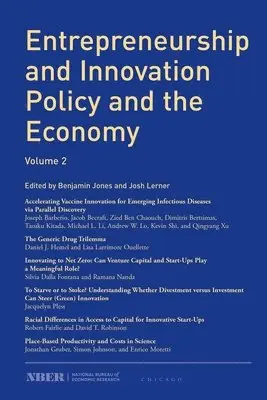
Rigorous nonpartisan research on the effects of economic forces and public policy on entrepreneurship and innovation.Entrepreneurship and innovation are widely recognized as drivers of economic dynamics and long-term prosperity. This series communicates key findings about the implications of entrepreneurial and innovative activity across the economy. In the first paper, Joseph Barberio, Jacob Becraft, Zied Ben Chaouch, Dimitris Bertsimas, Tasuku Kitada, Michael Li, Andrew Lo, Kevin Shi, and Qingyang Xu explore pharmaceutical firms’ weak incentives to develop vaccines against prospective diseases—due to high investment risks, low expected returns, and the rarity of pandemics— and consider a portfolio approach to financing vaccine research. Next, Daniel Hemel and Lisa Larrimore Ouellette describe a “trilemma” between quality, price, and access that appears after a generic pharmaceuticals patent expires, and show that it is difficult in a regulatory context to achieve distinct goals around price, access, and quality simultaneously. In the third paper, Silvia Dalla Fontana and Ramana Nanda examine the role of patents in the transition to a carbon-free world. They find relative to other technological areas, “Net Zero patents” are close to the scientific frontier, but due to difficulties of commercializing inventions, the share of such patents that are venture-backed has been increasingly directed to areas outside clean tech and other “deep” technologies. Jacquelyn Pless examines the effects of divestment from firms in “dirty” industries on innovation to combat climate change, or “green innovation.” She finds that compared with divesting, investing in firms and engaging with green corporate governance practices may induce more green innovation. Next, Robert Fairlie and David Robinson find that Black-owned innovative-intensive new businesses start smaller than their peers and do not converge in size over time. Differential access to bank financing is a major factor. Also “soft information,” which can help new businesses without established track records, can increase barriers for black founders and limit entrepreneurial pathways to prosperity. Finally, Jonathan Gruber, Simon Johnson, and Enrico Moretti consider the regional concentration of innovative activity in the United States. They find that while the concentration of activity has net advantages today, understanding the long-term benefits of more diffuse innovation clusters —including equity, industrial diversification, and talent development—is important.
496 kr
Skickas inom 7-10 vardagar
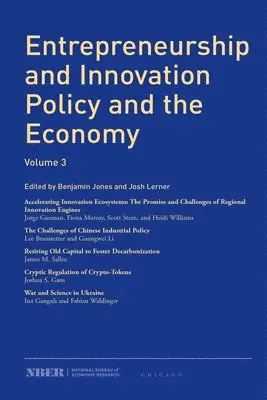
Rigorous nonpartisan research on the effects of economic forces and public policy on entrepreneurship and innovation.Entrepreneurship and innovation are widely recognized as drivers of economic dynamics and long-term prosperity. This series communicates key findings about the implications of entrepreneurial and innovative activity across the economy.Entrepreneurship and Innovation Policy and the Economy, Volume 3, synthesizes key findings about entrepreneurial and innovative activity in the U.S. economy, conveying insights on contemporary challenges and providing an analytical base for policy design. In the first paper, Jorge Guzman, Fiona Murray, Scott Stern, and Heidi Williams examine regional innovation engines and highlight the place-specific actions, potential bottlenecks, and roles of different stakeholders in catalyzing entrepreneurship and innovation. Next, Lee Branstetter and Guangwei Li examine the challenges faced by the Chinese central government in implementing industrial policy to push the technology frontier while local governments and businesses deploy resources to advance their own, not necessarily aligned, interests. Turning to climate issues, James Sallee analyzes policies aimed at accelerating the energy transition by hastening the replacement of durable capital assets like automobiles and residential appliances that last for decades and slow the adoption of cleaner technologies. Joshua Gans studies cryptocurrencies and other crypto-token-based instruments and the broad range of government responses to them, particularly in the U.S. Finally, Ina Ganguli and Fabian Waldinger consider the effects of the Russian invasion of Ukraine on the human capital in the Ukrainian science community.
496 kr
Skickas inom 7-10 vardagar
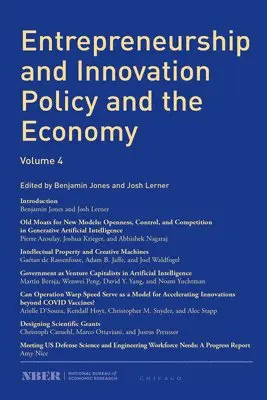
Rigorous nonpartisan research on the effects of economic forces and public policy on entrepreneurship and innovation.Entrepreneurship and innovation are widely recognized as drivers of economic dynamics and long-term prosperity. This series communicates key findings about the implications of entrepreneurial and innovative activity across the economy.Entrepreneurship and Innovation Policy and the Economy, Volume 4, synthesizes key findings about entrepreneurial and innovative activity in many sectors of the economy, conveying insights on contemporary challenges and seeking to inform policy. Several research papers address issues related to artificial intelligence (AI). In the first paper, Pierre Azoulay, Joshua Krieger, and Abhishek Nagaraj examine the future evolution of AI and its potential effects on market structure and competition. Next, Gaétan de Rassenfosse, Adam B. Jaffe, and Joel Waldfogel focus on how generative AI may influence creative activities and the intellectual property system. Martin Beraja, Wenwei Peng, David Y. Yang, and Noam Yuchtman examine Chinese government investment in the AI sector. Turning to research funding models, Arielle D’Souza, Kendall Hoyt, Christopher M. Snyder, and Alec Stapp elucidate the key features of Operation Warp Speed, which delivered effective vaccines in record time, and consider other settings in which this approach to research support might be applicable. Next, Christoph Carnehl, Marco Ottaviani, and Justus Preusser study the design of scientific research grants more broadly, analyzing existing grant systems and identifying key tradeoffs as well as open research issues. Finally, Amy Nice highlights the role of the science, technology, engineering, and mathematics (STEM) workforce in supporting the US defense sector and examines US workforce needs and immigration policy through this lens.
496 kr
Kommande
Rigorous nonpartisan research on the effects of economic forces and public policy on entrepreneurship and innovation.Entrepreneurship and innovation are widely recognized as drivers of economic dynamics and long-term prosperity. This volume of the Entrepreneurship and Innovation Policy and the Economy series brings rigorous new economic research to bear on a number of current policy issues. Andrew Fieldhouse and Karel Mertens quantify the social returns to public R&D and find that federal investments have yielded extraordinarily high productivity payoffs. They argue that cuts to non-defense R&D risk long-run damage to economic growth. Douglas Elmendorf, Glenn Hubbard, and Zachary Liscow examine the interaction of innovation-friendly growth-oriented policies with deficit reduction and conclude that while such policies alone cannot stabilize federal debt, they can meaningfully ease fiscal pressures. Nirupama Rao and Timothy Simcoe document the effectiveness of R&D tax credits while highlighting design challenges such as the need to ensure that credits stimulate additional research rather than subsidize activity that firms would have undertaken in their absence. Kyle Myers, Lauren Lanahan, and Evan Johnson analyze the Small Business Innovation Research (SBIR) program and show that small firms supported through SBIR pursue distinctive strategies compared to venture-backed startups. Pierre Azoulay, Daniel Gross, and Bhaven Sampat analyze indirect cost recovery, the system by which research universities are reimbursed for overhead. Fiona Paine, Richard Townsend, and Ting Xu assess restrictions on foreign investment in startups, weighing national security concerns against the costs to innovation ecosystems. Aaron Chatterji and Fiona Murray argue that geopolitics is fundamentally reshaping the economics of innovation, and distill the implications of this development for the approaches that are used in studying innovation policy.