Oxford Commentaries on American Law – serie
Visar alla böcker i serien Oxford Commentaries on American Law. Handla med fri frakt och snabb leverans.
4 produkter
4 produkter
2 625 kr
Skickas inom 5-8 vardagar
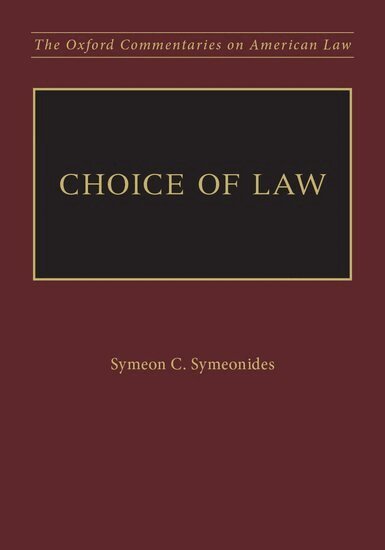
Choice of Law provides an in-depth sophisticated coverage of the choice-of-law part of Conflicts Law (or Private International Law) in torts, products liability, contracts, forum-selection and arbitration clauses, insurance, statutes of limitation, domestic relations, property, marital property, and successions. It also covers the constitutional framework and conflicts between federal law and foreign law.In this book, Symeon C. Symeonides focuses entirely on Choice of Law pertaining to the question of whether the merits of the dispute will be resolved under the substantive law of the state of adjudication (lex fori), or under the law of another involved state. Structured in three parts, this book discusses the Federal framework, history, doctrine, methodology, and the practice of choice of law. The author begins with the history of choice-of-law doctrine and follows its subsequent evolution to the present. He then moves on to methodology, and extensively explores the case law of the last fifty years, covering what courts say, and especially what they do. Symeonides goes on to identify emerging decisional patterns and extracts descriptive rules or tentative predictions about likely outcomes.
543 kr
Skickas inom 5-8 vardagar
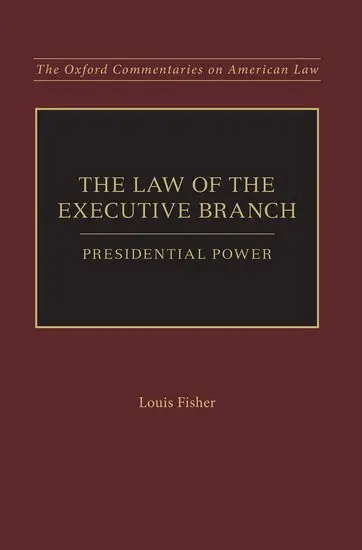
The scope of presidential authority has been a constant focus of constitutional dispute since the Framing. The bases for presidential appointment and removal, the responsibility of the Executive to choose between the will of Congress and the President, the extent of unitary powers over the military, even the ability of the President to keep secret the identity of those consulted in policy making decisions have all been the subject of intense controversy. The scope of that power and the manner of its exercise affect not only the actions of the President and the White House staff, but also all staff employed by the executive agencies. There is a clear need to examine the law of the entire executive branch.The Law of the Executive Branch: Presidential Power, places the law of the executive branch firmly in the context of constitutional language, framers' intent, and more than two centuries of practice. In this book, Louis Fisher strives to separate legitimate from illegitimate sources of power, through analysis that is informed by litigation as well as shaped by presidential initiatives, statutory policy, judicial interpretations, and public and international pressures. Each provision of the US Constitution is analyzed to reveal its contemporary meaning in concert with the application of presidential power. Controversial issues covered in the book include: unilateral presidential wars; the state secrets privilege; extraordinary rendition; claims of "inherent" presidential powers that may not be checked by other branches; and executive privilege.
2 619 kr
Skickas inom 5-8 vardagar
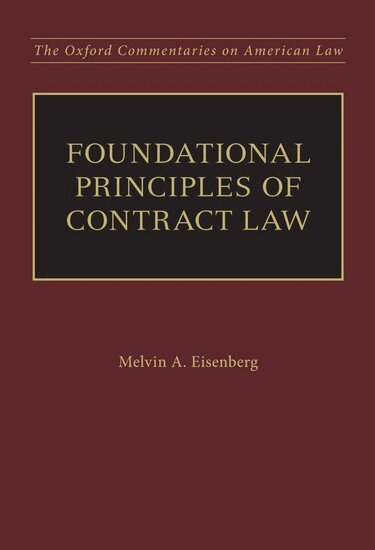
Foundational Principles of Contract Law not only sets out the principles and rules of contract law, it places more emphasis on what the principles and rules of contract law should be, based on policy, morality, and experience. A major premise of the book is that the best way to grasp contract law is to understand it from a critical perspective as an organic, dynamic subject. When contract law is approached in this way it is much easier to grasp and learn than when it is presented simply as a static collection of principles and rules. Professor Eisenberg covers almost all areas of contract law, including the enforceability of promises, remedies for breach of contract, problems of assent, form contracts, the effect of mistake and changed circumstances, interpretation, and problems of performance. Although the emphasis of the book is on the principles and rules of contract law, it also covers important theories in contract law, such as the theory of efficient breach, the theory of overreliance, the normative theory of contracts, formalism, and theories of contract interpretation.
2 378 kr
Skickas inom 5-8 vardagar
The scope of presidential authority has been a constant focus of constitutional dispute since the Framing. The bases for presidential appointment and removal, the responsibility of the Executive to choose between the will of Congress and the President, the extent of unitary powers over the military, even the ability of the President to keep secret the identity of those consulted in policy making decisions have all been the subject of intense controversy. The scope of that power and the manner of its exercise affect not only the actions of the President and the White House staff, but also all staff employed by the executive agencies. There is a clear need to examine the law of the entire executive branch.The Law of the Executive Branch: Presidential Power, places the law of the executive branch firmly in the context of constitutional language, framers' intent, and more than two centuries of practice. In this book, Louis Fisher strives to separate legitimate from illegitimate sources of power, through analysis that is informed by litigation as well as shaped by presidential initiatives, statutory policy, judicial interpretations, and public and international pressures. Each provision of the US Constitution is analyzed to reveal its contemporary meaning in concert with the application of presidential power. Controversial issues covered in the book include: unilateral presidential wars; the state secrets privilege; extraordinary rendition; claims of "inherent" presidential powers that may not be checked by other branches; and executive privilege.