Oxford Series on History and Archives – Serie
Visar alla böcker i serien Oxford Series on History and Archives. Handla med fri frakt och snabb leverans.
8 produkter
8 produkter
419 kr
Skickas inom 5-8 vardagar
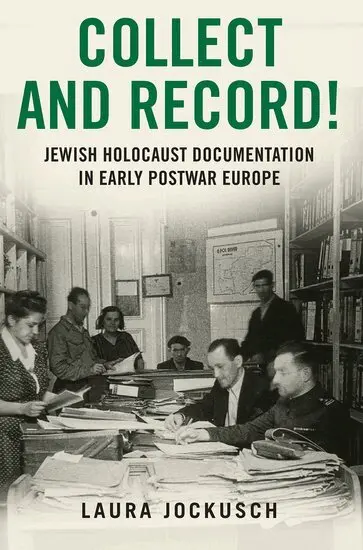
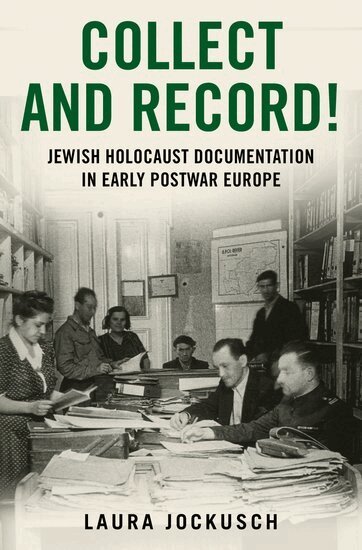
This book describes the vibrant activity of survivors who founded Jewish historical commissions and documentation centers in Europe immediately after the Second World War. In the first postwar decade, these initiatives collected thousands of Nazi documents along with testimonies, memoirs, diaries, songs, poems, and artifacts of Jewish victims. They pioneered in developing a Holocaust historiography that placed the experiences of Jews at the center and used both victim and perpetrator sources to describe the social, economic, and cultural aspects of the everyday life and death of European Jews under the Nazi regime. This book is the first in-depth monograph on these survivor historians and the organizations they created. A comparative analysis, it focuses on France, Poland, Germany, Austria, and Italy, analyzing the motivations and rationales that guided survivors in chronicling the destruction they had witnessed, while also discussing their research techniques, archival collections, and historical publications. It reflects growing attention to survivor testimony and to the active roles of survivors in rebuilding their postwar lives. It also discusses the role of documenting, testifying, and history writing in processes of memory formation, rehabilitation, and coping with trauma.Jockusch finds that despite differences in background and wartime experiences between the predominantly amateur historians who created the commissions, the activists found documenting the Holocaust to be a moral imperative after the war, the obligation of the dead to the living, and a means for the survivors to understand and process their recent trauma and loss. Furthermore, historical documentation was vital in the pursuit of postwar justice and was deemed essential in counteracting efforts on the part of the Nazis to erase their wartime crimes. The survivors who created the historical commissions were the first people to study the development of Nazi policy towards the Jews and also to document Jewish responses to persecution, a topic that was largely ignored by later generations of Holocaust scholars.
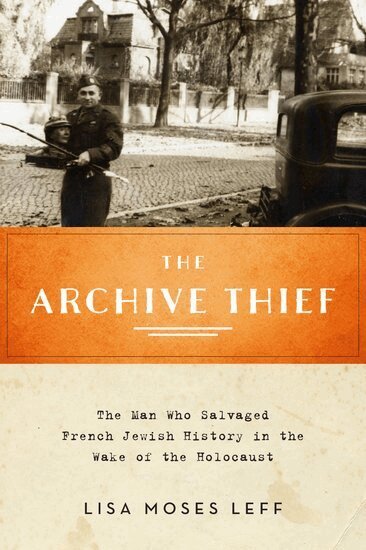
The Archive Thief
The Man Who Salvaged French Jewish History in the Wake of the Holocaust
Häftad, Engelska, 2018
248 kr
Skickas inom 5-8 vardagar
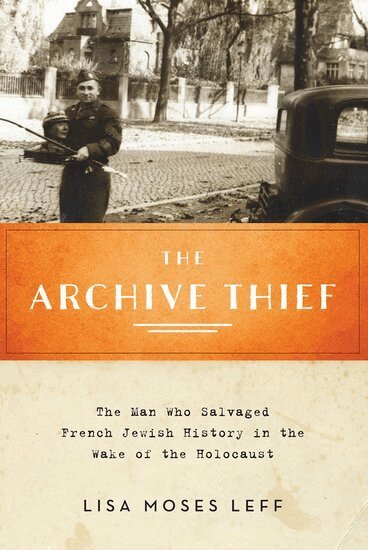
In the aftermath of the Holocaust, the Jewish historian Zosa Szajkowski stole tens of thousands of archival documents related to French Jewish history from public archives and collections in France and moved them, illicitly, to New York. Why did this respectable historian become a thief? And why did librarians in the United States and Israel accept these materials from him, turning a blind eye to the signs of ownership they bore? With her award-winning book, The Archive Thief, Lisa Moses Leff reconstructs Szajkowski's gripping story in all its ambiguity. Born into poverty in Russian Poland in 1911, Szajkowski was a self-made man who managed to make a life for himself as an intellectual, first as a journalist in 1930s Paris, and then, after a harrowing escape to New York in 1941, as a scholar. Although he never taught at a university or even earned a PhD, Szajkowski became one of the world's foremost experts on the history of the Jews in modern France, publishing in Yiddish, English, and Hebrew. His work opened up new ways of thinking about Jewish emancipation, economic and social modernization, and the rise of modern anti-Semitism. But beneath Szajkowski's scholarly accomplishments lay his shameful secret: his pathbreaking articles were based upon documents that he moved illicitly to New York. Eventually, he sold these documents, piecemeal, to American and Israeli research libraries where they still remain. Leff takes us into the backstage of the archives, revealing the powerful ideological, economic, and psychological forces that made Holocaust-era Jewish scholars care more deeply than ever before about preserving the remnants of their past. As Leff shows, it is only when we understand the issues at the heart of his story, in all their ambiguity and complexity, that we can begin to address the larger questions of the rightful ownership of Jewish archives, as well as other contested archives, that are still at issue today.
1 010 kr
Skickas inom 5-8 vardagar
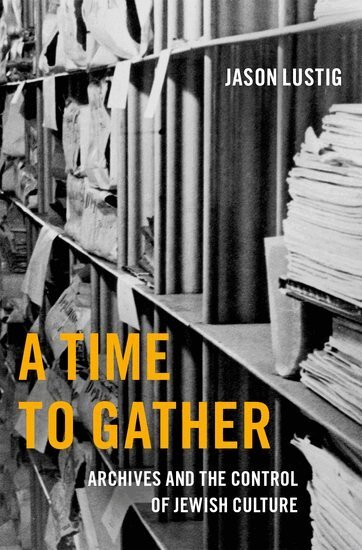
How do people link the past to the present, marking continuity in the face of the fundamental discontinuities of history? A Time to Gather argues that historical records took on potent value in modern Jewish life as both sources of history and anchors of memory because archives presented one way of transmitting Jewish culture and history from one generation to another as well as making claims of access to an “authentic” Jewish culture. Indeed, both before the Holocaust and in its aftermath, Jewish leaders around the world felt a shared imperative to muster the forces and resources of Jewish life and culture. It was a “time to gather,” a feverish era of collecting and conflict in which archive making was both a response to the ruptures of modernity and a mechanism for communities to express their cultural hegemony.Jason Lustig explores these themes across the arc of the twentieth century by excavating three distinctive archival traditions, that of the Cairo Genizah (and its transfer to Cambridge in the 1890s), folkloristic efforts like those of YIVO, and the Gesamtarchiv der deutschen Juden (Central or Total Archive of the German Jews) formed in Berlin in 1905. Lustig presents archive-making as an organizing principle of twentieth-century Jewish culture, as a metaphor of great power and broad symbolic meaning with the dispersion and gathering of documents falling in the context of the Jews' long diasporic history. In this light, creating archives was just as much about the future as it was about the past.
The Archive Thief
The Man Who Salvaged French Jewish History in the Wake of the Holocaust
Inbunden, Engelska, 2015
445 kr
Skickas inom 5-8 vardagar
Born into poverty in Russian Poland in 1911, Zosa Szajkowski (Shy-KOV-ski) was a self-made man who managed to make a life for himself as an intellectual, first as a journalist in 1930s Paris, and then, after a harrowing escape to New York in 1941, as a scholar. Although he never taught at a university or even earned a PhD, Szajkowski became one of the world's foremost experts on the history of the Jews in modern France, publishing in Yiddish, English, and Hebrew. His work opened up new ways of thinking about Jewish emancipation, economic and social modernization, and the rise of modern anti-Semitism.But beneath Szajkowski's scholarly success lay a shameful secret. In the aftermath of the Holocaust, the scholar stole tens of thousands of archival documents related to French Jewish history from public archives and private synagogue collections in France and moved them, illicitly, to New York. There, he used them as the basis for his pathbreaking articles. Eventually, he sold them, piecemeal, to American and Israeli research libraries, where they still remain today. Why did this respectable historian become an archive thief? And why did librarians in the United States and Israel buy these materials from him, turning a blind eye to the signs of ownership they bore? These are the questions that motivate this gripping tale. Throughout, it is clear that all involved--perpetrator, victims, and buyers--saw what Szajkowski was doing through the prism of the Holocaust. The buyers shared a desire to save these precious remnants of the European Jewish past, left behind on a continent where six million Jews had just been killed by the Nazis and their collaborators. The scholars who read Szajkowski's studies, based largely on the documents he had stolen, saw the treasures as offering an unparalleled window into the history that led to that catastrophe. And the Jewish caretakers of many of the institutions Szajkowski robbed in France saw the losses as a sign of their difficulties reconstructing their community after the Holocaust, when the balance of power in the Jewish world was shifting away from Europe to new centers in America and Israel. Based on painstaking research, Lisa Leff reconstructs Szajkowski's story in all its ambiguity by taking us backstage at the archives, revealing the powerful ideological, economic and scientific forces that made Holocaust-era Jewish scholars care more deeply than ever before about preserving the remnants of their past.
1 469 kr
Skickas inom 5-8 vardagar
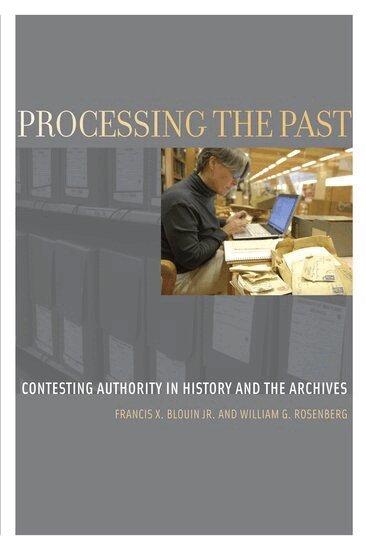
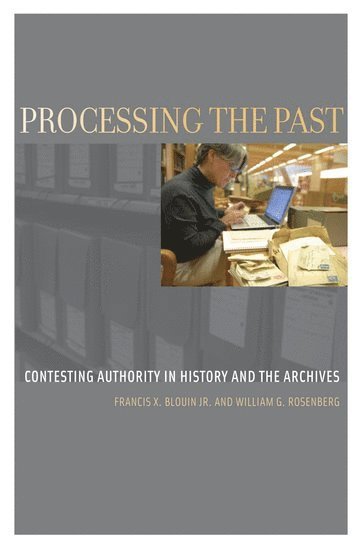
Processing the Past explores the dramatic changes taking place in historical understanding and archival management, and hence the relations between historians and archivists. Written by an archivist and a historian, it shows how these changes have been brought on by new historical thinking, new conceptions of archives, changing notions of historical authority, modifications in archival practices, and new information technologies. The book takes an "archival turn" by situating archives as subjects rather than places of study, and examining the increasingly problematic relationships between historical and archival work.The book sets the background to these changes by showing how nineteenth- and early twentieth-century historians and archivists in Europe and North American came to occupy the same conceptual and methodological space. For both, authoritative history was based on authoritative archives and mutual understandings of scientific research. The authors then show how these connections changed as historians began to ask questions not easily answered by traditional documentation, and archivists began to confront an unmanageable increase in the amount of material they processed and the challenges of new electronic technologies. The book situates these changes in a review of contemporary historical concepts and archival practices. The authors contend that historians and archivists have divided into two entirely separate professions with distinct conceptual frameworks, training, and purposes, as well as different understandings of the authorities that govern their work. Processing the Past moves toward bridging this divide by speaking in one voice to these very different audiences as well as to general readers. The book concludes by raising the worrisome question of what future historical archives might be like if historical scholars and archivists no longer understand each other, and indeed, whether their now different notions of what is archival and historical will ever again be joined.
1 379 kr
Skickas inom 5-8 vardagar
This volume tells the largely unknown story of Holocaust survivors who founded Jewish historical commissions and documentation centers in Europe immediately after World War II. Amidst political turmoil and extreme privation, physically exhausted and traumatized women and men who had survived ghettos, camps, hiding, or life under false identities sought to chronicle the catastrophe. They collected thousands of Nazi documents along with more than 18,000 testimonies, some 8,000 questionnaires, and large numbers of memoirs, diaries, songs, poems, and artifacts of Jewish victims. The activists found documenting the Holocaust to be a moral imperative after the war, the obligation of the dead to the living, and a means to understand and process their recent trauma and loss. They deemed historical documentation vital in the pursuit of postwar justice and essential in counteracting the Nazis' wartime efforts to erase the evidence of their crimes. These Jewish documentation initiatives pioneered the development of a Holocaust historiography that used both victim and perpetrator sources to describe the social, economic, and cultural aspects of the everyday life and death of European Jews under the Nazi regime, while placing the experiences of Jews at the center of the story. These groundbreaking efforts of survivors to study the Nazi regime's genocide of European Jews was ignored by subsequent generations of Holocaust scholars.With a comparative analysis, Jockusch focuses on France, Poland, Germany, Austria, and Italy to illuminate the transnational nature of Jewish efforts to write the history of the Holocaust in its immediate aftermath. The book explores the motivations and rationales that guided survivors in chronicling the destruction they had witnessed, their research techniques, archival collections, and historical publications. As the first comprehensive study on the subject, this book serves as an important complement to the literature on survivor testimony, Holocaust memory, and the rebuilding of Jewish life in postwar Europe.
2 025 kr
Skickas inom 3-6 vardagar
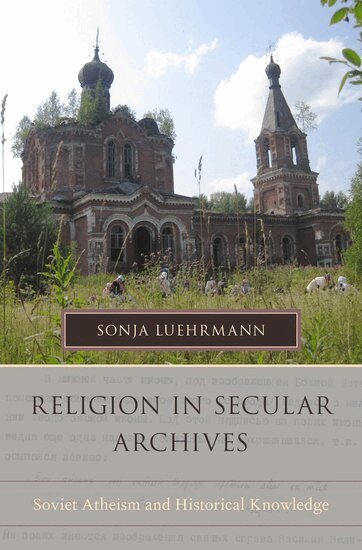
What can atheists tell us about religious life? Russian archives contain a wealth of information on religiosity during the Soviet era, but most of it is written from the hostile perspective of officials and scholars charged with promoting atheism. Based on archival research in locations as diverse as the multi-religious Volga region, Moscow, and Texas, Sonja Luehrmann argues that we can learn a great deal about Soviet religiosity when we focus not just on what documents say but also on what they did. Especially during the post-war decades (1950s-1970s), the puzzle of religious persistence under socialism challenged atheists to develop new approaches to studying and theorizing religion while also trying to control it. Taking into account the logic of filing systems as well as the content of documents, the book shows how documentary action made religious believers firmly a part of Soviet society while simultaneously casting them as ideologically alien. When juxtaposed with oral, printed, and samizdat sources, the records of institutions such as the Council of Religious Affairs and the Communist Party take on a dialogical quality. In distanced and carefully circumscribed form, they preserve traces of encounters with religious believers. By contrast, collections compiled by western supporters during the Cold War sometimes lack this ideological friction, recruiting Soviet believers into a deceptively simple binary of religion versus communism. Through careful readings and comparisons of different documentary genres and depositories, this book opens up a difficult set of sources to students of religion and secularism.
382 kr
Skickas inom 5-8 vardagar
Processing the Past explores the dramatic changes taking place in historical understanding and archival management and in the relations between historians and archivists. Written by an archivist and a historian, it shows how these changes have been brought on by new historical thinking, new conceptions of archives, changing notions of historical authority, modifications in archival practices, and new information technologies. The book situates archives as subjects rather than places of study and examines the increasingly problematic relationships between historical and archival work. The authors contend that though historians and archivists once occupied the same conceptual and methodological space, they have divided into two separate professions with distinct conceptual frameworks and understandings of the authorities that govern their work: historians now ask questions not easily answered by traditional documentation, and archivists confront the challenges of new technologies and increases in the amounts of material they process. Blouin and Rosenberg conclude by raising the question of what future historical archives might be like if historical scholars and archivists no longer understand each other.