OXFORD STUDIES COMPARATIVE SYNTAX SERIES - Böcker
Visar alla böcker i serien OXFORD STUDIES COMPARATIVE SYNTAX SERIES. Handla med fri frakt och snabb leverans.
3 produkter
3 produkter
1 508 kr
Skickas inom 7-10 vardagar
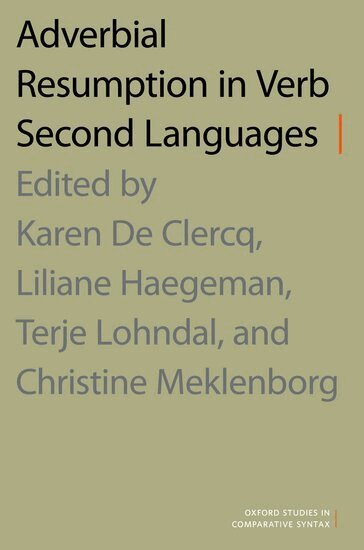
While Verb-third (V3) patterns have long been studied in verb-second (V2) languages, a similar pattern in which an initial adverbial constituent is resumed by a clause-internal element has been much less studied. The latter is referred to as 'adverbial resumption' and it also has the character of being a V3 phenomenon. Therefore, the pattern is labelled 'adverbial V3 resumption' or 'adverbial V3.' The present volume is an up-to-date overview of the subject featuring case studies of individual languages that display certain patterns of V3. The authors discuss this pattern in relation to several different languages, addressing among other things issues of microvariation in contemporary varieties and diachronic variation. The book covers Medieval Romance, Old Italian, Old English, diachronic and synchronic varieties of German, varieties of Flemish and Dutch, Icelandic, varieties of Swedish, and Norwegian. Through analyses of adverbial resumptive V3 orders in Germanic and Romance, the contributors explore the nature of V2: while adverbial resumption only occurs in varieties that observe the V2 rule, in itself it leads to apparent violations of linear V2 order, namely to V3 orders. Adverbial Resumption in Verb Second Languages provides comparative analyses which touch upon the nature of sentence-external versus sentence-internal adjuncts, and the fine-grained architecture of the clausal functional hierarchy. These papers constitute a valuable contribution to the theoretically important topics of V2 and V3 that will be of interest to comparative linguists, Germanic linguistics, Romance linguists, and anyone working on formal grammar in general.
670 kr
Skickas inom 5-8 vardagar
While Verb-third (V3) patterns have long been studied in verb-second (V2) languages, a similar pattern in which an initial adverbial constituent is resumed by a clause-internal element has been much less studied. The latter is referred to as 'adverbial resumption' and it also has the character of being a V3 phenomenon. Therefore, the pattern is labelled 'adverbial V3 resumption' or 'adverbial V3.' The present volume is an up-to-date overview of the subject featuring case studies of individual languages that display certain patterns of V3. The authors discuss this pattern in relation to several different languages, addressing among other things issues of microvariation in contemporary varieties and diachronic variation. The book covers Medieval Romance, Old Italian, Old English, diachronic and synchronic varieties of German, varieties of Flemish and Dutch, Icelandic, varieties of Swedish, and Norwegian. Through analyses of adverbial resumptive V3 orders in Germanic and Romance, the contributors explore the nature of V2: while adverbial resumption only occurs in varieties that observe the V2 rule, in itself it leads to apparent violations of linear V2 order, namely to V3 orders. Adverbial Resumption in Verb Second Languages provides comparative analyses which touch upon the nature of sentence-external versus sentence-internal adjuncts, and the fine-grained architecture of the clausal functional hierarchy. These papers constitute a valuable contribution to the theoretically important topics of V2 and V3 that will be of interest to comparative linguists, Germanic linguistics, Romance linguists, and anyone working on formal grammar in general.
1 319 kr
Skickas inom 5-8 vardagar
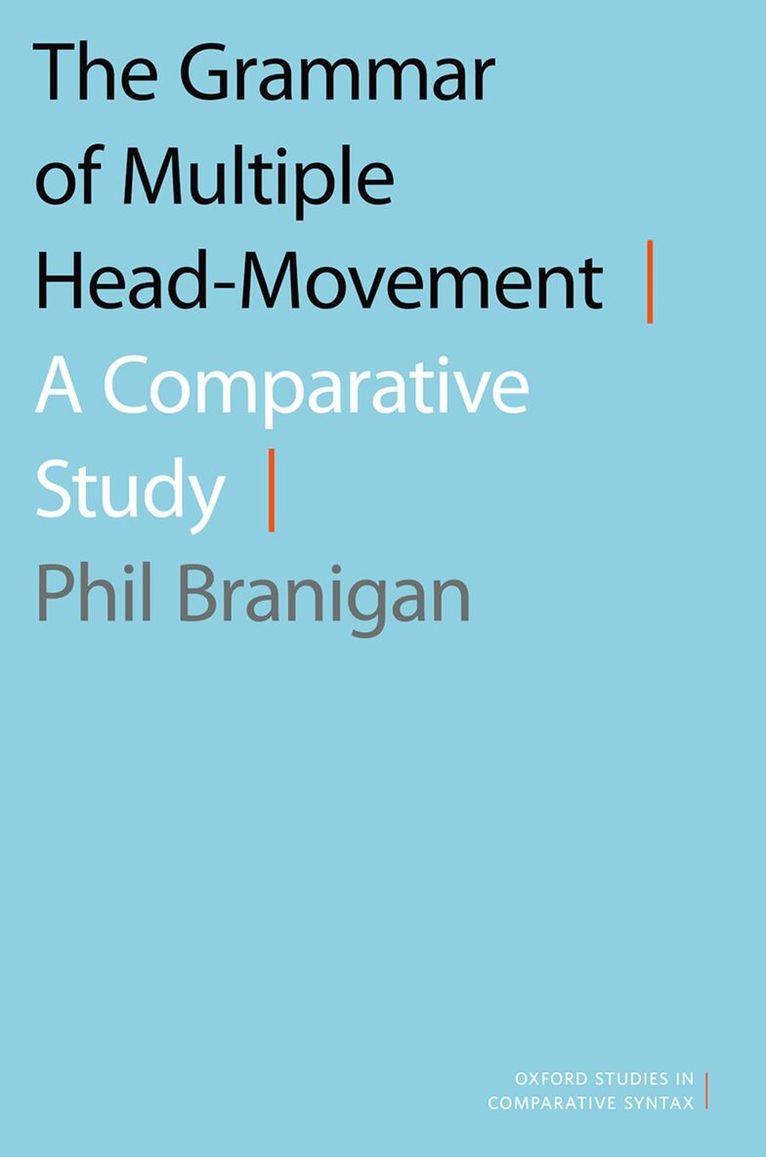
Head-movement has played a central role in morpho-syntactic theory, but its nature has remained unclear. While it is widely accepted that the main grammatical constraint controlling head-movement is the Head Movement Constraint (HMC), this constraint is flouted in many of the linguistic structures examined in this book. More specifically, the strictures of the HMC turn out to be sometimes inactive for specific grammars allowing multiple head-movement to take place in particular syntactic contexts. In The Grammar of Multiple Head-Movement, Phil Branigan shows that multiple head-movement is far from rare, forming a part of the grammar in Finnish, in English, in Perenakan Javanese, in northern Norwegian and Swedish dialects, and generally in the Slavic and Algonquian language families. Basing his analysis on a new model of the grammatical parameters which control word formation in the human brain, Branigan shows how careful attention to the contexts in which multiple head-movement takes place allows new generalizations to be identified. And these, in turn, allow a new model to be formulated of how head-movement fits into the overall architecture of grammatical computation. Through careful comparative study, Branigan not only provides a better understanding of head-movement, but also provides new opportunities to address larger questions concerning the architecture of the grammatical system and the theory of linguistic parameters. A new account of how complex words are formed in languages as different as Russian or Innu-aimun, as well as in English, this study deepens our understanding of how languages vary and of the mental computational system of human grammars.