OXFORD STUDIES DIGITAL POLITICS SERIES - Böcker
Visar alla böcker i serien OXFORD STUDIES DIGITAL POLITICS SERIES. Handla med fri frakt och snabb leverans.
6 produkter
6 produkter
929 kr
Skickas inom 7-10 vardagar
In the eighteenth century, the printing press enabled the rise of an independent press--the Fourth Estate--that helped check the power of governments, business, and industry. In similar ways, the internet is forming a more independent collectivity of networked individuals, which William H. Dutton identifies as the Fifth Estate. Their network power is contributing to a more pluralist role of individuals in democratic political processes and society, which is not only shaping political accountability but nearly every sector of society. Yet a chorus of critics have dismissed the internet's more democratic potentials, demonizing social media and user-generated-content as simply sources of fake news and populism. So, is the internet a tool for democracy or anarchy? In The Fifth Estate, Dutton uses estate theory to illuminate the most important power shift of the digital age. He argues that this network power shift is not only enabling greater democratic accountability in politics and governance but is also empowering networked individuals in their everyday life and work, from checking facts to making civic-minded social interventions. By marshalling world leading research and case studies in a wide range of contexts, Dutton demonstrates that the internet and related digital media are enabling ordinary individuals to search, create, network, collaborate, and leak information in such independent and strategic ways that they enhance their informational and communicative power vis-à-vis other actors and institutions. Dutton also makes the case that internet policy interventions across the globe have increased censorship of users and introduced levels of surveillance that will challenge the vitality of the internet and the Fifth Estate, along with its more pluralist distribution of power. Ambitious and timely, Dutton provides an understanding of the Fifth Estate and its democratic potential so that networked individuals and institutions around the world can maintain and enhance its role in our digital age.
268 kr
Skickas inom 5-8 vardagar
In the eighteenth century, the printing press enabled the rise of an independent press--the Fourth Estate--that helped check the power of governments, business, and industry. In similar ways, the internet is forming a more independent collectivity of networked individuals, which William H. Dutton identifies as the Fifth Estate. Their network power is contributing to a more pluralist role of individuals in democratic political processes and society, which is not only shaping political accountability but nearly every sector of society. Yet a chorus of critics have dismissed the internet's more democratic potentials, demonizing social media and user-generated-content as simply sources of fake news and populism. So, is the internet a tool for democracy or anarchy? In The Fifth Estate, Dutton uses estate theory to illuminate the most important power shift of the digital age. He argues that this network power shift is not only enabling greater democratic accountability in politics and governance but is also empowering networked individuals in their everyday life and work, from checking facts to making civic-minded social interventions. By marshalling world leading research and case studies in a wide range of contexts, Dutton demonstrates that the internet and related digital media are enabling ordinary individuals to search, create, network, collaborate, and leak information in such independent and strategic ways that they enhance their informational and communicative power vis-à-vis other actors and institutions. Dutton also makes the case that internet policy interventions across the globe have increased censorship of users and introduced levels of surveillance that will challenge the vitality of the internet and the Fifth Estate, along with its more pluralist distribution of power. Ambitious and timely, Dutton provides an understanding of the Fifth Estate and its democratic potential so that networked individuals and institutions around the world can maintain and enhance its role in our digital age.
301 kr
Skickas inom 5-8 vardagar
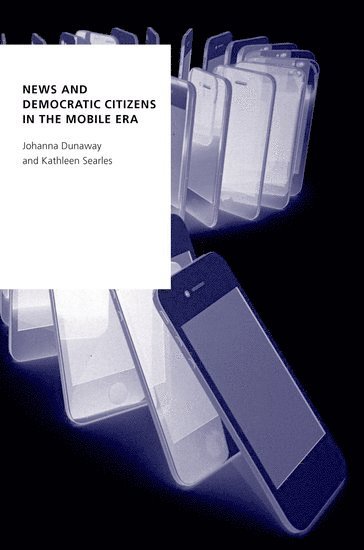
Though people frequently use mobile technologies for news consumption, evidence from several fields shows that smaller screens and slower connection speeds pose major limitations for meaningful reading. In News and Democratic Citizens in the Mobile Era, Johanna Dunaway and Kathleen Searles demonstrate the effects of mobile devices on news attention, engagement, and recall, and identify a key cognitive mechanism underlying these effects: cognitive effort. They advance a theory that is both old and new: the costs of information-seeking curb participatory behaviors unless the benefits outweigh them. For news consumers in the mobile era, for example, mobile devices increase the time, economic, and cognitive costs associated with information-seeking. Only for a small few do the benefits of attending to the news on mobile devices outweigh the costs. Building on economic theories of news, media choice, and the ways audience demand shapes news craft and production, Dunaway and Searles argue that attention, engagement, and recall suffer when people consume news on mobile devices. They then investigate the implications of these effects for the news industry and for an informed democratic citizenry. Drawing on both laboratory and real-world studies, Dunaway and Searles bring the psychophysiology of news consumption to bear on the question of what we could lose in an information environment characterized by a dramatic shift in reliance on mobile devices.
1 200 kr
Skickas inom 5-8 vardagar
Though people frequently use mobile technologies for news consumption, evidence from several fields shows that smaller screens and slower connection speeds pose major limitations for meaningful reading. In News and Democratic Citizens in the Mobile Era, Johanna Dunaway and Kathleen Searles demonstrate the effects of mobile devices on news attention, engagement, and recall, and identify a key cognitive mechanism underlying these effects: cognitive effort. They advance a theory that is both old and new: the costs of information-seeking curb participatory behaviors unless the benefits outweigh them. For news consumers in the mobile era, for example, mobile devices increase the time, economic, and cognitive costs associated with information-seeking. Only for a small few do the benefits of attending to the news on mobile devices outweigh the costs. Building on economic theories of news, media choice, and the ways audience demand shapes news craft and production, Dunaway and Searles argue that attention, engagement, and recall suffer when people consume news on mobile devices. They then investigate the implications of these effects for the news industry and for an informed democratic citizenry. Drawing on both laboratory and real-world studies, Dunaway and Searles bring the psychophysiology of news consumption to bear on the question of what we could lose in an information environment characterized by a dramatic shift in reliance on mobile devices.
1 200 kr
Skickas inom 5-8 vardagar
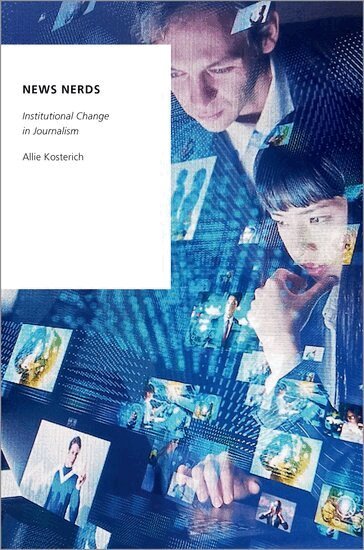
The content of news has not changed much over the last century--politicians, celebrities, wars, crime, and sports dominate past and present headlines. Yet, the ways in which journalists both gather and disseminate information have been turned on their head. Gone are the days of editors assigning stories to writers, who then research, inquire, and present what they found in a compelling yet accurate fashion. Today's journalists are coding, programming, running analytics, and developing apps. These "news nerds" are industry professionals working in jobs at the intersection of traditional journalism and technologically intensive positions that were once largely separate. Consequently, news nerds have changed the institutionalized view of journalism, which now accounts for these professionals. News Nerds explores how technological, economic, and societal changes are impacting the institutionalized profession of journalism. Allie Kosterich draws on a mixed-methods research design that blends interviews, social network analysis of LinkedIn data, job postings, and industry publications to make sense of how skills and practices become entrenched throughout the news industry. Taken together, these data reveal the ways in which the profession is evolving to incorporate new technological skillsets and new routines of production.In telling these stories and sharing these findings, Kosterich directly confronts what happens when new skillsets and new ways of understanding and producing news start to collide with the old routines of journalism. News Nerds introduces the notion of institutional augmentation--a process of institutional change that is not restricted to the expected binary outcome of the reinstitutionalization of something new or failure as a fleeting fad. Instead, as in the case of news nerds and journalism, there exists an alternative possibility in the coexistence of supplementary institutions. News Nerds provides a timely and relevant analysis of contemporary journalism and a model for understanding how industries react to the emergence of new career trajectories and new categories of employment.
334 kr
Skickas inom 5-8 vardagar
The content of news has not changed much over the last century--politicians, celebrities, wars, crime, and sports dominate past and present headlines. Yet, the ways in which journalists both gather and disseminate information have been turned on their head. Gone are the days of editors assigning stories to writers, who then research, inquire, and present what they found in a compelling yet accurate fashion. Today's journalists are coding, programming, running analytics, and developing apps. These "news nerds" are industry professionals working in jobs at the intersection of traditional journalism and technologically intensive positions that were once largely separate. Consequently, news nerds have changed the institutionalized view of journalism, which now accounts for these professionals. News Nerds explores how technological, economic, and societal changes are impacting the institutionalized profession of journalism. Allie Kosterich draws on a mixed-methods research design that blends interviews, social network analysis of LinkedIn data, job postings, and industry publications to make sense of how skills and practices become entrenched throughout the news industry. Taken together, these data reveal the ways in which the profession is evolving to incorporate new technological skillsets and new routines of production.In telling these stories and sharing these findings, Kosterich directly confronts what happens when new skillsets and new ways of understanding and producing news start to collide with the old routines of journalism. News Nerds introduces the notion of institutional augmentation--a process of institutional change that is not restricted to the expected binary outcome of the reinstitutionalization of something new or failure as a fleeting fad. Instead, as in the case of news nerds and journalism, there exists an alternative possibility in the coexistence of supplementary institutions. News Nerds provides a timely and relevant analysis of contemporary journalism and a model for understanding how industries react to the emergence of new career trajectories and new categories of employment.