Oxford Studies In Abrahamic Religions – serie
Visar alla böcker i serien Oxford Studies In Abrahamic Religions. Handla med fri frakt och snabb leverans.
2 produkter
2 produkter
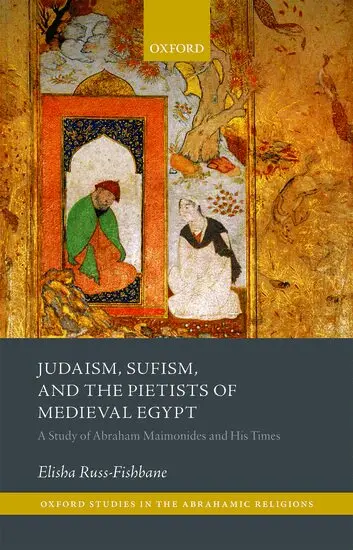
Judaism, Sufism, and the Pietists of Medieval Egypt
A Study of Abraham Maimonides and His Times
Inbunden, Engelska, 2015
2 367 kr
Skickas inom 5-8 vardagar
Judaism, Sufism, and the Pietists of Medieval Egypt addresses the extraordinary rise and inner life of the Egyptian pietist movement in the first half of the thirteenth century. The creative engagement with the dominant Islamic culture was always present, even when unspoken. Dr Russ-Fishbane calls attention to the Sufi subtext of Jewish pietiem, while striving not to reduce its spiritual synthesis and religious renewal to a set of political calculations. Ultimately, no single term or concept can fully address the creative expression of pietism that so animated Jewish society and that left its mark in numerous manuscripts and fragments from medieval Egypt.Russ-Fishbane offers a nuanced examination of the pietist sources on their own terms, drawing as far as possible upon their own definitions and perceptions. Jewish society in thirteenth-century Egypt reflects the dynamic reexamination by a venerable community of its foundational texts and traditions, even of its very identity and institutions, viewed and reviewed in the full light of its Islamic environment. The historical legacy of this religious synthesis belongs at once to the realm of Jewish culture, in all its diversity and dynamism, as well as to the broader spiritual orbit of Islamicate civilization.
2 006 kr
Skickas inom 7-10 vardagar
This book presents how ancient Christianity must be understood from the viewpoint of the history of religions in late antiquity. The continuation of biblical prophecy runs like a thread from Jesus through Mani to Muhammad. And yet this thread, arguably the single most important characteristic of the Abrahamic movement, often remains outside the mainstream, hidden, as it were, since it generates heresy. The figures of the Gnostic, the holy man, and the mystic are all sequels of the Israelite prophet. They reflect a mode of religiosity that is characterized by high intensity. It is centripetal and activist by nature and emphasizes sectarianism and polemics, esoteric knowledge, or gnosis and charisma. The other mode of religiosity, much more common than the first, is centrifugal and irenic. It favours an ecumenical attitude, contents itself with a widely shared faith, or pistis, and reflects, in Weberian parlance, the routinisation of the new religious movement. This is the mode of priests and bishops, rather than that of martyrs and holy men. These two main modes of religion, high versus low intensity, exist simultaneously, and cross the boundaries of religious communities. They offer a tool permitting us to follow the transformations of religion in late antiquity in general, and in ancient Christianity in particular, without becoming prisoners of the traditional categories of patristic literature. Through the dialectical relationship between these two modes of religiosity, one can follow the complex transformations of ancient Christianity in its broad religious context.