Oxford Studies in Grand Strategy - Böcker
Visar alla böcker i serien Oxford Studies in Grand Strategy. Handla med fri frakt och snabb leverans.
5 produkter
5 produkter
1 262 kr
Kommande
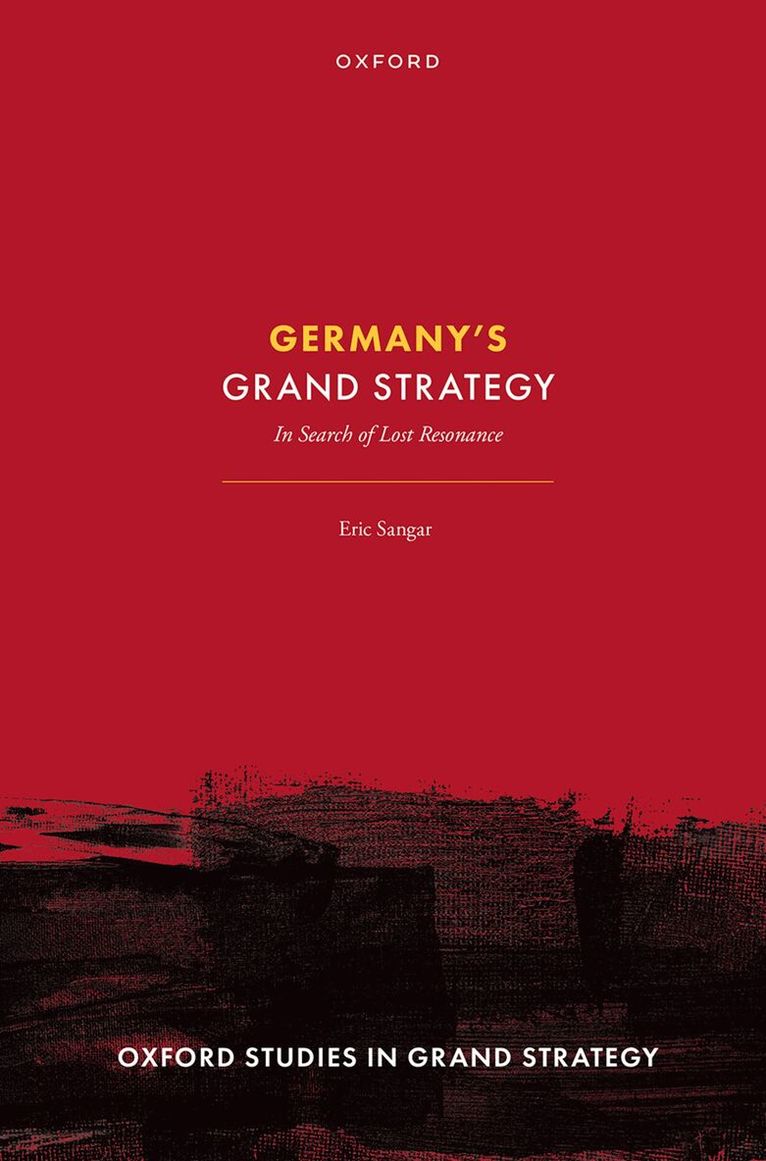
Germany's grand strategy - historically associated with two world wars and several genocides - is one of the most impactful but difficult phenomena in the history of international relations. Given its geographical, military, and economic limitations, why did the country perceive military might as the most effective means to shape its environment and ensure its security until the mid-twentieth century? Why did its political elites often fail, as in the Weimar Republic, but sometimes succeed in changing grand strategy, including after 1945?Eric Sangar answers these questions by tracing the major developments in Germany's grand strategy since the Napoleonic wars and examining the perceived lessons of its national history. In particular, he explores the impact the resonance between historical lessons at the elite level and memory discourses in society has had on Germany's grand strategy. He argues that the current fragmentation of German collective memory can explain the contemporary gap between the ambitions of universalist leadership and their hesitant and, at times isolationist, practices. As Germany faces an increasingly uncertain regional and international environment, (re)building domestic support for a clearly articulated grand strategy seems more difficult than ever.The Oxford Studies in Grand Strategy is a major new series of cutting-edge monographs that examine the grand strategies of states, and those intergovernmental organizations and nonstate actors who credibly aspire to sovereignty. Books concentrate on the contemporary aspects of grand strategy, while paying due respect to the historical antecedents of a nation's grand strategy and their relevance for a leadership's current choices. The series is pluralistic in terms of theory and method, and maintains a broad view of the ways, means, and ends that undergird a grand strategy. Analytical and explanatory in contribution, books in the series feature a rigorous analysis of the interaction between domestic factors and global forces and provide a clear understanding of how that interaction shapes a grand strategy's formulation, codification, and implementation.Series Editors: Thierry Balzacq (Sciences Po, Paris), Peter Dombrowski (US Naval War College), and Simon Reich (Rutgers University, Newark)
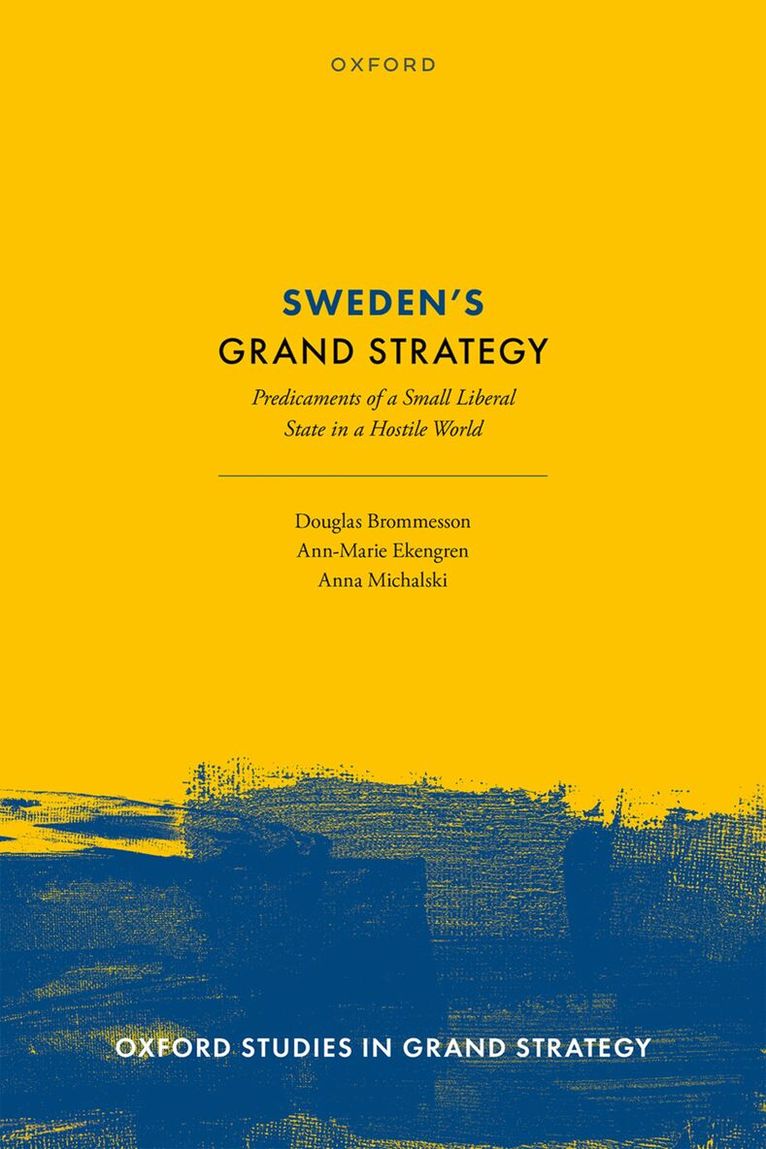
Sweden's Grand Strategy
Predicaments of a Small Liberal State in a Hostile World
Inbunden, Engelska, 2025
1 146 kr
Skickas inom 5-8 vardagar
This is an open access title available under the terms of a CC BY-NC-ND 4.0 International licence. It is free to read on the Oxford Academic platform and offered as a free PDF download from OUP and selected open access locations.Using the example of Sweden, the authors reassess the grand strategies of small states in international politics from the end of World War II until its new membership in NATO in 2024. Utilizing role theory, they identify a small state's grand strategy through specific national foreign policy roles which at certain times coalesce into master roles. Four foreign policy action strategies, building on domestic agency and the influence of systemic structures, depict this domestic process of role adaptation. Sweden's foreign policy roles were shaped according to the degree of autonomy and integration deemed necessary for security, economic development, and social cohesion as perceived by the domestic political elite. The ensuing empirical analysis identifies this set of evolving roles in an increasingly unstable international security environment. The authors thus explore how a small state can develop certain roles over time and how the dominant roles can coalesce into an overarching grand strategy.The Oxford Studies in Grand Strategy is a major new series of cutting-edge monographs that examine the grand strategies of states, and those intergovernmental organizations and nonstate actors who credibly aspire to sovereignty. Books concentrate on the contemporary aspects of grand strategy, while paying due respect to the historical antecedents of a nation's grand strategy and their relevance for a leadership's current choices. The series is pluralistic in terms of theory and method, and maintains a broad view of the ways, means, and ends that undergird a grand strategy. Analytical and explanatory in contribution, books in the series feature a rigorous analysis of the interaction between domestic factors and global forces and provide a clear understanding of how that interaction shapes a grand strategy's formulation, codification, and implementation.Series Editors: Thierry Balzacq (Sciences Po, Paris), Peter Dombrowski (US Naval War College), and Simon Reich (Rutgers University, Newark)
1 349 kr
Skickas inom 5-8 vardagar
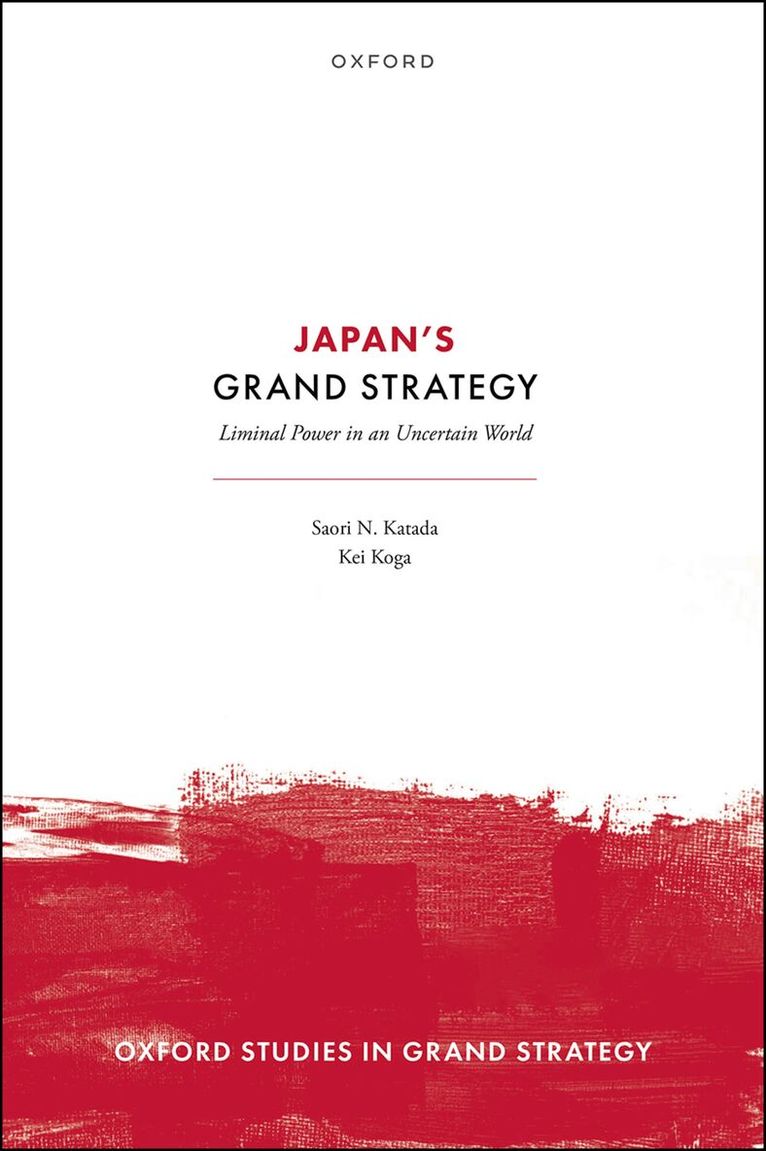
As a liminal state with contrasting identities, Japan often struggles to define its consistent strategic objective due to its fluctuating power status and social role in international relations. In this volume Katada and Koga employ a historical institutionalist approach to examine the evolution of Japan's grand strategy as a liminal power from the Meiji period, starting in 1868, to the present. The authors explore four historical and contemporary "critical junctures" as key determinants of the shifts in Japan's grand strategies: the Meiji era, the inter-war era between World War I and II, the Cold War era, and the Post-Cold War/Indo-Pacific era. In particular, they focus on the contemporary era during which Japan has established its Indo-Pacific grand strategy featuring a "Free and Open Indo-Pacific." As the strategic environment changed in each period, the authors examine how a window of opportunity opened that offered Japan's core decision-makers a chance to construct - or reconstruct - the country's grand strategy.The Oxford Studies in Grand Strategy is a major new series of cutting-edge monographs that examine the grand strategies of states, and those intergovernmental organizations and nonstate actors who credibly aspire to sovereignty. Books concentrate on the contemporary aspects of grand strategy, while paying due respect to the historical antecedents of a nation's grand strategy and their relevance for a leadership's current choices. The series is pluralistic in terms of theory and method, and maintains a broad view of the ways, means, and ends that undergird a grand strategy. Analytical and explanatory in contribution, books in the series feature a rigorous analysis of the interaction between domestic factors and global forces and provide a clear understanding of how that interaction shapes a grand strategy's formulation, codification, and implementation.Series Editors: Thierry Balzacq (Sciences Po, Paris), Peter Dombrowski (US Naval War College), and Simon Reich (Rutgers University, Newark)
The European Union's Grand Strategy
A Planetary-Scale Approach for Safeguarding the Future
Inbunden, Engelska, 2026
1 417 kr
Kommande
While many people dismiss the European Union as little more than a regional political project, this book reveals its quietly growing global influence. Mai'a K. Davis Cross argues that despite often flying under the radar, long-standing European global strategies have permeated the very fabric of the international system, upholding strong norms of stability, liberalism, and social consciousness from the deep sea to outer space. For the EU, grand strategy is not so much about pursuing a position at the top of the international hierarchy, but about shaping the international environment itself.This book offers a globe-spanning, planetary perspective on how and why the European Union has deeply mattered to world order in the 21st century .With a fresh perspective on grand strategy, Cross argues that the EU's grand strategy should be understood on a planetary level, extending strategic thinking beyond traditional state-centric models to address multi-generational existential challenges that transcend borders. Utilizing nine case studies- from space exploration to human rights, the book states that at the heart of the EU's global impact is its social power, which operates through transnational networks, and whose activities are our best hope to sustain our planet over the next 50-100 years. In this deeply interconnected yet fragile world, it is time to move away from evaluating grand strategy merely for its achievement of national self-interest, and instead towards its capacity to safeguard the future of humanity. In this regard, the EU is the indispensable actor.The Oxford Studies in Grand Strategy is a major new series of cutting-edge monographs that examine the grand strategies of states, and those intergovernmental organizations and nonstate actors who credibly aspire to sovereignty. Books concentrate on the contemporary aspects of grand strategy, while paying due respect to the historical antecedents of a nation's grand strategy and their relevance for a leadership's current choices. The series is pluralistic in terms of theory and method, and maintains a broad view of the ways, means, and ends that undergird a grand strategy. Analytical and explanatory in contribution, books in the series feature a rigorous analysis of the interaction between domestic factors and global forces and provide a clear understanding of how that interaction shapes a grand strategy's formulation, codification, and implementation.Series Editors: Thierry Balzacq (Sciences Po, Paris), Peter Dombrowski (US Naval War College), and Simon Reich (Rutgers University, Newark)
1 200 kr
Kommande
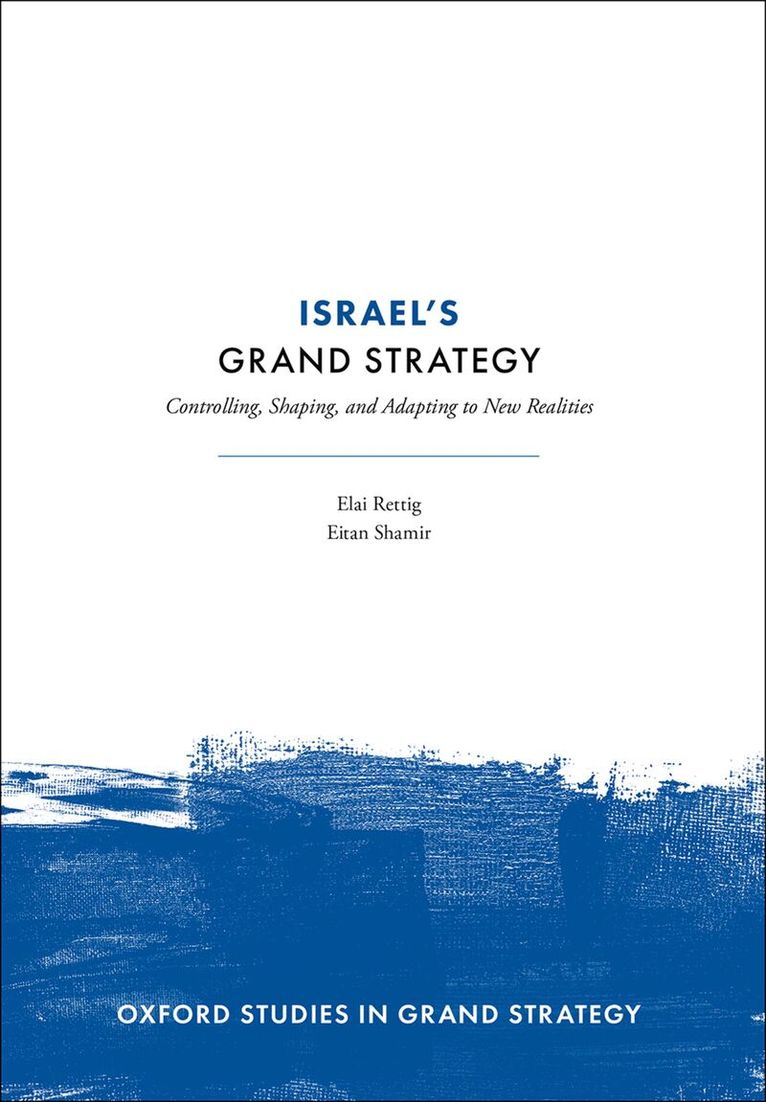
Israel is often described as a state without a grand strategy, one that wins wars through superior military and technological capabilities yet struggles to secure peace because it lacks a clear vision for durable political outcomes. That sentiment was especially evident during the turbulent years between 2020 and 2025, when the diplomatic breakthrough of the Abraham Accords gave way to a multi-front regional conflict.Israel's Grand Strategy challenges this view. It argues that beneath the veneer of tactical improvisation, Israel has pursued a discernible and persistent grand strategy that links its desired ends, prioritized threats, preferred instruments, and available resources with visible continuity across different Israeli governments and decision-makers over time. To demonstrate this pattern, this book offers a novel framework that views small-state grand strategy as a "calibration" between three geographic circles of local controlling, regional shaping, and global adaptation strategies, dictated by the state's arena of action and available military, economic, and diplomatic means.The book tests this framework through eight detailed case studies. The first three consider the local arena, examining strategies of control toward the Palestinian Authority, Hamas, and Hezbollah. The next two trace efforts to shape the regional environment through the Eastern Mediterranean and the Abraham Accords. The final three case studies, focusing on the global arena, analyze Israel's adaptation to US priorities on Iran's nuclear program, the growing US§hina rivalry, and Russia's declining influence in the Middle East.Through these case studies, Elai Rettig and Eitan Shamir show that Israel follows a consistent grand strategy. In doing so, they clarify both the strengths and limits of Israel's grand strategy, and the developments that may force its revision.The Oxford Studies in Grand Strategy is a major new series of cutting-edge monographs that examine the grand strategies of states, and those intergovernmental organizations and nonstate actors who credibly aspire to sovereignty. Books concentrate on the contemporary aspects of grand strategy, while paying due respect to the historical antecedents of a nation's grand strategy and their relevance for a leadership's current choices. The series is pluralistic in terms of theory and method, and maintains a broad view of the ways, means, and ends that undergird a grand strategy. Analytical and explanatory in contribution, books in the series feature a rigorous analysis of the interaction between domestic factors and global forces and provide a clear understanding of how that interaction shapes a grand strategy's formulation, codification, and implementation.Series Editors: Thierry Balzacq (Sciences Po, Paris), Peter Dombrowski (US Naval War College), and Simon Reich (Rutgers University, Newark)