Perspectives on Economic Change - Böcker
Visar alla böcker i serien Perspectives on Economic Change. Handla med fri frakt och snabb leverans.
3 produkter
3 produkter
622 kr
Skickas inom 3-6 vardagar
This book challenges the prevailing idea that labor markets are governed by universal economic processes. The author argues instead that labor markets develop in tandem with social and political institutions, and thus function in locally specific ways. Drawing on a critical reading of segmentation and regulation theory, the book examines ways that the spatially uneven development of labor markets affects work structure, job security, and labor relations in different regions. Peck integrates labor market theory with empirical case studies, laying the theoretical groundwork for an alternative regulatory agenda which might deprioritize short-term cost-effectiveness in favor of social protection, improved working conditions, and negotiated worker involvement
719 kr
Skickas inom 3-6 vardagar
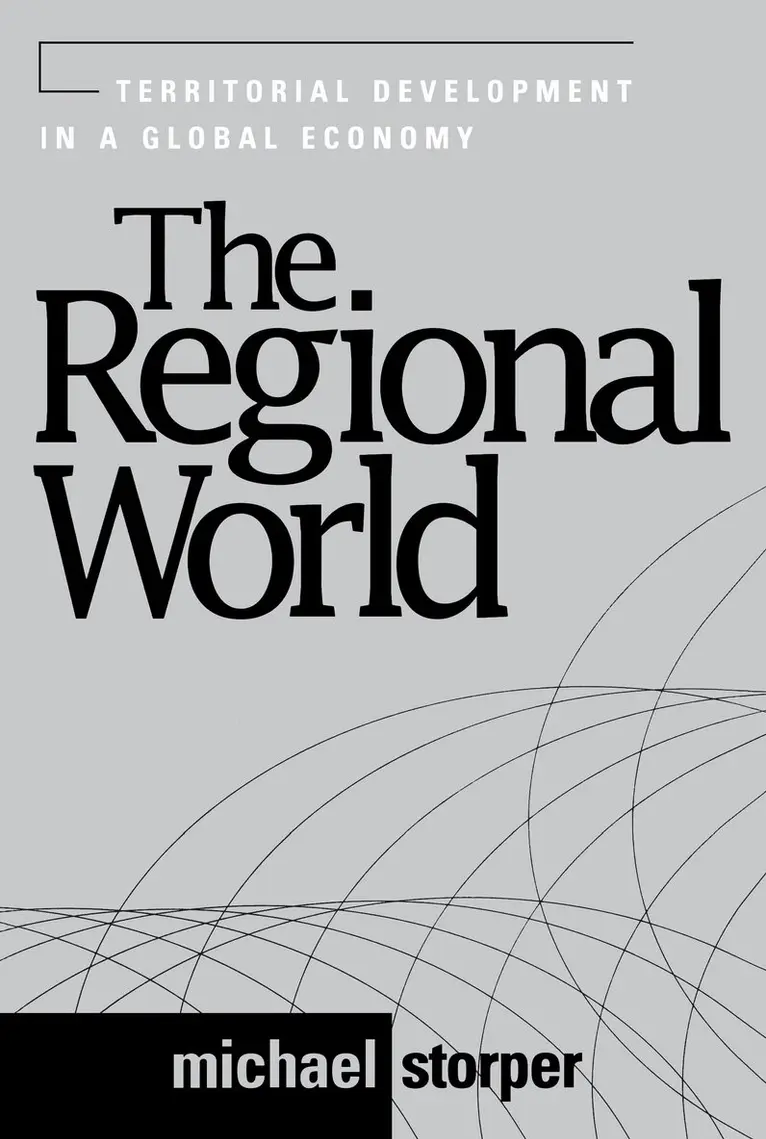
This pioneering volume proposes a compelling new theory of how regions have sustained their economic viability in the era of multinational corporations. Unlike traditional approaches, which analyze economic systems in terms of their mechanics (inputs, outputs, prices, technology, etc.), this work views them as systems for coordinating human actions and relationships. Reconceptualizing the role of learning, technology, and local institutions in development, Storper illuminates the key role of regional economies as building blocks of the increasingly connected world.A thought-provoking and timely work, The Regional World carries resounding implications for educators, students, and policymakers in economic geography, economic sociology, and international business. It is an essential primary or supplementary text for graduate-level courses on economic, regional, or industrial development and policy and international business.
590 kr
Tillfälligt slut
Since the large-scale manufacture of personal timepieces began, industry leadership has shifted among widely disparate locations, production systems, and cultures. This book recounts the story of the quest for supremacy in the manufacture of watches--from the cottage industries of Britain; to the preeminence of Switzerland and, later, the United States; to the high-tech plants of Japan and the sweatshops of Hong Kong. Glasmeier examines both the strategies adopted by specific firms and the interplay of such varying influences as technological change, cyclical economic downturns, war, and national trade policies. In so doing, she delineates a cohesive framework within which to address such broader questions as how sustained regional economic development takes place (or starts and then stops); how decisions made by corporations are structured by internal and external forces; and the ways industrial cultures with different strategic learning capabilities facilitate or thwart the pursuit of technological change.