Political & Legal Anthropology Series – serie
Visar alla böcker i serien Political & Legal Anthropology Series. Handla med fri frakt och snabb leverans.
4 produkter
4 produkter
1 194 kr
Skickas inom 10-15 vardagar
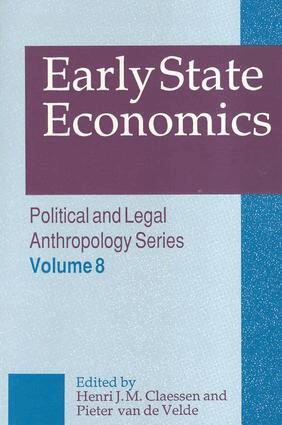
The central theme of this volume is the political economy of early state societies: the ways in which the income of the central government of such systems was collected and spent. The work contains descriptive as well as narrative and commemorative essays. Contributions present data on early states as diverse as the Interlacustrine states of East Africa, the Sudanic states of West Africa, prehistoric Cahokia in the Mississippi Valley, Aztec Mexico, the Classical Maya, eighteenth-century Nepal, and Polynesian, Tahitian, and Mayan case studies. At the theoretical end of the spectrum, the book offers a general discussion of the concept of political economy; modes of production in antiquity, and the editors themselves offer an overview of early state organizational forms. With the data of the contributions to this volume, such theoretical viewpoints are evaluated. The conclusion is that inherited approaches fall far short of explaining the political economies of early states. The editors of this volume maintain that much thinking on this issue of the early state is off-base because it is confined to the study of redistribution. They hold that a prestige goods system is probably as important, while in some cases, the key factor to look at is tribute or taxation. Likewise, the system of gift giving, often viewed as ancillary, should be considered central to the performance of the ancient states. In short, political economy is rooted in the stages of social growth. Nearly all contributors agree that simple evolutionary generalizations can no longer be applied to specific cases without considerable modification, and in this undertaking formalist and Marxist canons alike need to be invoked for a deeper understanding of the actual operations of the state in earlier societies.
483 kr
Skickas inom 10-15 vardagar
The central theme of this volume is the political economy of early state societies: the ways in which the income of the central government of such systems was collected and spent. The work contains descriptive as well as narrative and commemorative essays. Contributions present data on early states as diverse as the Interlacustrine states of East Africa, the Sudanic states of West Africa, prehistoric Cahokia in the Mississippi Valley, Aztec Mexico, the Classical Maya, eighteenth-century Nepal, and Polynesian, Tahitian, and Mayan case studies. At the theoretical end of the spectrum, the book offers a general discussion of the concept of political economy; modes of production in antiquity, and the editors themselves offer an overview of early state organizational forms. With the data of the contributions to this volume, such theoretical viewpoints are evaluated. The conclusion is that inherited approaches fall far short of explaining the political economies of early states. The editors of this volume maintain that much thinking on this issue of the early state is off-base because it is confined to the study of redistribution. They hold that a prestige goods system is probably as important, while in some cases, the key factor to look at is tribute or taxation. Likewise, the system of gift giving, often viewed as ancillary, should be considered central to the performance of the ancient states. In short, political economy is rooted in the stages of social growth. Nearly all contributors agree that simple evolutionary generalizations can no longer be applied to specific cases without considerable modification, and in this undertaking formalist and Marxist canons alike need to be invoked for a deeper understanding of the actual operations of the state in earlier societies.
969 kr
Tillfälligt slut
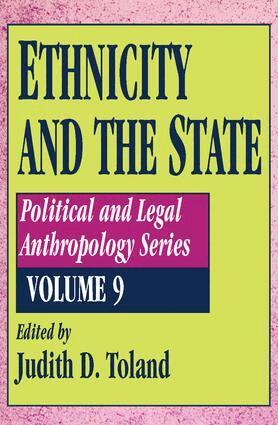
Modern states have evolved as complex political structures in which unitary forms of government maintain an uncertain equilibrium with ethnically plural societies. Historically, ruling elites have tried with little success to eradicate ethnicity through genocide, bury it under accusations of tribalism, discredit it with the mind-frame of modernization, or confine it to local rather than national political arenas. This broad-ranging volume examines the dynamics of ethnic manipulation and accommodation by dominant and subordinate groups in the state-building process.Ethnicity and the State reflects the widely varying political contexts and cultures in which reasons of state contend with unyielding ethnic allegiances. European, South American, Asian, and Middle Eastern examples reveal a consistent set of themes and attitudes. The authors find that while the state must realize its authority and stability through a strictly defined charter of rights and values, ethnic identity exercises its power more freely and flexibly. The sense of peoplehood may be artificially constructed in response to immediate need, or it may be ancient and organic, growing over time. It has the potential to cut across race, class, and gender. Its central tenets and myths may be reinterpreted, recreated, enlarged upon, or modified as the political situation warrants. Flexibility of belief and the need to identify with a larger group account both for the durability of ethnic loyalty and its vulnerability to manipulation.This volume is particularly timely at a moment when national governments in many parts of the world must face the adoption of more equitable forms of rule to hold their ethnically diverse societies together. Taken together, the analyses presented here warn against institutionalizing ethnic strife and offer a vision of how the state may foster expectations and policies that serve the interests of all ethnic groups within their borders. Political scientists, historians, and anthropologists will find this book valuable for its interpretations of forces that continue to reshape the social and political fabric of the world.
686 kr
Skickas inom 10-15 vardagar
Modern states have evolved as complex political structures in which unitary forms of government maintain an uncertain equilibrium with ethnically plural societies. Historically, ruling elites have tried with little success to eradicate ethnicity through genocide, bury it under accusations of tribalism, discredit it with the mind-frame of modernization, or confine it to local rather than national political arenas. This broad-ranging volume examines the dynamics of ethnic manipulation and accommodation by dominant and subordinate groups in the state-building process.Ethnicity and the State reflects the widely varying political contexts and cultures in which reasons of state contend with unyielding ethnic allegiances. European, South American, Asian, and Middle Eastern examples reveal a consistent set of themes and attitudes. The authors find that while the state must realize its authority and stability through a strictly defined charter of rights and values, ethnic identity exercises its power more freely and flexibly. The sense of peoplehood may be artificially constructed in response to immediate need, or it may be ancient and organic, growing over time. It has the potential to cut across race, class, and gender. Its central tenets and myths may be reinterpreted, recreated, enlarged upon, or modified as the political situation warrants. Flexibility of belief and the need to identify with a larger group account both for the durability of ethnic loyalty and its vulnerability to manipulation.This volume is particularly timely at a moment when national governments in many parts of the world must face the adoption of more equitable forms of rule to hold their ethnically diverse societies together. Taken together, the analyses presented here warn against institutionalizing ethnic strife and offer a vision of how the state may foster expectations and policies that serve the interests of all ethnic groups within their borders. Political scientists, historians, and anthropologists will find this book valuable for its interpretations of forces that continue to reshape the social and political fabric of the world.