Praeger Series in War Studies – serie
Visar alla böcker i serien Praeger Series in War Studies. Handla med fri frakt och snabb leverans.
4 produkter
4 produkter
Inbunden, Engelska, 1997
1 072 kr
Skickas inom 10-15 vardagar
This book is an operational history of the Canadian Corps in the battles of the final 100 days of World War I, beginning with the battle of Amiens, August 8, 1918, and culminating in the retaking of Mons on November 11, 1918, only hours before the war ended. During the late summer and autumn of 1918, the Canadian Corps, under Lt. Gen. Sir Arthur Currie, played a crucial role in the defeat of the German Army on the Western Front. This work examines the operational, organizational, and tactical innovations developed by the Corps during this campaign and their subsequent effect on military thought. Six battles are examined for their planning, conduct, and lessons: the Battle of Amiens, the breaking of the Drocourt-Queant line, the Canal du Nord and Cambrai, the pursuit to Valenciennes, the storming of Mount Huoy, and the return to Mons.
Inbunden, Engelska, 1999
1 105 kr
Skickas inom 10-15 vardagar
The most complete memoir or primary account in English of two of the most important phases of the Thirty Years' War, Monro's Expedition is a regimental history, a guide to would-be mercenary officers, a social history, and a window into an earlier era. Although the Thirty Years War (1618-1648) ended three and a half centuries ago, it continues to intrigue readers as one of the most devastating wars in modern European history. Initially a religious/political confrontation, the conflict soon expanded into a continent-wide series of wars. Monro's account of his experiences is one of the most important primary sources of the period.From the creation of new tactical formations to improved military technology, the sheer magnitude of the crisis required new methods of waging war. Firsthand accounts by the combatants themselves are virtually non-existent, as rank and file soldiers were rarely literate, and their officers were only slightly more educated. Monro was a Scot who wrote proudly of his Scottish regiment and of his Scottish soldiers. Brockington's account retains the original spelling and punctuation and includes the original pagination within the new text for the benefit of readers searching for information cited elsewhere. Glossaries provide ready reference for place names, proper names, and archaic terms.
Inbunden, Engelska, 1999
1 075 kr
Skickas inom 10-15 vardagar
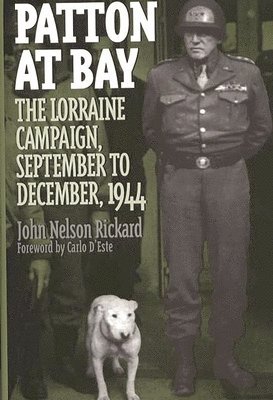
For General George S. Patton, Jr., the battle for Lorraine during the fall and winter of 1944 was a frustrating and grueling experience of static warfare. Plagued by supply shortages, critical interference from superiors, flooded rivers, fortified cities, and the highly-determined German army, Patton had little opportunity to wage a fast armored campaign. Rickard examines Patton's generalship during these bitter battles and suggests that Patton was unable to adapt to the new realities of the campaign, thereby failing to wage the most effective warfare possible.By the beginning of the Ardennes offensive, Patton had crippled his worthy opponent, but had suffered the highest casualties of any campaign that he conducted during the war. Until now, his better known exploits in Sicily and Normandy have overshadowed this campaign. Relying on a broad range of sources, this treatment of Patton's operational performance in Lorraine goes beyond the official history. It describes Patton's philosophy of war and explains why it essentially failed in Lorraine. Supplemented by full orders of battle, casualty and equipment losses, and excellent maps, Patton at Bay is a penetrating study of America's best fighting general.
E-bok
PDF, Engelska, 20001 128 kr
Läs direkt efter köp
A reinterpretation of the British Army's conduct in the crucial 1944-45 Northwest Europe campaign, this work examines systematically the Colossal Cracks operational technique employed by Montgomery's Anglo-Canadian 21st Army Group and demonstrates the key significance that morale and casualty concerns exerted on this technique. To ensure a full understanding of the campaign, one needs to look not only at Montgomery's methods but at those of his army commanders, Dempsey and Crerar; thus, this study addresses the scant attention to date paid to these two figures. Hart suggests that Montgomery and his two senior subordinates handled this formation more effectively than some scholars have suggested. In fact, Colossal Cracks, the concentration of massive force at a point of German weakness, represented the most appropriate weapon the 1944 British Army could develop under the circumstances.Previous studies have been characterized by an overemphasis on Montgomery's role in the campaign, rather than a systematic examination of overall British methods. They have ignored the difficulties that the 1944 British Army faced given its manpower shortage, and they have underestimated the appropriateness of Monty's methods to the campaign war aims that Britain pursued: namely, the desire that Britain's modest military forces secure a high profile within a larger Allied effort. The cautious, firepower-laden approach used by the 21st Army Group was both crude and a double-edged sword; however, despite these weaknesses, Colossal Cracks represented an appropriate technique given the nature of British war aims and the relative capabilities of the forces involved. It proved to be just enough to defeat the Germans and keep alive British hopes that her war aims might be achieved.