Princeton Landmarks in Biology - Böcker
Visar alla böcker i serien Princeton Landmarks in Biology. Handla med fri frakt och snabb leverans.
2 produkter
2 produkter
695 kr
Skickas inom 7-10 vardagar
Biogeography was stuck in a "natural history phase" dominated by the collection of data, the young Princeton biologists Robert H. MacArthur and Edward O. Wilson argued in 1967. In this book, the authors developed a general theory to explain the facts of island biogeography. The theory builds on the first principles of population ecology and genetics to explain how distance and area combine to regulate the balance between immigration and extinction in island populations. The authors then test the theory against data. The Theory of Island Biogeography was never intended as the last word on the subject. Instead, MacArthur and Wilson sought to stimulate new forms of theoretical and empirical studies, which will lead in turn to a stronger general theory. Even a third of a century since its publication, the book continues to serve that purpose well. From popular books like David Quammen's Song of the Dodo to arguments in the professional literature, The Theory of Island Biogeography remains at the center of discussions about the geographic distribution of species. In a new preface, Edward O. Wilson reviews the origins and consequences of this classic book.
695 kr
Skickas inom 7-10 vardagar
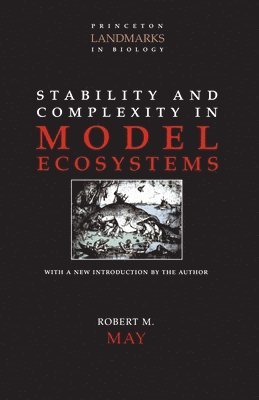
What makes populations stabilize? What makes them fluctuate? Are populations in complex ecosystems more stable than populations in simple ecosystems? In 1973, Robert May addressed these questions in this classic book. May investigated the mathematical roots of population dynamics and argued-counter to most current biological thinking-that complex ecosystems in themselves do not lead to population stability. Stability and Complexity in Model Ecosystems played a key role in introducing nonlinear mathematical models and the study of deterministic chaos into ecology, a role chronicled in James Gleick's book Chaos. In the quarter century since its first publication, the book's message has grown in power. Nonlinear models are now at the center of ecological thinking, and current threats to biodiversity have made questions about the role of ecosystem complexity more crucial than ever. In a new introduction, the author addresses some of the changes that have swept biology and the biological world since the book's first publication.