Real Utopias Project - Böcker
Visar alla böcker i serien Real Utopias Project. Handla med fri frakt och snabb leverans.
10 produkter
10 produkter
379 kr
Skickas inom 3-6 vardagar
Rising inequality of income and power, along with recent convulsions in the finance sector, have made the search for alternatives to unbridled capitalism more urgent than ever. Yet few are attempting this task-most analysts argue that any attempt to rethink our social and economic relations is utopian. Erik Olin Wright's major new work is a comprehensive assault on the quietism of contemporary social theory. A systematic reconstruction of the core values and feasible goals for Left theorists and political actors, Envisioning Real Utopias lays the foundations for a set of concrete, emancipatory alternatives to the capitalist system. Characteristically rigorous and engaging, this will become a landmark of social thought for the twenty-first century.
316 kr
Skickas inom 7-10 vardagar
Democracy means rule by the people, but in practice even the most robust democracies delegate most rule making to a political class. The gap between the public and its public officials might seem unbridgeable in the modern world, but Legislature by Lot presents a close examination of an inspiring solution: a legislature chosen through "sortition"-the random selection of lay citizens. It's a concept that has come to the attention of democratic reformers across the globe. Proposals for such bodies are being debated in Australia, Belgium, Iceland, the United Kingdom, and many other countries. Sortition promises to reduce corruption and create a truly representative legislature in one fell swoop. In Legislature by Lot, John Gastil and Erik Olin Wright make the case for pairing a sortition body with an elected chamber within a bicameral legislature. Gastil is a leading deliberative democracy scholar, and Wright a distinguished sociologist and series editor of the Real Utopias books, of which this is a part. In this volume, they bring together critics and advocates of sortition who studied ancient Athens, deliberative polling, political theory, social movements, and civic innovation. The constellation of voices in this book lays out a wide variety of ideas for how to implement sortition, without obscuring its limitations, and examine its potential for reshaping modern politics.Legislature by Lot includes sixteen essays that respond to Gastil and Wright's detailed proposal. Essays comparing it to contemporary reforms see it as a dramatic extension of deliberative "minipublics," which gather random samples of citizens to weight public policy dilemmas without being empowered to enact legislation. Another set of essays explores the democratic principles underlying sortition and elections and considers, for example, how a sortition body holds itself accountable to a public that did not elect it. The third set of essays consider alternative paths to democratic reform, which limit the powers of a sortition chamber or more quickly establish a pure sortition body.
288 kr
Skickas inom 7-10 vardagar
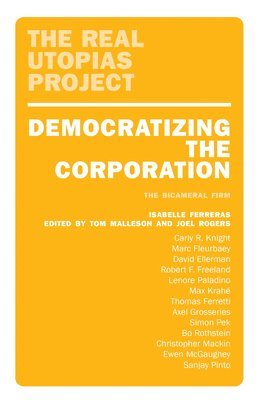
Although contemporary Western societies refer to themselves as "democratic," the bulk of the population spend much of their lives in workplaces that have more in common with tyranny. Gigantic corporations such as Amazon, Meta, Exxon, and Walmart are among the richest and most powerful institutions in the world yet accountable to no one but their shareholders. The undemocratic nature of conventional firms generates profound problems across society, hurting more than just the workplace and contributing to environmental destruction and spiraling inequality.Against this backdrop, Isabelle Ferreras proposes a radical but realistic plan to democratize the private firm. She suggests that all large firms should be bicamerally governed, with a chamber of worker representatives sharing equal governance power with the standard board representing owners. In response to this proposal, twelve leading experts on corporate behavior from multiple disciplines consider its attractiveness, viability, and achievability as a "real utopian" proposal to strengthen democracy in our time.
288 kr
Skickas inom 7-10 vardagar
What if our financial system were organized to the benefit of the many rather than simply empowering the few? Robert Hockett and Fred Block argue that an entirely different financial system is both desirable and possible. They outline concrete steps that could get us there. Financial systems move the worlds savings from investment to investment, chasing the highest rates of return. They run on profit. But what if investment went to the enterprises or institutions that provided things that the majority of people would prioritize? Democratizing Finance includes six responses that seek to amend, elaborate, and challenge the arguments developed by Hockett and Block. Some of the core arguments put forward by other contributors include calls for the rapid elimination of private financial entities, the dilemmas of the politics associated with financial reforms, and the fate of parallel proposals advanced in the US in the 1930s.
501 kr
Skickas inom 3-6 vardagar
In the labor market and workplace, anti-discrimination rules, affirmative action policies, and pay equity procedures exercise a direct effect on gender relations. But what can be done to influence the ways that men and women allocate tasks and responsibilities at home?In Gender Equality, Volume VI in the Real Utopias series, social scientists Janet C. Gornick and Marcia K. Meyers propose a set of policies-paid family leave provisions, working time regulations, and early childhood education and care-designed to foster more egalitarian family divisions of labor by strengthening men's ties at home and women's attachment to paid work. Their policy proposal is followed by a series of commentaries-both critical and supportive-from a group of distinguished scholars, and a concluding essay in which Gornick and Meyers respond to a debate that is a timely and valuable contribution to egalitarian politics.
Redesigning Distribution
Basic Income and Stakeholder Grants as Cornerstones for an Egalitarian Capitalism
Häftad, Engelska, 2006
371 kr
Skickas inom 3-6 vardagar
Volume V in the acclaimed Real Utopias Project series, edited by Erik Olin Wright.Are there ways that contemporary capitalism can be rendered a dramatically more egalitarian economic system without destroying its productivity and capacity for growth?This book explores two proposals, unconditional basic income and stakeholder grants, that attempt just that. In a system of basic income, as elaborated by Philippe van Parijs, all citizens are given a monthly stipend sufficient to provide them with a no-frills but adequate standard of living. This monthly income is universal rather than means-tested, and it is unconditional - receiving the basic income does not depend upon performing any labor services or satisfying other conditions. It affirms the idea that as a matter of basic rights, no one should live in poverty in an affluent society. In a system of stakeholder grants, as discussed by Bruce Ackerman and Anne Alstott, all citizens upon reaching the age of early adulthood receive a substantial one-time lump-sum grant sufficiently large so that all young adults would be significant wealth holders. Ackerman and Alstott propose that this grant be in the vicinity of $80,000 and be financed by an annual wealth tax of roughly 2 percent. A system of stakeholder grants, they argue, "expresses a fundamental responsibility: every American has an obligation to contribute to a fair starting point for all."
408 kr
Skickas inom 3-6 vardagar
Throughout the West, democracy is under fire. "Government is part of the problem, not the solution" is a common refrain. As the tasks of the state become more complex and the size of polities larger, the institutional forms of liberal democracy developed in the 19th century seem increasingly unable to cope. Rather than seeking to deepen the democratic character of politics, much energy in recent years has been directed as reducing the role of politics altogether. In Associations and Democracy, Joshua Cohen and Joel Rogers advance an innovative scheme for rejuvenating the democratic state. Their proposal involves the strengthening of secondary associations, organizations like unions, works councils, neighborhood associations, parent-teacher groups and women's societies. With enlivened secondary associations mediating between individual citizens and the state, active participation in the political process can be expanded and democracy enhanced. Such an approach raises a number of thorny issues: Can such associations retain their independence from government if they are pulled further into the political sphere? Will a shift from territorial to functional representation further fragment an already divided polity? In an array of original contributions, leading social scientists respond to Cohen and Rogers with questions like these; Cohen and Rogers, in turn, sum up the debate. The first of a series of polemics providing workable scenarios for a progressive future, Associations and Democracy is a lively and stimulating exploration of one of the central issues on today's political agenda.
302 kr
Skickas inom 3-6 vardagar
"Nice idea, but it doesn't work in practice." How often have socialists had this claim thrown back at them? And now, after the events of 1989, many of the Left are openly wondering what a defensible idea of socialism would be. This work addresses this question, taking as its point of departure John Roemer's model of "coupon socialism". Roemer's model aims to combine the market with a commitment to equality through a simple, yet starkly radical, proposal: all citizens would receive an equal number of coupons with which to buy ownership rights (voting, dividends) in companies. These coupons would constitute a second, separate form of currency, but could not be exchanged for ordinary money, nor transferred to other people. Not all the contributors to this collection endorse Roemer's working model of market socialism, but they are all stimulated by his foray into a "real utopia".
256 kr
Skickas inom 3-6 vardagar
In Recasting Egalitarianism, part of Verso's Real Utopias series, economists Samuel Bowles and Herbert Gintis diagnose the current malaise of the Left as a result of the obsolescence of its traditional economic models. They propose to rejuvenate the egalitarian project through a strategy of asset-based redistribution, drawing in novel ways on markets, competition, state regulation and community governance. In this major work on economic and social policy, the authors address the twin challenges posed by a globally integrated economy and the key economic roles now played by information, motivation, and other intangibles. They propose an egalitarian redistribution of assets-land, capital, and housing-and argue for the beneficial disciplining effects of competition both in markets and among publicly-funded service providers, pointing out that the injustices commonly associated with markets can be avoided if assets are more equally distributed. The lead essay in the book lays out the underlying logic of this proposal in some detail. This is followed by responses by critics and supporters.
Deepening Democracy
Institutional Innovations in Empowered Participatory Governance
Häftad, Engelska, 2003
361 kr
Skickas inom 3-6 vardagar
The institutional forms of liberal democracy developed in the nineteenth century seem increasingly ill-suited to the problems we face in the twenty-first. This dilemma has given rise in some places to a new, deliberative democracy, and this volume explores four contemporary empirical cases in which the principles of such a democracy have been at least partially instituted: the participatory budget in Porto Alegre; the school decentralization councils and community policing councils in Chicago; stakeholder councils in environmental protection and habitat management; and new decentralised governance structures in Kerala. In keeping with the other Real Utopias Project volumes, these case studies are framed by an editors' introduction, a set of commentaries, and concluding notes.