Reconfiguring American Political History – serie
Visar alla böcker i serien Reconfiguring American Political History. Handla med fri frakt och snabb leverans.
19 produkter
19 produkter
Häftad, Engelska, 1998
393 kr
Skickas inom 5-8 vardagar
In the 1850s, Washington County, Oregon, gathered together a broad cross-section of antebellum America -- rich and poor, Northerners and Southerners, Protestant and Catholics, old natives and new immigrants. More than that, however, it left for historians a rare opportunity to explore political, social, and cultural trends in American history due to its unique practice of viva voce voting -- announcing individual ballots publicly rather than recording them in secret. Paul Bourke and Donald DeBats tap into this remarkable resource to reveal how individual political identities developed and political choices were made.
Häftad, Engelska, 2001
416 kr
Skickas inom 5-8 vardagar
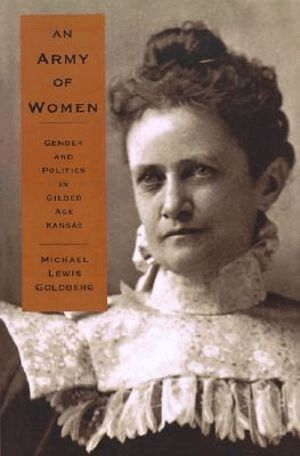
Looking at both the private and public lives of women and men in rural and urban Kansas, Michael Lewis Goldberg offers sweeping evidence of the role gender played in influencing Gilded Age politics. In An Army of Women, he analyzes how political activists in the Populist Party and the Woman Movement sought to create a role for women while retaining the support of men. When these activists employed the often slippery symbols of masculinity and femininity, they found that gendered meanings often changed with the shifting political context. Their ideas and assumptions about gender helped determine their ideologies, strategies, the fate of their movements, and their impact on American politics. Goldberg's broad scope and use of both traditional and unusual sources -- including folkways, poems, songs, and novels -- allow readers to understand the movements both as part of a national framework and within the context of the state and local cultures that were their primary concern.
Inbunden, Engelska, 2000
655 kr
Skickas
In Fireside Politics, Douglas B. Craig provides the first detailed and complete examination of radio's changing role in American political culture between 1920 and 1940-the medium's golden age, when it commanded huge national audiences without competition from television. Craig follows the evolution of radio into a commercialized, networked, and regulated industry, and ultimately into an essential tool for winning political campaigns and shaping American identity in the interwar period. Finally, he draws thoughtful comparisons of the American experience of radio broadcasting and political culture with those of Australia, Britain, and Canada.
Inbunden, Engelska, 2001
736 kr
Skickas
Drawing on substantial new research, Red Feminism traces the development of a distinctive Communist strain of American feminism from its troubled beginnings in the 1930s, through its rapid growth in the Congress of American Women during the early years of the Cold War, to its culmination in Communist Party circles of the late 1940s and early 1950s. The author argues persuasively that, despite the devastating effects of anti-Communism and Stalinism on the progressive Left of the 1950s, Communist feminists such as Susan B. Anthony II, Betty Millard, and Eleanor Flexner managed to sustain many important elements of their work into the 1960s, when a new generation took up their cause and built an effective movement for women's liberation. Red Feminism provides a more complex view of the history of the modern women's movement, showing how key Communist activists came to understand gender, sexism, and race as central components of culture, economics, and politics in American society.
Häftad, Engelska, 2003
416 kr
Skickas inom 5-8 vardagar
Drawing on substantial new research, Red Feminism traces the development of a distinctive Communist strain of American feminism from its troubled beginnings in the 1930s, through its rapid growth in the Congress of American Women during the early years of the Cold War, to its culmination in Communist Party circles of the late 1940s and early 1950s. The author argues persuasively that, despite the devastating effects of anti-Communism and Stalinism on the progressive Left of the 1950s, Communist feminists such as Susan B. Anthony II, Betty Millard, and Eleanor Flexner managed to sustain many important elements of their work into the 1960s, when a new generation took up their cause and built an effective movement for women's liberation. Red Feminism provides a more complex view of the history of the modern women's movement, showing how key Communist activists came to understand gender, sexism, and race as central components of culture, economics, and politics in American society.
Häftad, Engelska, 2005
359 kr
Skickas inom 5-8 vardagar
In Fireside Politics, Douglas B. Craig provides the first detailed and complete examination of radio's changing role in American political culture between 1920 and 1940-the medium's golden age, when it commanded huge national audiences without competition from television. Craig follows the evolution of radio into a commercialized, networked, and regulated industry, and ultimately into an essential tool for winning political campaigns and shaping American identity in the interwar period. Finally, he draws thoughtful comparisons of the American experience of radio broadcasting and political culture with those of Australia, Britain, and Canada.
Häftad, Engelska, 2007
359 kr
Skickas inom 5-8 vardagar
Low voter turnout is a serious problem in American politics today, but it is not a new one. Its roots lay in the 1920s when, for the first time in nearly a century, a majority of eligible Americans did not bother to cast ballots in a presidential election. Stunned by this civic failure so soon after a world war to "make the world safe for democracy," reforming women and business men launched massive campaigns to "Get Out the Vote." By 1928, they had enlisted the enthusiastic support of more than a thousand groups in Forty-six states. In The Big Vote, historian Liette Gidlow shows that the Get-Out-the-Vote campaigns-overlooked by historians until now-were in fact part of an important transformation of political culture in the early twentieth century. Weakened political parties, ascendant consumer culture, labor unrest, Jim Crow, widespread anti-immigration sentiment, and the new woman suffrage all raised serious questions about the meanings of good citizenship.Gidlow recasts our understandings of the significance of the woman suffrage amendment and shows that it was important not only because it enfranchised women but because it also ushered in a new era of near-universal suffrage. Faced with the apparent equality of citizens before the ballot box, middle-class and elite whites in the Get-Out-the-Vote campaigns and elsewhere advanced a searing critique of the ways that workers, ethnics, and sometimes women behaved as citizens. Through techniques ranging from civic education to modern advertising, they worked in the realm of culture to undo the equality that constitutional amendments had seemed to achieve. Through their efforts, by the late 1920s, "civic" had become practically synonymous with "middle class" and "white." Richly documented with primary sources from political parties and civic groups, popular and ethnic periodicals, and electoral returns, The Big Vote looks closely at the national Get-Out-the-Vote campaigns and at the internal dynamics of campaigns in the case-study cities of New York, New York, Grand Rapids, Michigan, and Birmingham, Alabama.In the end, the Get-Out-the Vote campaigns shed light not only on the problem of voter turnout in the 1920s, but on some of the problems that hamper the practice of full democracy even today.
Häftad, Engelska, 2007
381 kr
Skickas inom 5-8 vardagar
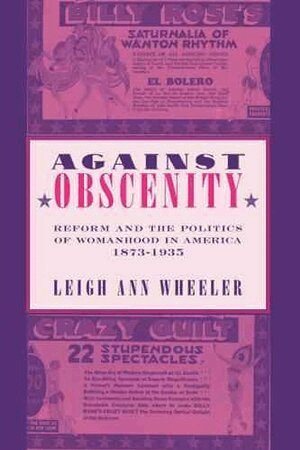
As women beat down the doors and won the right to vote in the early twentieth century, adult (patriarchal) males rightly anticipated crusades on behalf of, or mounting conflicts over, those issues that particularly agitated women--drink, child welfare, and vice chief among them. This study examines the struggle of women to exert (matriarchal) control over burlesque houses, motion-picture theaters, and sex education in the schools--employing censorship in the role of moral leadership--and the opposition they encountered, from some men but also some women. Answering which, and why, Leigh Ann Wheeler finds that public disagreements on anti-obscenity fractured what appeared to be unity among women, undercut the earlier view of women as disinterested because apart from the public fray, and led to a resurgence of patriarchal authority--now in the shape of religious anti-obscenity. The leaders of the women's anti-obscenity movement launched their crusade in Minneapolis, but women across the country followed their example, so that Wheeler avoids the limitations of a purely local case study.Completed under the direction of Sara Evans, Wheeler's work offers a sterling example of how students of the women's experience can open new questions and deepen our understanding of cultural-political conflict in American life.
Inbunden, Engelska, 2007
755 kr
Skickas inom 5-8 vardagar
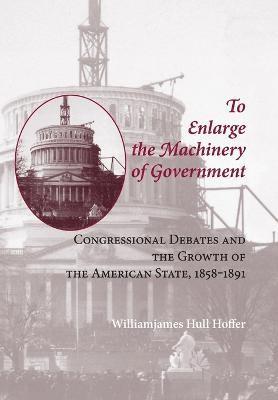
How did the federal government change from the weak apparatus of the antebellum period to the large, administrative state of the Progressive Era? To Enlarge the Machinery of Government explores the daily proceedings of the U.S. House and Senate from 1858 to 1891 to find answers to this question. Through close readings of debates centered around sponsorship, supervision, and standardization recorded in the Congressional Globe and Congressional Record during this period, Williamjames Hull Hoffer traces a critical shift in ideas that ultimately ushered in Progressive legislation: the willingness of American citizens to allow, and in fact ask for, federal intervention in their daily lives. He describes this era of congressional thought as a "second state," distinct from both the minimalist approaches that came before and the Progressive state building that developed later. The "second state" era, Hoffer contends, offers valuable insight into how conceptions of American uniqueness contributed to the shape of the federal government.
Inbunden, Engelska, 2014
678 kr
Skickas inom 5-8 vardagar
Few issues defined the period between American independence and the Mexican War more sharply than westward settlement and the role of the federal government in that expansion. In Securing the West, John R. Van Atta examines the visions of the founding generation and the increasing influence of ideological differences in the years after the peace of 1815. Americans expected the country to grow westward, but on the details of that growth they held strongly different opinions. What part should Congress play in this development? How much should public land cost? What of the families and businesses left behind, and how would society's institutions be established in the West? What of the premature settlers, the "squatters" who challenged the rule of law while epitomizing democratic daring? Taking a broad approach, Van Atta addresses three interrelated queries: First, how did competing economic beliefs and divergent cultural mandates influence the various outcomes of this broad debate over the means, timing, and purposes of settling the trans-Appalachian West?Second, what alternative visions of western society lay behind the battles among policy makers within the government and the interested parties who would sway them? Third, why did settlement of the West take such a different course in the end from that which the earliest leaders of the republic intended? This story explores dimensions of the federal lands question that other historians have minimized or left out entirely. Van Atta draws upon a range of sources known to have influenced the public discourse, including congressional debates, committee reports, and correspondence; editorial writings by the famous and unknown; and news coverage in various widely circulated newspapers and magazines of the period. Much of the attention focuses on Congress-the elected leaders who advocated divergent plans about western lands. In Congress, more than any other place, public leaders articulated basic concerns about the character, structure, direction, and destiny of society in the early United States.By 1830, many other important national concerns had become critically entangled with land disposition, creating points of ideological tension among rival regions, parties, and interests in the early years of the republic - particularly in Jacksonian America.
Inbunden, Engelska, 2014
540 kr
Skickas inom 5-8 vardagar
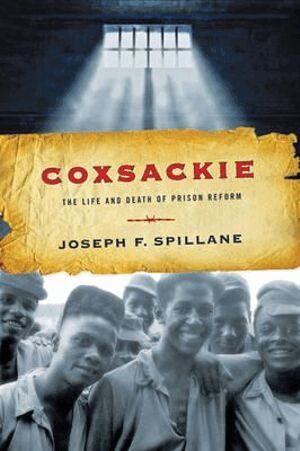
Should prisons attempt reform and uplift inmates or, by means of principled punishment, deter them from further wrongdoing? This debate has raged in Western Europe and in the United States at least since the late eighteenth century. Joseph F. Spillane examines the failure of progressive reform in New York State by focusing on Coxsackie, a New Deal reformatory built for young male offenders. Opened in 1935 to serve "adolescents adrift," Coxsackie instead became an unstable and brutalizing prison. From the start, the liberal impulse underpinning the prison's mission was overwhelmed by challenges it was unequipped or unwilling to face-drugs, gangs, and racial conflict. Spillane draws on detailed prison records to reconstruct a life behind bars in which "ungovernable" young men posed constant challenges to racial and cultural order. The New Deal order of the prison was unstable from the start; the politics of punishment quickly became the politics of race and social exclusion, and efforts to save liberal reform in postwar New York only deepened its failures. In 1977, inmates took hostages to focus attention on their grievances.The result was stricter discipline and an end to any pretense that Coxsackie was a reform institution. Why did the prison fail? For answers, Spillane immerses readers in the changing culture and racial makeup of the U.S. prison system and borrows from studies of colonial prisons, which emblematized efforts by an exploitative regime to impose cultural and racial restraint on others. In today's era of mass incarceration, prisons have become conflict-ridden warehouses and powerful symbols of racism and inequality. This account challenges the conventional wisdom that America's prison crisis is of comparatively recent vintage, showing instead how a racial and punitive system of control emerged from the ashes of a progressive ideal.
Häftad, Engelska, 2014
422 kr
Skickas inom 5-8 vardagar
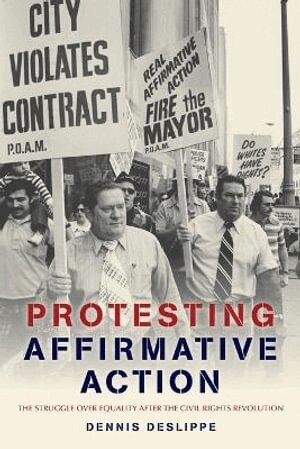
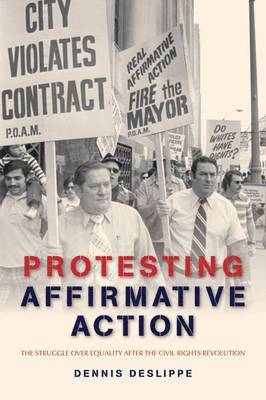
A lightning rod for liberal and conservative opposition alike, affirmative action has proved one of the more divisive issues in the United States over the past five decades. Dennis Deslippe here offers a thoughtful study of early opposition to the nation's race- and gender-sensitive hiring and promotion programs in higher education and the workplace. This story begins more than fifteen years before the 1978 landmark U.S. Supreme Court case Regents of the University of California v. Bakke. Partisans attacked affirmative action almost immediately after it first appeared in the 1960s. Liberals in the opposition movement played an especially significant role. While not completely against the initiative, liberal opponents strove for "soft" affirmative action (recruitment, financial aid, remedial programs) and against "hard" affirmative action (numerical goals, quotas). In the process of balancing ideals of race and gender equality with competing notions of colorblindness and meritocracy, they even borrowed the language of the civil rights era to make far-reaching claims about equality, justice, and citizenship in their anti-affirmative action rhetoric.Deslippe traces this conflict through compelling case studies of real people and real jobs. He asks what the introduction of affirmative action meant to the careers and livelihoods of Seattle steelworkers, New York asbestos handlers, St. Louis firemen, Detroit policemen, City University of New York academics, and admissions counselors at the University of Washington Law School. Through their experiences, Deslippe examines the diverse reactions to affirmative action, concluding that workers had legitimate grievances against its hiring and promotion practices. In studying this phenomenon, Deslippe deepens our understanding of American democracy and neoconservatism in the late twentieth century and shows how the liberals' often contradictory positions of the 1960s and 1970s reflect the conflicted views about affirmative action many Americans still hold today.
Häftad, Engelska, 2020
660 kr
Skickas inom 5-8 vardagar
In this lively study, Robert E. Shalhope supplies a fascinating microcosmic view of the rise and triumph of liberal individualism in America and explores its impact on political culture.Selected by Choice Magazine as an Outstanding Academic TitleOriginally published in 1996. Americans who lived between the Revolution and Civil War felt the brunt of resounding and sometimes frightening changes, which together eventually influenced the political culture of early America. In this lively study, Robert E. Shalhope examines one of the changes most difficult to gauge and most controversial among students of the period—the rise and triumph of liberal individualism in America—and explores its impact on political culture.Taking Bennington, Vermont, and its environs as a case study, Shalhope untangles the clash among three competing elements in the community—the egalitarian communalism of the Strict Congregationalists; the democratic individualism of the revolutionary Green Mountain Boys; and the hierarchical authority of the community's Federalist gentlemen of property and standing. None of these players anticipated (and indeed did not wish for) the result—the emergence of democratic liberalism. Shalhope writes of class tension, economic competition, and religious differences—and ultimately of cultural conflict and political partisanship—and yet throughout uses individual life experiences to give the narrative piquancy and to emphasize the significance of seemingly small, personal decisions. Shalhope thus demonstrates how the private lives of ordinary people played a role in the settlement of public issues.As an account of a single town and how its residents responded to change, Bennington and the Green Mountain Boys supplies a fascinating microcosmic view of the larger story of how liberal America came to be.
Inbunden, Engelska, 2002
524 kr
Tillfälligt slut
Captivating disgruntled voters, third parties have often complicated the American political scene. In the years before the Civil War, third-party politics took the form of the Know Nothings, who mistrusted established parties and gave voice to anti-government sentiment. Originating about 1850 as a nativist fraternal order, the Know Nothing movement soon spread throughout the industrial North. In Beyond Party, Mark Voss-Hubbard draws on local sources in three different states where the movement was especially strong to uncover its social roots and establish its relationship to actual public policy issues. Focusing on the 1852 ten hour movement in Essex County, Massachusetts, the pro-temperance and anti-Catholic agitation in and around Dauphin County, Pennsylvania, and the movement to restrict immigrants' voting rights and overthrow "corrupt parties and politicians" in New London County, Connecticut, he shows that these places shared many of the social problems that occurred throughout the North-the consolidation of capitalist agriculture and industry, the arrival of Irish and German Catholic immigrants, and the changing fortunes of many established political leaders.Voss-Hubbard applies the insights of social history and social movement theory to politics in arguing that we need to understand Know Nothing rhetoric and activism as part of a wider tradition of American suspicion of "politics as usual"-even though, of course, this antipartyism served agendas that included those of self-interested figures seeking to accumulate power.
Inbunden, Engelska, 2003
497 kr
Tillfälligt slut
Between the Civil War and the Great Depression, twin revolutions swept through American business and government. In business, large corporations came to dominate entire sectors and markets. In government, new services and agencies, especially at the city and state levels, sprang up to ameliorate a broad spectrum of social problems. In The Price of Progress, R. Rudy Higgens-Evenson offers a fresh analysis of therelationship between those two revolutions. Using previously unexploited data from the annual reports of state treasurers and comptrollers, he provides a detailed, empirical assessment of the goods and services provided to citizens, as well as the resources extracted from them, by state governments during the Gilded Age and Progressive Era.Focusing on New York, Massachusetts, California, and Kansas, but including data on 13 other states, his comparative study suggests that the "corporate state" originated in tax policies designed to finance new and innovative government services. Business and government grew together in a surprising and complex fashion.In the late nineteenth century, services such as mental health care for the needy and free elementary education for all children created new strains on the states' old property tax systems. In order to pay for newly constructed state asylums and schools, states experimented for the first time with corporate taxation as a source of revenue, linking state revenues to the profitability of industries such as railroads and utilities. To control their tax bills, big businessesintensified lobbying efforts in state legislatures, captured important positions in state tax bureaus, and sponsored a variety of government-efficiency reform organizations. The unintended result of corporate taxation-imposed to allow states to fulfill their responsibilities to their citizens-was the creation of increasingly intimate ties between politicians, bureaucrats, corporate leaders, and progressive citizens. By the 1920s, a variety of "corporate states" had proliferated across the nation, each shaped by a particular mix of taxation and public services, each offering a case study in how the business of America, as President Calvin Coolidge put it, became business.
Inbunden, Engelska, 2004
509 kr
Tillfälligt slut
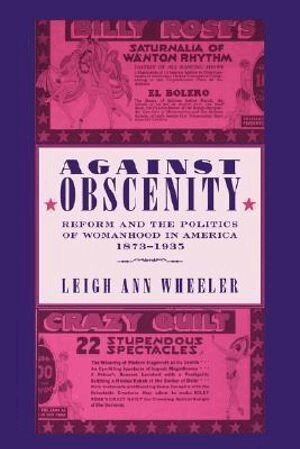
Radio "shock jocks," Super Bowl entertainment, music videos, and internet spam-all of these topics inspire passionate disagreements about whether and how to regulate sexually explicit material. But even in the midst of heated debate, most people agree that children should be shielded from exposure to pornographic images. Why are children the focal point of debates over sexually explicit material? And how did a culture rooted in Puritanism and Victorianism become saturated with sex? In Against Obscenity, Leigh Ann Wheeler offers new answers to these questions through a study of women's anti-obscenity activism from 1873 to 1935. This period saw the emergence of an increasingly sexualized popular culture comprised of burlesque shows, risque vaudeville acts, and indecent motion pictures. It also witnessed the enfranchisement of women. These momentous cultural and political developments come together in a story about middle- and upper-class women who mobilized against lewd public amusements and, simultaneously, challenged the men whose work as activists, jurors, and even law enforcement officials, had defined and regulated obscenity for several decades.By the 1920s, women who led the anti-obscenity movement enjoyed the support of millions of American women and the attention of presidents, congressmen, and Hollywood moguls. Today we live in a world profoundly shaped by their work but largely ignorant of their influence. Using primary sources as intimate as private correspondence and as formal as meeting minutes, Against Obscenity tells the story of these all but forgotten women, exploring their passionate disagreements over whether to ban a touring stage show, close a local burlesque theater, disseminate explicit sex education pamphlets, or create a federal agency to regulate Hollywood films. It shows that the rise and fall of women's anti-obscenity leadership shaped American attitudes toward and regulation of sexually explicit material even as it charted a new era in women's politics. In the end, the book argues that essentialist identity politics divided and ultimately disarmed women's anti-obscenity reform, helping us understand the curiously muted impact of woman suffrage.It also cautions against framing debates over sexual material narrowly in terms of harm to children while highlighting the dangers of surrendering discourse about sexuality to the commercial realm.
Inbunden, Engelska, 2004
587 kr
Tillfälligt slut
Low voter turnout is a serious problem in American politics today, but it is not a new one. Its roots lay in the 1920s when, for the first time in nearly a century, a majority of eligible Americans did not bother to cast ballots in a presidential election. Stunned by this civic failure so soon after a world war to "make the world safe for democracy," reforming women and business men launched massive campaigns to "Get Out the Vote." By 1928, they had enlisted the enthusiastic support of more than a thousand groups in Forty-six states. In The Big Vote, historian Liette Gidlow shows that the Get-Out-the-Vote campaigns-overlooked by historians until now-were in fact part of an important transformation of political culture in the early twentieth century. Weakened political parties, ascendant consumer culture, labor unrest, Jim Crow, widespread anti-immigration sentiment, and the new woman suffrage all raised serious questions about the meanings of good citizenship.Gidlow recasts our understandings of the significance of the woman suffrage amendment and shows that it was important not only because it enfranchised women but because it also ushered in a new era of near-universal suffrage. Faced with the apparent equality of citizens before the ballot box, middle-class and elite whites in the Get-Out-the-Vote campaigns and elsewhere advanced a searing critique of the ways that workers, ethnics, and sometimes women behaved as citizens. Through techniques ranging from civic education to modern advertising, they worked in the realm of culture to undo the equality that constitutional amendments had seemed to achieve. Through their efforts, by the late 1920s, "civic" had become practically synonymous with "middle class" and "white." Richly documented with primary sources from political parties and civic groups, popular and ethnic periodicals, and electoral returns, The Big Vote looks closely at the national Get-Out-the-Vote campaigns and at the internal dynamics of campaigns in the case-study cities of New York, New York, Grand Rapids, Michigan, and Birmingham, Alabama.In the end, the Get-Out-the Vote campaigns shed light not only on the problem of voter turnout in the 1920s, but on some of the problems that hamper the practice of full democracy even today.
Inbunden, Engelska, 2012
584 kr
Tillfälligt slut
A lightning rod for liberal and conservative opposition alike, affirmative action has proved one of the more divisive issues in the United States over the past five decades. Dennis Deslippe here offers a thoughtful study of early opposition to the nation's race- and gender-sensitive hiring and promotion programs in higher education and the workplace. This story begins more than fifteen years before the 1978 landmark U.S. Supreme Court case Regents of the University of California v. Bakke. Partisans attacked affirmative action almost immediately after it first appeared in the 1960s. Liberals in the opposition movement played an especially significant role. While not completely against the initiative, liberal opponents strove for "soft" affirmative action (recruitment, financial aid, remedial programs) and against "hard" affirmative action (numerical goals and quotas). In the process of balancing ideals of race and gender equality with competing notions of colorblindness and meritocracy, they even borrowed the language of the civil rights era to make far-reaching claims about equality, justice, and citizenship in their anti-affirmative action rhetoric.Deslippe traces this conflict through compelling case studies of real people and real jobs. He asks what the introduction of affirmative action meant to the careers and livelihoods of Seattle steelworkers, New York asbestos handlers, St. Louis firemen, Detroit policemen, City University of New York academics, and admissions counselors at the University of Washington Law School. Through their experiences, Deslippe examines the diverse reactions to affirmative action, concluding that workers had legitimate grievances against its hiring and promotion practices. In studying this phenomenon, Deslippe deepens our understanding of American democracy and neoconservatism in the late twentieth century and shows how the liberals' often contradictory positions of the 1960s and 1970s reflect the conflicted views about affirmative action many Americans still hold today.
Inbunden, Engelska, 2017
504 kr
Tillfälligt slut
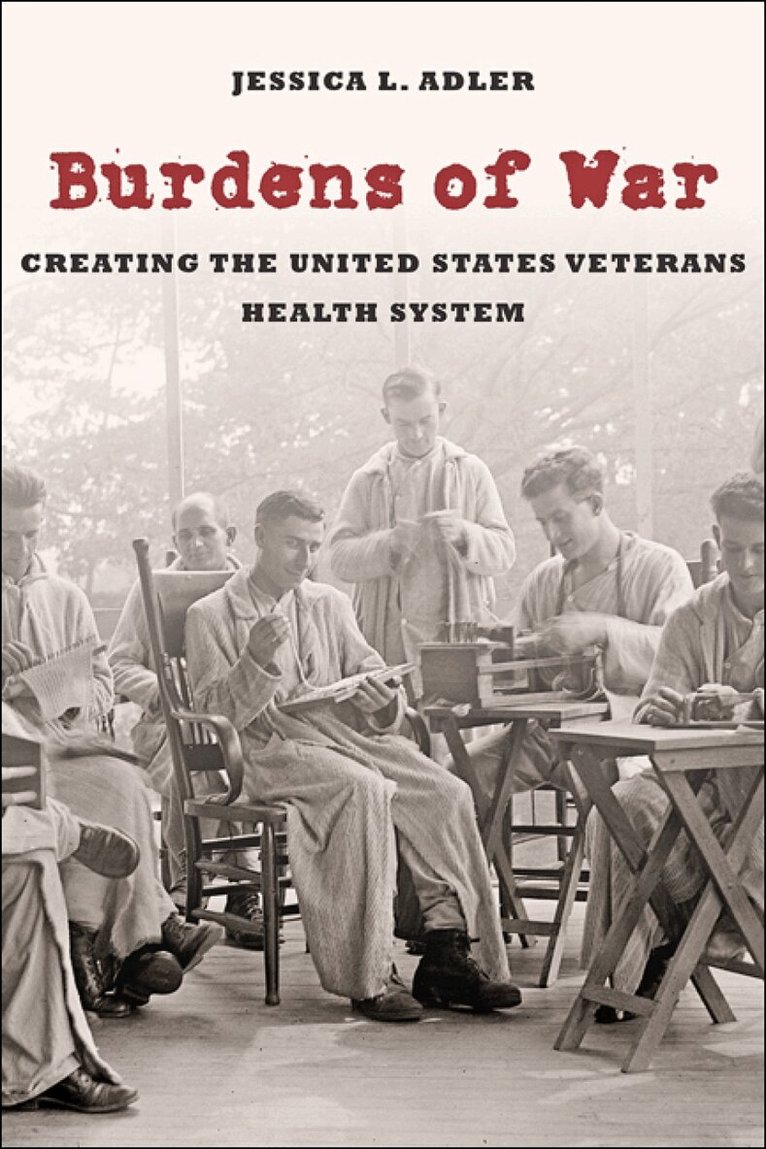
During and after World War I, policy makers, public health advocates, and veterans laid the groundwork for the extension of government-sponsored medical care to millions of former service members. In the process, they built a pillar of American social policy. In Burdens of War, Jessica L. Adler explores how the establishment of the veterans' health system marked a reimagining of modern veterans' benefits and signaled a pathbreaking validation of the power of professionalized institutional medical care. Adler reveals that a veterans' health system came about incrementally, amid skepticism from legislators, doctors, and army officials concerned about the burden of long-term obligations, monetary or otherwise, to ex-service members. She shows how veterans' welfare shifted from centering on pension and domicile care programs rooted in the nineteenth century to direct access to health services.She also traces the way that fluctuating ideals about hospitals and medical care influenced policy at the dusk of the Progressive Era; how race, class, and gender affected the health-related experiences of soldiers, veterans, and caregivers; and how interest groups capitalized on a tense political and social climate to bring about change. The book moves from the 1910s-when service members requested better treatment, Congress approved new facilities and increased funding, and elected officials expressed misgivings about who should have access to care-to the 1930s, when the economic crash prompted veterans to increasingly turn to hospitals for support while bureaucrats, politicians, and doctors attempted to rein in the system. By the eve of World War II, the roots of what would become the country's largest integrated health care system were firmly planted and primed for growth. Drawing readers into a critical debate about the level of responsibility America bears for wounded service members, Burdens of War is a unique and moving case study.