Research in Financial Services: Private and Public Policy - Böcker
Visar alla böcker i serien Research in Financial Services: Private and Public Policy. Handla med fri frakt och snabb leverans.
6 produkter
6 produkter
Del 10 - Research in Financial Services: Private and Public Policy
Bank Crises
Causes, Analysis and Prevention
Inbunden, Engelska, 1999
1 618 kr
Skickas inom 5-8 vardagar
The papers in this volume were presented at three invited sessions at the annual meeting of the Western Economic Association in Lake Tahoe, Nevada on June 30 and July 1, 1998. The comments of the speaker at each of these sessions are also included. The papers focus on the widespread banking and financial crises that have plagued many countries worldwide. A study by the International Monetary Fund (Lindgren, Garcia, & Saal, 1996) reported that banking crises had been experienced by nearly three-quarters of its 180-plus member countries since 1980. And this was before the current problems in Korea and Southeast Asia. Only the African continent, where banking systems are generally quite primitive, appears to have been unaffected. The papers in this volume amplify on the evidence in this area for additional countries; expand the earlier analyses; describe, discuss, and evaluate alternative procedures for resolving bank insolvencies and recapitalizing the banking system, and suggest ways of maintaining bank solvency and preventing reoccurrences of these costly crises. The papers are timely, add considerably to our storehouse of knowledge, and are likely to be of particular value to policy makers, bankers, and fellow researchers.
Del 11 - Research in Financial Services: Private and Public Policy
Bank Problems
A Global Perspective
Inbunden, Engelska, 1997
1 666 kr
Skickas inom 5-8 vardagar
The papers in this volume were presented at three invited sessions at the annual meetings of the Western Economic Association in San Diego, California on July 8-10, 1999. The comments by delegates were also presented at that time and are included in the volume. The theme of the sessions was "Bank Problems: A Global Perspective." As has been well documented in previous volumes in this series, serious banking problems have plagued the large majority of countries globally be they industrial, emerging or transition economies. The problems arose because of both market failures and regulatory or government policy failures. The costs of these problems in terms of reduction in real output, misallocations of both real and financial resources, and transfer payments and cross-subsidies, particularly from taxpayers to protected stakeholders in failed banks, have been large and burdensome. Thus, a better understanding of the causes of the problems in both the private and government sectors and their potential solutions is a prerequisite for avoiding, or at least minimizing repetitions in the future. The papers in this volume contribute to this effort and add to our storehouse of knowledge. The emphasis on global in the title is reinforced by including papers by authors from Italy, Spain, and the United Kingdom, as well as the United States.
Del 12 - Research in Financial Services: Private and Public Policy
Bank Fragility and Regulation
Evidence from Different Countries
Inbunden, Engelska, 2000
1 419 kr
Skickas inom 7-10 vardagar
This volume focuses on current problems in banking that have the potential not only for disrupting the smooth provision of banking and other financial services, but also for adversely affecting domestic and even international macroeconomic activity. Because serious banking problems have been experienced in most countries in recent years, the papers both focus on fragility and regulation in different countries and are authored by leading financial economists in six different countries including Belgium, Germany, Italy, The Netherlands, the United Kingdom and the United States. By providing an international perspective, the papers provide insights into the commonality of banking problems in different countries and the role of regulation both in attempting to prevent and in potentially, albeit unintentionally, encouraging bank crises. As such, the papers add to our storehouse of knowledge on the causes, symptoms, and consequences of banking problems across countries.
Del 13 - Research in Financial Services: Private and Public Policy
Asset Price Bubbles
Implications for Monetary and Regulatory Policies
Inbunden, Engelska, 2001
1 828 kr
Skickas inom 5-8 vardagar
Asset price bubbles have been and continue to be an area of major public policy concern in many countries. But while we know that the bursting of such bubbles is exceedingly painful and destructive to the economy, little is known of their causes. Indeed, there is little agreement even on the definition of a bubble and whether, whatever it is, is economically rational or irrational and reflect temporary excessive exuberance. Can bubbles be identified ex-ante before they burst? Often, one person's perceived bubble is another's perceived equilibrium price path. How and when is a bubble recognized? Should asset prices be a concern for monetary or fiscal policy makers and, if so how and when should policy-makers act? Should monetary policy attempt to target and stabilize asset prices the same as product prices? Should monetary policy act quickly at the beginning of the bubble or wait until the perceived bubble has been underway for some time? For how long? Will bubble restraining policies burst a bubble? Would it have burst on it's own? How can the damage done after bubbles be minimized? Does the experience of the U.S. in the 1920s and of Japan in the 1990s provide any lessons and guidelines for these and other countries in the 2000s? The papers in this volume examine these and other aspects of asset price bubbles from the perspective of different times and different countries. The authors are experts who represent different countries, different economic philosophies, and different backgrounds - academic, government, bank regulatory agency and private. As a result, the papers add greatly to our storehouse of knowledge about asset price bubbles and hopefully will continue to more successful public and private policies for restraining both the bubbles and their consequences and improving economic welfare.
Del 14 - Research in Financial Services: Private and Public Policy
Prompt Corrective Action in Banking
10 Years Later
Inbunden, Engelska, 2003
1 582 kr
Skickas inom 7-10 vardagar
In December 1991, the U.S. Congress enacted and President George Bush signed the Federal Deposit Insurance Corporation Improvement Act (FDICIA). The Act was motivated by the severity of the U.S. banking and thrift crisis of the 1980s and represented the most important banking legislation since the Banking (Glass-Steagall) Act, which was enacted in 1933 at the depth of the previous most severe banking crisis in U.S. history. Between 1980 and 1991, some 1,500 commercial and savings banks, representing 10 percent of the industry in 1980, failed and more than 1,000 savings and loan associations, representing 25 percent of the industry, failed. In addition, delays in resolving the failures helped to increase the cost beyond the resources of the then Federal Savings and Loan Insurance Corporation (FSLIC) and required the taxpayers to pay some $150 billion To insured depositors at these institutions. The large number and high cost of the failures were in large measure attributable to serious flaws in the extant government-sponsored deposit insurance program that encouraged insured institutions to assume excessive credit and interest rate risks and bank regulators to delay imposing corrective sanctions on troubled institutions and resolving economically insolvent institutions. FDICIA attempted to correct these flaws by reforming the deposit insurance structure through requiring regulatory prompt corrective action (PCA) and least cost resolution (LCR).PCA mandated a series of both discretionary and mandatory sanctions that the regulators first may and then must apply as an institutions' financial health progressively deteriorates as reflected in a number of capital-to-asset ratios. These sanctions are intended to encourage the institutions to reverse their deterioration before it is too late. But if they fail to do so, PCA requires resolution of the institution before their book-value capital is fully depleted. This is intended to minimize any losses from failure. The designed PCA sanctions are modelled after the actual sanctions that the private market typically imposes on troubled firms in uninsured industries and that are distorted in banking by the government-provided insurance. Thus, FDICIA attempts to supplement regulatory and supervisory discipline with stimulated market discipline. Since its introduction in the United States in 1991, PCA has been explicitly or implicitly adopted in word if not spirit in many developed and developing countries with greatly different banking and regulatory structures. How well has it worked or could it work? The papers also consider reinforcing or alternative prudential techniques. Thus, they add to our storehouse of knowledge on improving the performance of banking systems and should prove useful to researchers, practitioners, and policy-makers both in evaluating extant regulatory structures and in designing new or modified structures. All the papers were presented by the authors and commented on by the discussants at invited sessions at the annual meeting of the Western Economic Association in Seattle, Washington in July 2002. Maia Pykina (Loyola University Chicago) provided assistance both in arranging the session programs and in preparing the papers for publications.
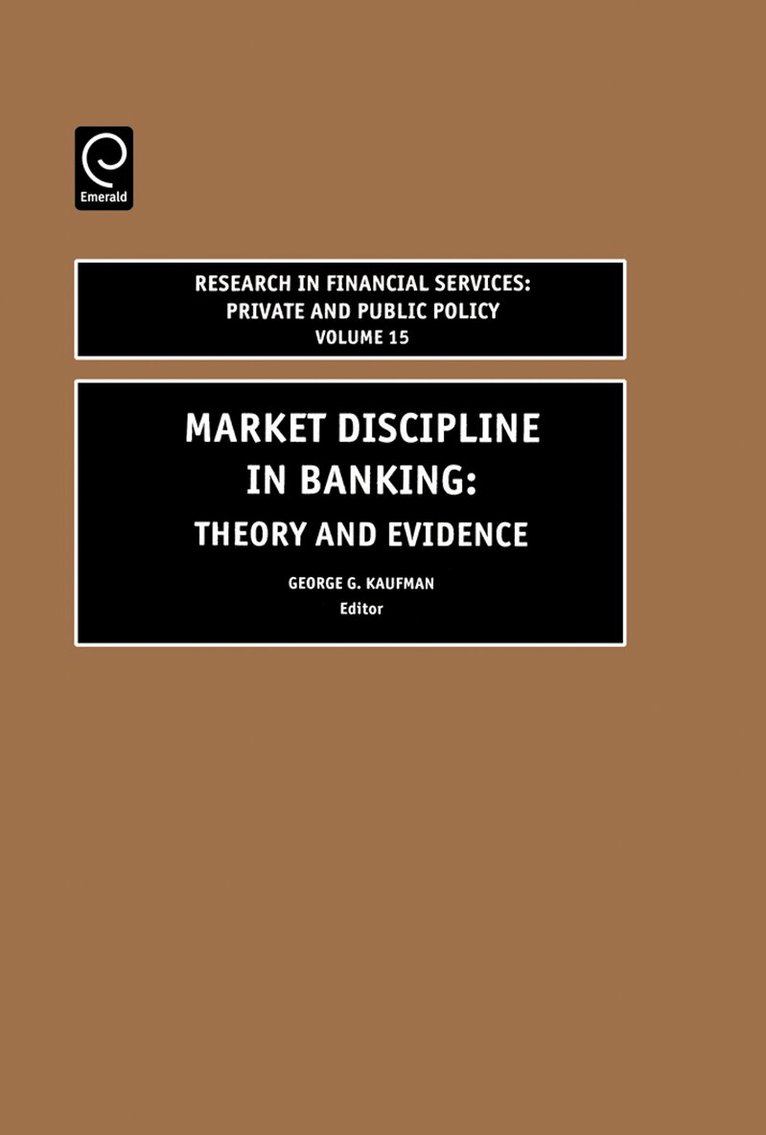
Del 15 - Research in Financial Services: Private and Public Policy
Market Discipline in Banking
Theory and Evidence
Inbunden, Engelska, 2003
1 582 kr
Skickas inom 7-10 vardagar
It has become increasingly evident in recent years that the safe and the efficient operation of the banking system cannot be guaranteed by Government regulation and supervisory review alone, regardless of how conscientious the regulator, or well-intended the regulations. Government regulation needs to be supplemented by market discipline. Market discipline requires the existence of at least some "de-facto at-risk" bank stakeholders, who have an incentive both to monitor the financial performance of the banks and to take action to influence bank management if they find performance unsatisfactory. But the concept of market discipline in banking was dormant for many years in the post-World War II era in almost all countries, as the fear of major economic spillover damage from bank failures led governments and regulators to either not failing insolvent banks officially or protecting most or all stakeholders, if they did place these banks in receivership. Only recently has the concept of market discipline been resurrected in banking. The 12 papers in this volume and eight commentaries on the papers discuss whether the resurrection is worthwhile. They consider the basic role of market discipline, how it may be applied to banking and more broadly to large financial institutions of any type, and the evidence of how well it has worked to date and the promise it may have for the future. The authors and discussants represent a wide array of both countries and affiliations - academic and regulatory. Thus, the papers reflect a wide spectrum of experience and thought.