Review of Maritime Transport – serie
Visar alla böcker i serien Review of Maritime Transport. Handla med fri frakt och snabb leverans.
11 produkter
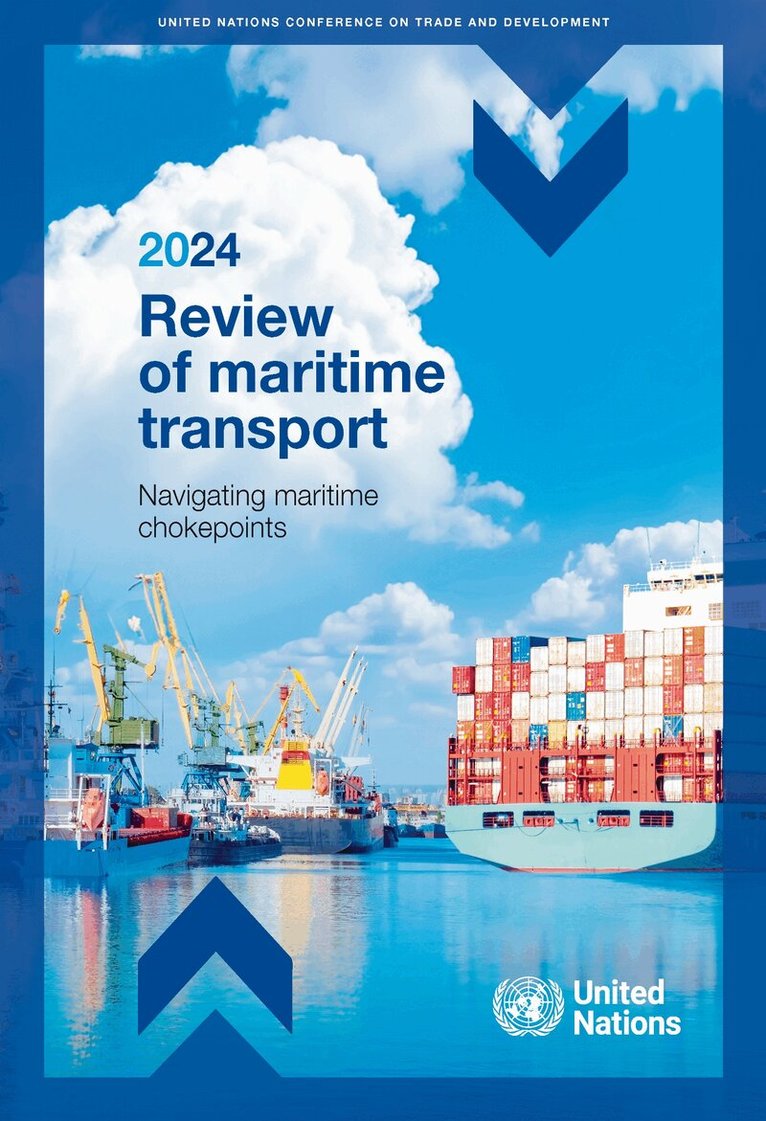
Review of Maritime Transport 2024
Navigating Maritime Chokepoints
Av United Nations Conference on Trade and Development
Häftad, 2025
1086 kr
Lägg i varukorg
Global maritime trade grew by 2.4% in 2023, recovering from a 2022 contraction, but the recovery remains fragile. Key chokepoints like the Suez and Panama Canals are increasingly vulnerable to geopolitical tensions, conflicts and climate change. These disruptions are extending shipping routes, …
Review of Maritime Transport 2013
Av United Nations Conference on Trade and Development United Nations
Häftad, 2014
1102 kr
Lägg i varukorg
As in previous issues since 1968, the Review of Maritime Transport 2013 contains a wealth of analysis and unique data. The Review is the renowned United Nations source of statistics and analysis on seaborne trade, the world fleet, freight costs, port traffic and the latest trends in the legal and …
Review of Maritime Transport 2016
Av United Nations Conference on Trade and Development, United Nations Publications
Häftad, 2017
1347 kr
Lägg i varukorg
The Review of Maritime Transport is an UNCTAD flagship publication, published annually since 1968. It provides an analysis of structural and cyclical changes affecting seaborne trade, ports and shipping, as well as an extensive collection of statistical information. The present edition of the …
Review of Maritime Transport 2020
Av United Nations Conference on Trade and Development, United Nations
Häftad, 2021
983 kr
Lägg i varukorg
The Review provides an in-depth analysis and update on developments in seaborne trade, the maritime industry and markets, key performance indicators, and the legal and regulatory environment. The 2020 issue counts on a number of novel data sets that help analyse the performance of seaports in terms …
Review of Maritime Transport 2025
Staying the Course in Turbulent Waters
Av United Nations Conference on Trade and Development
Häftad, 2026
1086 kr
Lägg i varukorg
In 2025, global maritime trade continues to navigate an environment marked by volatility, rerouted flows and uncertainty. Persistent geopolitical tensions and trade policy changes have altered shipping patterns, with many routes redirected away from traditional chokepoints. Maritime transport and …
Review of Maritime Transport 2012
Häftad, 2013
983 kr
Tillfälligt slut
More than 80 per cent of international trade in goods is carried by sea and an even higher percentage of developing-country trade is carried in ships. The Review of Maritime Transport, an annual publication prepared by the Division on Technology and Logistics of the UNCTAD secretariat, is an …
Review of Maritime Transport 2014
Av United Nations Conference on Trade and Development
Häftad, 2015
983 kr
Tillfälligt slut
As in previous issues since 1968, the 2014 Review of Maritime Transport contains a wealth of analysis and unique data. The Review is the renowned United Nations source of statistics and analysis on seaborne trade, the world fleet, freight costs, port traffic and the latest trends in the legal and …
Review of Maritime Transport 2015
Häftad, 2015
1070 kr
Tillfälligt slut
Access to frequent and reliable shipping services is key for developing countries' trade with overseas markets. Firms cannot export competitively and participate global value chains without adequate transport connectivity, and maritime transport continues to be the dominant mode of shipping goods. …
Review of Maritime Transport 2017
Av United Nations Conference on Trade and Development, United Nations Publications
Häftad, 2018
983 kr
Tillfälligt slut
With over 80 per cent of global trade by volume and more than 70 per cent of its value being carried on board ships and handled by seaports worldwide, the importance of maritime transport for trade and development cannot be overemphasized. The 2017 Review of Maritime Transport presents and …
Review of Maritime Transport 2018
Av United Nations Conference on Trade and Development, United Nations
Häftad, 2019
1070 kr
Tillfälligt slut
The Review of Maritime Transport is an UNCTAD flagship publication, published annually since 1968 with 2018 marking the 50 year anniversary. Around 80 per cent of the volume of international trade in goods is carried by sea, and the percentage is even higher for most developing countries. The …
Review of Maritime Transport 2019
Av United Nations Conference on Trade and Development, United Nations
Häftad, 2020
1102 kr
Tillfälligt slut
This report provides a concise update of key data relating to the maritime transport sector, spanning demand and supply, performance, as well as transversal issues ranging from regulatory and legal developments affecting maritime transport and technological developments/innovation, with the theme …