Richard Ellmann Lectures in Modern Literature - Böcker
Visar alla böcker i serien Richard Ellmann Lectures in Modern Literature. Handla med fri frakt och snabb leverans.
5 produkter
5 produkter
523 kr
Skickas inom 3-6 vardagar
In a series of essays on the complicated relations between reading, writing and remembering, gifted novelist and critic Byatt sorts the modish from the merely interesting and the truly good to arrive at a new view of British writing in our time.
Del 3 - Richard Ellmann Lectures in Modern Literature
Consciousness and the Novel
Connected Essays
Häftad, Engelska, 2004
343 kr
Skickas inom 10-15 vardagar
Human consciousness, long the province of literature, has lately come in for a remapping--even rediscovery--by the natural sciences, driven by developments in Artificial Intelligence, neuroscience, and evolutionary biology. As the richest record we have of human consciousness, literature, David Lodge suggests, may offer a kind of understanding that is complementary, not opposed, to scientific knowledge. Writing with characteristic wit and brio, and employing the insight and acumen of a skilled novelist and critic, Lodge here explores the representation of human consciousness in fiction (mainly English and American) in light of recent investigations in the sciences. How does the novel represent consciousness? And how has this changed over time? In a series of interconnected essays, Lodge pursues these questions down various paths: How does the novel's method compare with that of other creative media such as film? How does the consciousness (and unconscious) of the creative writer do its work? And how can criticism infer the nature of this process through formal analysis? In essays on Charles Dickens, E. M. Forster, Evelyn Waugh, Kingsley and Martin Amis, Henry James, John Updike, and Philip Roth, and in reflections on his own practice as a novelist, Lodge is able to bring to light--and to engaging life--the technical, intellectual, and sometimes simply mysterious working of the creative mind.
171 kr
Skickas inom 7-10 vardagar
When a master novelist, essayist, and critic searches for the wellsprings of his own work, where does he turn? Mario Vargas Llosa—Peruvian writer, presidential contender, and public intellectual—answers this most personal question with elegant concision in this collection of essays. In “Four Centuries of Don Quixote,” he revisits the quintessential Spanish novel—a fiction about fiction whose ebullient prose still questions the certainties of our stumbling ideals. In recounting his illicit, delicious discovery of Borges’ fiction—“the most important thing to happen to imaginative writing in the Spanish language in modern times”—Vargas Llosa stands in for a generation of Latin American novelists who were liberated from their sense of isolation and inferiority by this Argentinean master of the European tradition.In a nuanced appreciation of Ortega y Gasset, Vargas Llosa recovers the democratic liberalism of a misunderstood radical—a mid-century political philosopher on a par with Sartre and Russell, ignored because “he was only a Spaniard.” And in essays on the influence of Karl Popper and Isaiah Berlin, the author finds an antidote to the poisonous well of fanaticism in its many modern forms, from socialist utopianism and nationalism to religious fundamentalism. From these essays a picture emerges of a writer for whom the enchantment of literature awakens a critical gaze on the turbulent world in which we live.
Del 5 - Richard Ellmann Lectures in Modern Literature
Confessions of a Young Novelist
Inbunden, Engelska, 2011
454 kr
Skickas inom 10-15 vardagar
Umberto Eco published his first novel, The Name of the Rose, in 1980, when he was nearly fifty. In these “confessions,” the author, now in his late seventies, looks back on his long career as a theorist and his more recent work as a novelist, and explores their fruitful conjunction.He begins by exploring the boundary between fiction and nonfiction—playfully, seriously, brilliantly roaming across this frontier. Good nonfiction, he believes, is crafted like a whodunnit, and a skilled novelist builds precisely detailed worlds through observation and research. Taking us on a tour of his own creative method, Eco recalls how he designed his fictional realms. He began with specific images, made choices of period, location, and voice, composed stories that would appeal to both sophisticated and popular readers. The blending of the real and the fictive extends to the inhabitants of such invented worlds. Why are we moved to tears by a character’s plight? In what sense do Anna Karenina, Gregor Samsa, and Leopold Bloom “exist”?At once a medievalist, philosopher, and scholar of modern literature, Eco astonishes above all when he considers the pleasures of enumeration. He shows that the humble list, the potentially endless series, enables us to glimpse the infinite and approach the ineffable. This “young novelist” is a master who has wise things to impart about the art of fiction and the power of words.
Del 1 - Richard Ellmann Lectures in Modern Literature
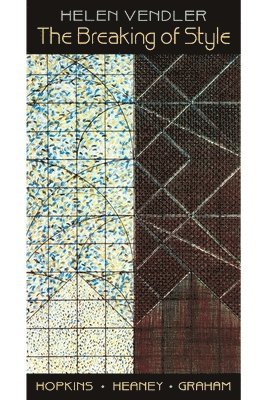
Breaking of Style
Hopkins, Heaney, Graham
Häftad, Engelska, 1995
355 kr
Skickas inom 10-15 vardagar
"Lucid and elegant...a tour de force."—A. O. Scott, The NationThree lectures on the fraught process of poetic development from a titan of contemporary criticism. Style is the material body of lyric poetry. To cast off an earlier style is to commit an act of violence against the creative self. Why do poets so often make these dramatic breaks? In her 1994 Richard Ellman Lectures, Helen Vendler investigates poets’ motives for inventing a new voice, along with their means of doing so. Exploring three archetypal ruptures, she yields a new view of the interplay of moral, emotional, and intellectual forces in each poet’s work.Gerard Manley Hopkins’s invention of sprung rhythm marks a radical break with his early style. Rhythm, Vendler shows us, is at the heart of Hopkins’s aesthetic, and sprung rhythm is his symbol for danger, difference, and the shock of the beautiful. In Seamus Heaney’s work, she identifies clear shifts in grammatical “atmosphere” from one poem to the next—from “nounness” to the “betweenness” of an adverbial style—shifts whose moral and political implications come under scrutiny here. And finally, Vendler looks at Jorie Graham’s departure from short lines to numbered lines to squared long lines of sentences, marking a move from “deliberation” to cinematic “freeze-framing” to “coverage,” each with its own meaning in this poet’s career.Throughout, Vendler reminds us that what distinguishes successful poetry is a mastery of language at all levels—including the rhythmic, the grammatical, and the graphic. A lucid reading of three poets and a superb exposition of the craft of poetry, The Breaking of Style revives our lapsed sense of what style means.