Routledge Early Modern Translations - Böcker
Visar alla böcker i serien Routledge Early Modern Translations. Handla med fri frakt och snabb leverans.
4 produkter
4 produkter
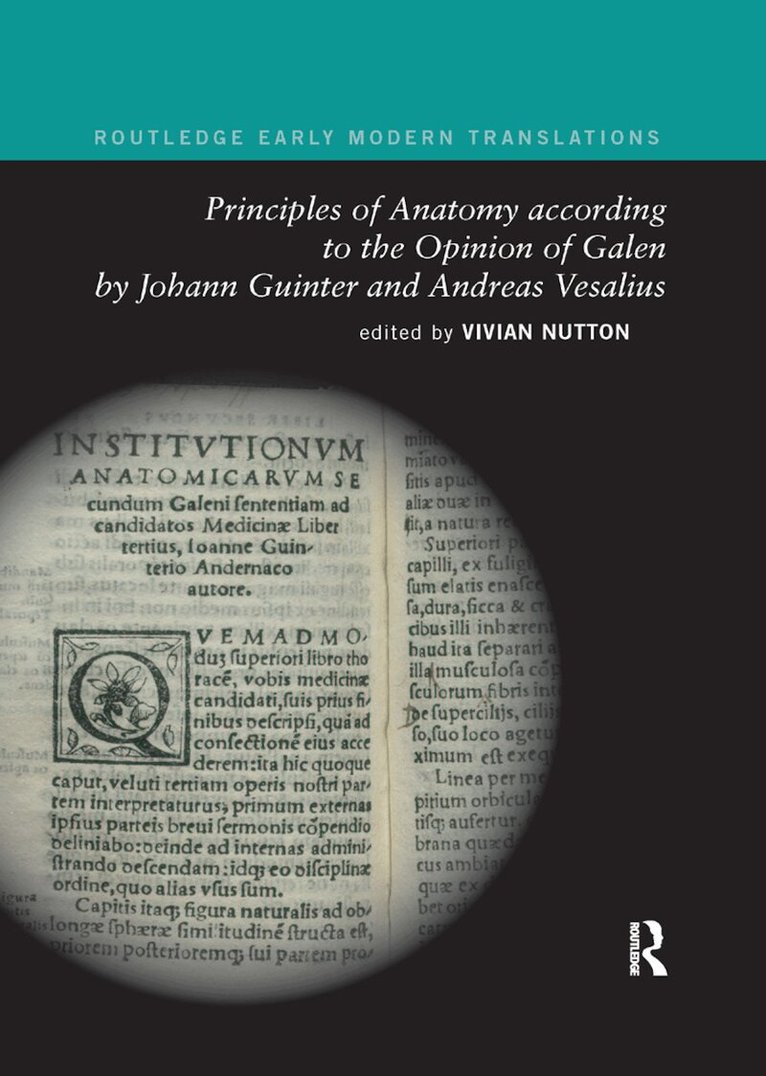
Principles of Anatomy according to the Opinion of Galen by Johann Guinter and Andreas Vesalius
Häftad, Engelska, 2019
679 kr
Skickas inom 10-15 vardagar
Principles of Anatomy according to the Opinion of Galen is a translation of Johann Guinter’s textbook as revised and annotated by Guinter’s student, Andreas Vesalius, in 1538. Despite Vesalius’ fame as an anatomist, his 1538 revision has attracted almost no attention. However, this new translation shows the significant rewrites and additional information added to the original based on his own dissections. 250 newly discovered annotations by Vesalius himself, published here in full for the first time, also show his working methods and ideas. Together they offer remarkable insights into Vesalius’ intellectual biography and the development of his most famous work: De humani corporis fabrica, 1543. An extensive introduction by Vivian Nutton also provides new information on Johann Guinter, and his substantial use of Vesalius’ work for his own revised version of the text in 1539. Their joint production, a student textbook, is set against a background of the development of Renaissance anatomy, and of attitudes to their ancient Greek predecessor, Galen of Pergamum. This text will be of great interest to historians of science and medicine, as well as to Renaissance scholars.
651 kr
Skickas inom 10-15 vardagar
John Caius (1510–1573), second founder of Gonville and Caius College, Cambridge, was an English scholar with an international reputation in his lifetime as a naturalist, historian and medical writer. His Autobibliography is a major contribution to the history of English culture in the middle years of the sixteenth century and has been translated into English for the first time in this book. Beginning with an in-depth introduction to John Caius’ life and works, An Autobibliography by John Caius provides a wealth of information to support and accompany the translation of this significant text. In his Autobibliography, Caius lists the books that he wrote but also details the circumstances of their writing. He describes his travels in Italy in search of manuscripts of the ancient Greek doctor Galen of Pergamum as well as giving an insight into his personal life, including his vigorously conservative views, whether on medicine, spelling and pronunciation, or on Cambridge University. His religious views, which led to the ransacking of his rooms by a Cambridge mob, are explored in detail in Appendix II of this book. In Appendix I, recent discoveries of books owned and annotated by Caius are used to supplement what he says about his activities, as well as to trace at least one of his lost works in Italy and Denmark. The resulting picture throws light on European medicine in the sixteenth century, as well as on the humanistic culture that linked learned men and women across Renaissance Europe.
2 176 kr
Skickas inom 10-15 vardagar
John Caius (1510–1573), second founder of Gonville and Caius College, Cambridge, was an English scholar with an international reputation in his lifetime as a naturalist, historian and medical writer. His Autobibliography is a major contribution to the history of English culture in the middle years of the sixteenth century and has been translated into English for the first time in this book. Beginning with an in-depth introduction to John Caius’ life and works, An Autobibliography by John Caius provides a wealth of information to support and accompany the translation of this significant text. In his Autobibliography, Caius lists the books that he wrote but also details the circumstances of their writing. He describes his travels in Italy in search of manuscripts of the ancient Greek doctor Galen of Pergamum as well as giving an insight into his personal life, including his vigorously conservative views, whether on medicine, spelling and pronunciation, or on Cambridge University. His religious views, which led to the ransacking of his rooms by a Cambridge mob, are explored in detail in Appendix II of this book. In Appendix I, recent discoveries of books owned and annotated by Caius are used to supplement what he says about his activities, as well as to trace at least one of his lost works in Italy and Denmark. The resulting picture throws light on European medicine in the sixteenth century, as well as on the humanistic culture that linked learned men and women across Renaissance Europe.
Principles of Anatomy according to the Opinion of Galen by Johann Guinter and Andreas Vesalius
Inbunden, Engelska, 2017
2 176 kr
Skickas inom 10-15 vardagar
Principles of Anatomy according to the Opinion of Galen is a translation of Johann Guinter’s textbook as revised and annotated by Guinter’s student, Andreas Vesalius, in 1538. Despite Vesalius’ fame as an anatomist, his 1538 revision has attracted almost no attention. However, this new translation shows the significant rewrites and additional information added to the original based on his own dissections. 250 newly discovered annotations by Vesalius himself, published here in full for the first time, also show his working methods and ideas. Together they offer remarkable insights into Vesalius’ intellectual biography and the development of his most famous work: De humani corporis fabrica, 1543. An extensive introduction by Vivian Nutton also provides new information on Johann Guinter, and his substantial use of Vesalius’ work for his own revised version of the text in 1539. Their joint production, a student textbook, is set against a background of the development of Renaissance anatomy, and of attitudes to their ancient Greek predecessor, Galen of Pergamum. This text will be of great interest to historians of science and medicine, as well as to Renaissance scholars.