Routledge Research in Pragmatics - Böcker
Visar alla böcker i serien Routledge Research in Pragmatics. Handla med fri frakt och snabb leverans.
5 produkter
5 produkter
2 159 kr
Skickas inom 10-15 vardagar
Most of the innovative and exciting work done by East Asian pragmaticians on their languages, past and present alike, is written and published in local languages. As a result, research published in and about a particular East Asian language has been largely unavailable to those who do not speak the language.The contributors seek to present a comprehensive survey of existing outputs of pragmatics research on three major East Asian languages (Chinese, Japanese and Korean). The survey concentrates on a number of core pragmatic topics such as speech acts, deixis, discourse markers, conversation analysis, discourse analysis, and face/(im)politeness. To complement and compare with the picture of research work published in the local languages, the volume also includes a survey of internationally published, English-mediated articles and books studying the regional languages or contrasting them with other languages. A rivetting discourse on pragmatics research, it will be a valuable read for students and scholars alike.
590 kr
Skickas inom 10-15 vardagar
Most of the innovative and exciting work done by East Asian pragmaticians on their languages, past and present alike, is written and published in local languages. As a result, research published in and about a particular East Asian language has been largely unavailable to those who do not speak the language.The contributors seek to present a comprehensive survey of existing outputs of pragmatics research on three major East Asian languages (Chinese, Japanese and Korean). The survey concentrates on a number of core pragmatic topics such as speech acts, deixis, discourse markers, conversation analysis, discourse analysis, and face/(im)politeness. To complement and compare with the picture of research work published in the local languages, the volume also includes a survey of internationally published, English-mediated articles and books studying the regional languages or contrasting them with other languages. A rivetting discourse on pragmatics research, it will be a valuable read for students and scholars alike.
2 020 kr
Skickas inom 10-15 vardagar
Obana and Haugh question the extent to which commonly accepted theories in pragmatics can readily explain sociopragmatic phenomena in Japanese. Studies of Japanese in pragmatics have often challenged the cross-linguistic relevance of dominant theories. However, they have also inadvertently perpetuated stereotypes about the Japanese. It is often been assumed, for instance, that Japanese people are less strategic, more polite and more reliant on tacit forms of communication than speakers of other languages. But the Japanese are not as polite as one might think. The aim of this book is thus to question those folk assumptions around politeness, impoliteness, irony and indirectness while at the same time emphasizing that close examination of sociopragmatic phenomena in Japanese yields important empirical insights that combat common theoretical assumptions in pragmatics. The content is structured in three parts, in which the authors highlight a key building block of a theory of sociopragmatics. Part I focuses on indexing through the lens of chapters on honorifics, routine formula and politeness strategies. Part II focuses on evaluating through the lens of chapters on giving/receiving expressions and honorific irony. Finally, Part III focuses on relating through the lens of chapters on joint utterances and off record requests. Throughout the chapters the authors draw attention to ways in which these three dimensions are invariably intertwined in various ways.This book is not simply a collection of studies that promotes our understanding of the sociopragmatics of a particular language, but goes deeper and challenges what many have taken for granted in pragmatics. It proposes a framework for exploring sociopragmatic phenomena, building on the key sociopragmatic axes of indexing, evaluating and relating, and offers fresh new perspectives on time-honoured phenomena in pragmatics.It will interest scholars and postgraduate students in pragmatics, particularly those specializing in: politeness, impoliteness, indirectness and irony. The book explains what Japanese terms mean, and all the Japanese examples are morphologically-glossed. Therefore, teachers (and advanced learners) of Japanese at all levels will benefit from the book as it will enrich their knowledge of the Japanese language.
590 kr
Skickas inom 10-15 vardagar
Obana and Haugh question the extent to which commonly accepted theories in pragmatics can readily explain sociopragmatic phenomena in Japanese. Studies of Japanese in pragmatics have often challenged the cross-linguistic relevance of dominant theories. However, they have also inadvertently perpetuated stereotypes about the Japanese. It is often been assumed, for instance, that Japanese people are less strategic, more polite and more reliant on tacit forms of communication than speakers of other languages. But the Japanese are not as polite as one might think. The aim of this book is thus to question those folk assumptions around politeness, impoliteness, irony and indirectness while at the same time emphasizing that close examination of sociopragmatic phenomena in Japanese yields important empirical insights that combat common theoretical assumptions in pragmatics. The content is structured in three parts, in which the authors highlight a key building block of a theory of sociopragmatics. Part I focuses on indexing through the lens of chapters on honorifics, routine formula and politeness strategies. Part II focuses on evaluating through the lens of chapters on giving/receiving expressions and honorific irony. Finally, Part III focuses on relating through the lens of chapters on joint utterances and off record requests. Throughout the chapters the authors draw attention to ways in which these three dimensions are invariably intertwined in various ways.This book is not simply a collection of studies that promotes our understanding of the sociopragmatics of a particular language, but goes deeper and challenges what many have taken for granted in pragmatics. It proposes a framework for exploring sociopragmatic phenomena, building on the key sociopragmatic axes of indexing, evaluating and relating, and offers fresh new perspectives on time-honoured phenomena in pragmatics.It will interest scholars and postgraduate students in pragmatics, particularly those specializing in: politeness, impoliteness, indirectness and irony. The book explains what Japanese terms mean, and all the Japanese examples are morphologically-glossed. Therefore, teachers (and advanced learners) of Japanese at all levels will benefit from the book as it will enrich their knowledge of the Japanese language.
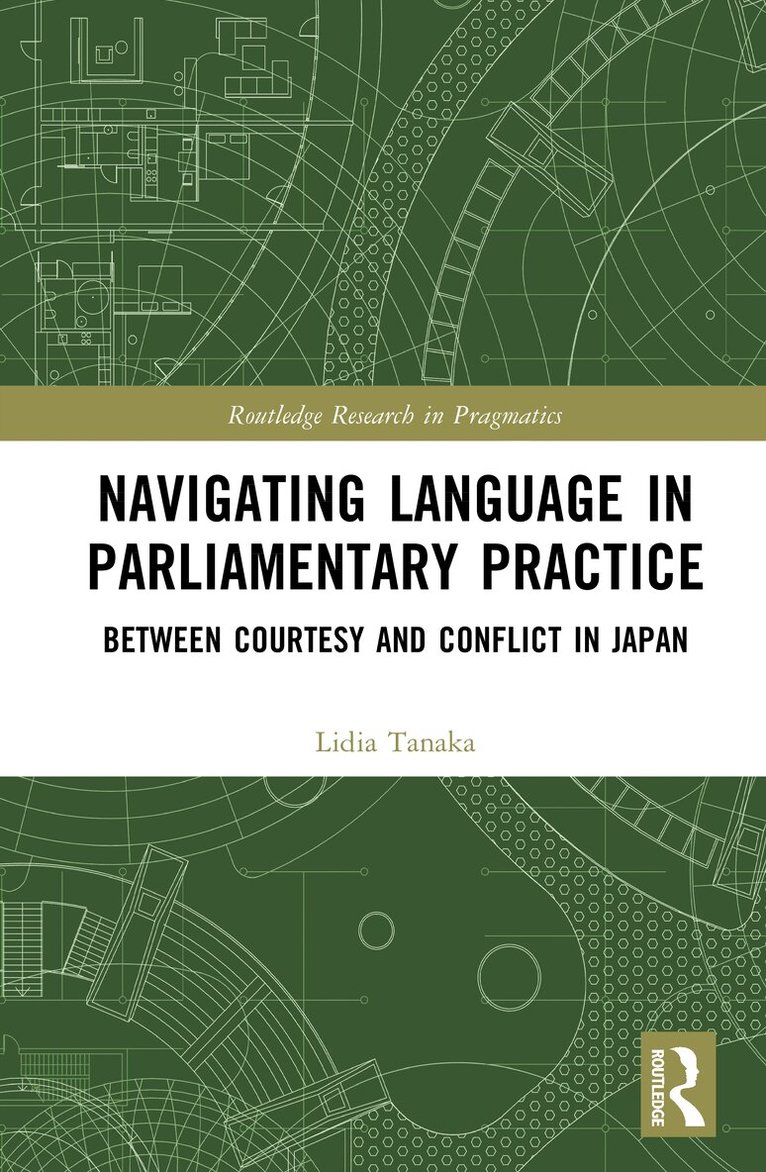
Navigating Language in Parliamentary Practice
Between Courtesy and Conflict in Japan
Inbunden, Engelska, 2025
2 104 kr
Skickas inom 10-15 vardagar
Tanaka explores the language used in Japanese parliamentary interactions to shed light on the use of language as a tool by politicians to convince, negotiate, persuade, as well as deliver aggression and criticism. By looking at the speech of politicians in the parliament of Japan, Tanaka demonstrates the unbreakable link between language and politics.Despite the association of Japan as a society in which linguistic politeness is paramount, Tanaka highlights the many examples of impoliteness in parliament and illustrates the idea that Japanese parliamentarians use language strategically to accomplish their political agenda. Analysis of questions and answers in committee meetings demonstrate that regardless of which party they belong to, those in opposition use the most antagonistic strategies. The book also shows the ways in which politicians deliver face-attacks and demonstrates that impoliteness can be delivered without insults or open aggression, using extremely polite language, honorifics, or sarcasm and irony.Lastly, the book also reveals that face-attacks are sent by members of both the government and opposition. As a book that explores the commonly overlooked phenomenon of impoliteness in Japan in the context of parliamentary interactions, it is a valuable resource for researchers and academics in the field of pragmatics and discourse analysis as well as a viable resource for undergraduate and graduate students.